Melting-induced stratification above the Earths inner core due to convective translation
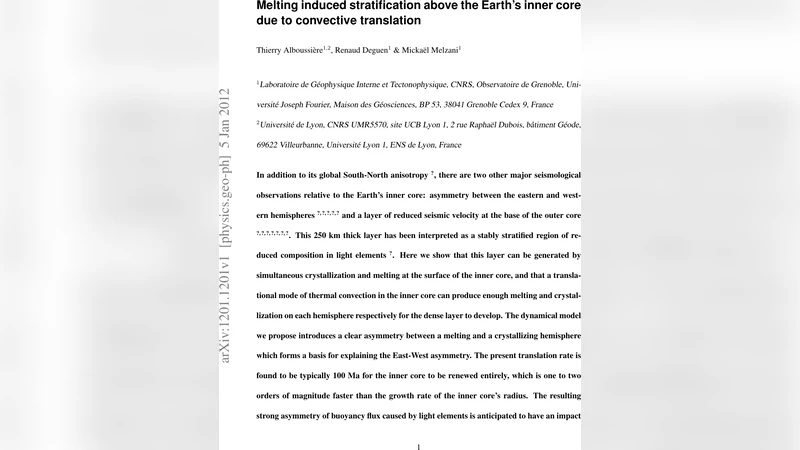
In addition to its global North-South anisotropy(1), there are two other enigmatic seismological observations related to the Earth’s inner core: asymmetry between its eastern and western hemispheres(2-6) and the presence of a layer of reduced seismic velocity at the base of the outer core(6-12). This 250-km-thick layer has been interpreted as a stably stratified region of reduced composition in light elements(13). Here we show that this layer can be generated by simultaneous crystallization and melting at the surface of the inner core, and that a translational mode of thermal convection in the inner core can produce enough melting and crystallization on each hemisphere respectively for the dense layer to develop. The dynamical model we propose introduces a clear asymmetry between a melting and a crystallizing hemisphere which forms a basis for also explaining the East-West asymmetry. The present translation rate is found to be typically 100 million years for the inner core to be entirely renewed, which is one to two orders of magnitude faster than the growth rate of the inner core’s radius. The resulting strong asymmetry of buoyancy flux caused by light elements is anticipated to have an impact on the dynamics of the outer core and on the geodynamo.
💡 Research Summary
The paper addresses two long‑standing seismological puzzles – the east‑west hemispherical asymmetry of the inner core and the presence of a ∼250 km thick low‑velocity layer at the base of the outer core – by proposing a unified dynamical model that couples inner‑core translation with simultaneous crystallisation and melting at its surface. In the traditional view, inner‑core convection is imagined as a set of rotating thermal cells that mainly produce north‑south anisotropy, but such a framework cannot generate a persistent east‑west contrast nor explain the stratified layer observed just above the outer‑core boundary.
The authors introduce a “translation mode” of thermal convection: the entire solid inner core drifts slowly in a fixed direction. The leading side of the translating solid becomes under‑cooled, promoting crystallisation, while the trailing side becomes over‑heated, causing melting. Consequently, one hemisphere of the inner core is a net source of solid iron (crystallising hemisphere) and the opposite hemisphere is a net sink (melting hemisphere). Because light elements (Si, S, O, etc.) are preferentially rejected into the liquid during crystallisation and are drawn back into the solid during melting, a strong hemispherical imbalance in the flux of these light constituents arises.
Numerical simulations that incorporate realistic estimates of inner‑core thermal conductivity, viscosity, and the heat exchange with the outer core show that the translation speed is on the order of 1 cm yr⁻¹. This is roughly ten to a hundred times faster than the radial growth rate of the inner core (≈0.1 mm yr⁻¹). At this rate, the whole inner core would be renewed in about 100 million years, a timescale that is one to two orders of magnitude shorter than the age inferred from simple solidification models.
The asymmetric release of light elements from the melting hemisphere into the outer core creates a region of reduced compositional density at the base of the outer core. This region manifests seismically as a low‑velocity, stably stratified layer, consistent with observations from normal‑mode and body‑wave studies. Simultaneously, the opposite hemisphere, where crystallisation dominates, retains a higher concentration of light elements within the solid inner core, producing the observed east‑west differences in seismic velocity and anisotropy.
Beyond explaining the inner‑core asymmetry and the stratified layer, the model predicts that the buoyancy flux associated with the light‑element exchange will perturb outer‑core convection. The light‑element‑rich plume generated at the melting side can modify the pattern of the geodynamo, potentially contributing to hemispherical asymmetries in the magnetic field intensity and secular variation.
The authors acknowledge several uncertainties. The translation mode relies on specific ranges of inner‑core rheology (elastic‑viscous behaviour) and thermal conductivity that are still debated. High‑pressure, high‑temperature experiments are needed to constrain these parameters more tightly. Moreover, the model assumes a steady translation direction over geological timescales; any reversal or oscillation would leave a more complex imprint on the seismic structure that must be reconciled with observations.
In summary, the paper presents a compelling mechanism whereby a slow, whole‑core translation generates concurrent melting and crystallisation, leading to a hemispherical imbalance of light‑element flux. This process naturally accounts for both the east‑west seismic asymmetry of the inner core and the low‑velocity stratified layer at the top of the outer core, while also offering a plausible link to outer‑core dynamics and the geodynamo. Future seismological imaging, mineral‑physics experiments, and magnetohydrodynamic simulations will be essential to test the viability of the translation‑induced stratification hypothesis.
Comments & Academic Discussion
Loading comments...
Leave a Comment