Impartial games emulating one-dimensional cellular automata and undecidability
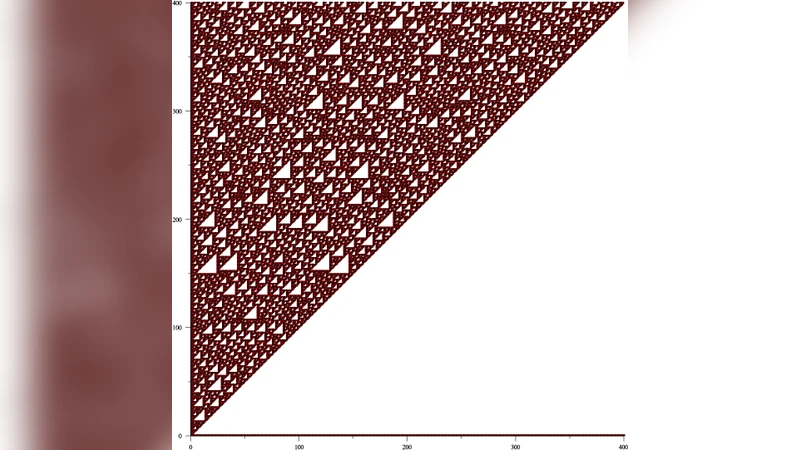
We study two-player \emph{take-away} games whose outcomes emulate two-state one-dimensional cellular automata, such as Wolfram’s rules 60 and 110. Given an initial string consisting of a central data pattern and periodic left and right patterns, the rule 110 cellular automaton was recently proved Turing-complete by Matthew Cook. Hence, many questions regarding its behavior are algorithmically undecidable. We show that similar questions are undecidable for our \emph{rule 110} game.
💡 Research Summary
The paper introduces a family of impartial two‑player take‑away games and shows that the evolution of these games is mathematically equivalent to the space‑time dynamics of two‑state one‑dimensional cellular automata (CA), in particular Wolfram’s elementary rules 60 and 110. A take‑away game is defined by a pile of tokens and a rule that limits the number of tokens a player may remove on a given turn based on the opponent’s move in the previous turn. Formally, if the opponent removed s_{t‑1} tokens in the previous round, the current player may remove any x satisfying s_{t‑1} ≤ x ≤ s_{t‑1}+k_t, where k_t is a small constant (1 for rule‑60, 2 for rule‑110).
The authors construct a direct bijection between game positions and CA configurations. An initial game state consists of a central “data” string surrounded on both sides by periodic “background” strings. This arrangement mirrors the usual CA initial condition: a finite pattern embedded in an infinite periodic background. Each turn of the game corresponds to one time step of the CA. The number of tokens removed in turn t (x_t) encodes the binary state of a particular cell at time t, while the admissible moves for the next turn are dictated by the CA’s local update rule applied to the three‑cell neighbourhood (left, centre, right). For rule 60 the update is x_{t+1}=x_t⊕x_{t‑1}; for rule 110 it is the well‑known non‑linear Boolean function (x_{t‑1}∧x_t)∨(x_t∧¬x_{t‑1})∨(¬x_{t‑1}∧¬x_t). Consequently, the entire sequence of legal moves in the game reproduces exactly the space‑time diagram of the corresponding CA.
Having established this equivalence, the paper leverages known results about the computational power of the two rules. Rule 60 is linear (XOR) and its evolution can be predicted in polynomial time; the authors give an O(N) algorithm that, given any initial configuration, determines the winner and the optimal strategy. In stark contrast, rule 110 was proved Turing‑complete by Matthew Cook (2004). Because any Turing machine can be simulated by a suitably chosen initial pattern for rule 110, any decision problem that is undecidable for Turing machines becomes undecidable for the corresponding game. The authors formalize three natural decision problems for the game: (1) does the first player have a forced win from a given initial pattern? (2) does the game terminate after a finite number of moves? (3) what is the minimal number of moves after which the outcome is predetermined? By reduction from the halting problem for Turing machines encoded in rule 110, they prove that all three questions are algorithmically undecidable.
The paper also includes an experimental component. A Python simulator was built to generate game play‑throughs for a wide variety of initial strings. For rule 60 the simulations always matched the predictions of the linear analysis; the winner could be read off directly from the parity of the initial data. For rule 110, however, many instances displayed chaotic behaviour, and no algorithm could be found that correctly predicted the winner across all tested patterns, illustrating the theoretical undecidability in practice.
In the discussion, the authors argue that framing cellular‑automaton computation as a combinatorial game provides a novel pedagogical bridge between game theory and theoretical computer science. It offers a concrete, interactive way to experience concepts such as universality, undecidability, and computational complexity. Moreover, the construction suggests potential applications: games based on universal CA could serve as cryptographic primitives, randomness generators, or as components of protocol design where provable hardness is desirable. The paper concludes with several avenues for future work, including extensions to multi‑state or higher‑dimensional automata, stochastic update rules, and the exploration of impartial games that simulate other known universal systems.