Numerical Code for Fitting Radial Emission Profile of a Shell Supernova Remnant
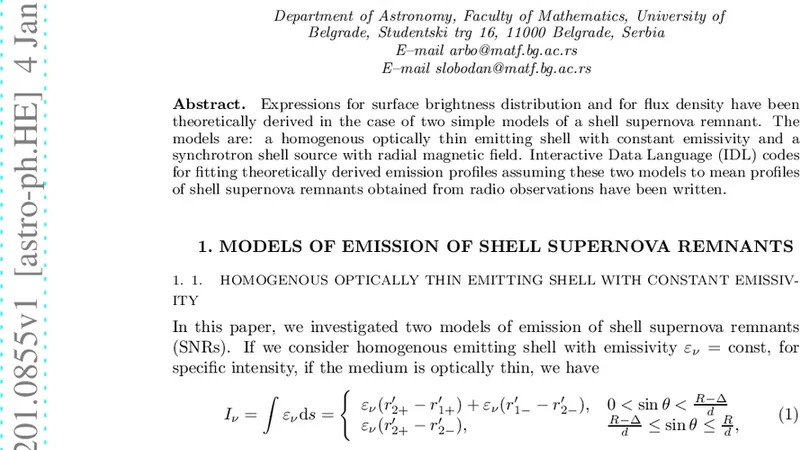
Expressions for surface brightness distribution and for flux density have been theoretically derived in the case of two simple models of a shell supernova remnant. The models are: a homogenous optically thin emitting shell with constant emissivity and a synchrotron shell source with radial magnetic field. Interactive Data Language (IDL) codes for fitting theoretically derived emission profiles assuming these two models to mean profiles of shell supernova remnants obtained from radio observations have been written.
💡 Research Summary
The paper presents a comprehensive framework for quantitatively fitting the radial emission profiles of shell-type supernova remnants (SNRs) using two analytically tractable models and a dedicated numerical implementation. In the first part, the authors derive closed‑form expressions for the surface brightness distribution and the integrated flux density under two simplifying assumptions. The first model treats the remnant as a geometrically thin, optically transparent spherical shell with a constant volume emissivity. By integrating the line‑of‑sight path length through the shell, the surface brightness I(θ) becomes a simple function of the angular distance from the centre, proportional to the product of shell thickness and emissivity. The second model incorporates synchrotron radiation from relativistic electrons spiralling in a radially decreasing magnetic field (B∝r⁻¹). Assuming a power‑law electron energy distribution N(E)∝E⁻ᵖ, the synchrotron emissivity scales as jν∝N(E) B^{(p+1)/2} ν^{-(p‑1)/2}. The resulting I(θ) exhibits a steep central decline and a pronounced limb‑brightening, reflecting the combined angular dependence of the magnetic field and electron density. Both models are derived under the assumption that the radio emission is optically thin, allowing absorption effects to be neglected.
The second part of the work translates these analytic formulas into a practical fitting tool written in Interactive Data Language (IDL). The workflow proceeds as follows: (1) the user supplies a calibrated radio image of a shell SNR; the code automatically determines the geometric centre and computes a radially averaged brightness profile I_obs(θ) together with its statistical uncertainties σ(θ). (2) The user selects one of the two theoretical models and provides initial guesses for the key parameters – overall radius R, fractional shell thickness ΔR/R, emissivity ε (or synchrotron normalization), electron spectral index p, and magnetic‑field scaling exponent if applicable. (3) A Levenberg‑Marquardt non‑linear least‑squares optimizer minimizes the chi‑square statistic χ²=∑