Order Handling in Convergent Environments
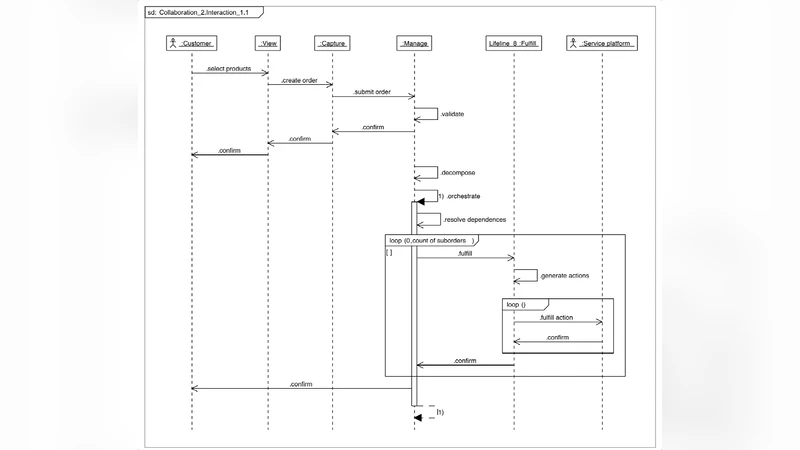
The rapid development of IT&T technology had big impact on the traditional telecommunications market, transforming it from monopolistic market to highly competitive high-tech market where new services are required to be created frequently. This paper aims to describe a design approach that puts order management process (as part of enterprise application integration) in function of rapid service creation. In the text we will present a framework for collaborative order handling supporting convergent services. The design splits the order handling processes in convergent environments in three business process groups: order capture, order management and order fulfillment. The paper establishes abstract framework for order handling and provides design guidelines for transaction handling implementation based on the checkpoint and inverse command strategy. The proposed design approach is based in a convergent telecommunication environment. Same principles are applicable in solving problems of collaboration in function of order processing in any given heterogeneous environment.
💡 Research Summary
The paper addresses the challenges posed by the rapid evolution of information‑technology and telecommunications (IT&T) that have transformed the traditional, monopolistic telecom market into a highly competitive arena where new services must be introduced quickly. In such a convergent environment, order handling becomes a critical integration point among heterogeneous enterprise applications—OSS/BSS, CRM, ERP, partner systems, and emerging cloud services. To enable rapid service creation while maintaining data integrity and operational resilience, the authors propose a modular design that decomposes the overall order handling process into three distinct business‑process groups: Order Capture, Order Management, and Order Fulfillment.
Order Capture is responsible for collecting customer requests from multiple channels (web, mobile, call‑center, etc.), normalising the input into a common message format, and performing initial validation. Dynamic routing rules direct each request to the appropriate order‑management engine based on service type, geography, or customer segment.
Order Management takes the captured data, breaks it into logical order lines, and constructs a workflow that respects service policies, pricing rules, inventory constraints, and approval hierarchies. The core contribution of the paper lies in its transaction‑control strategy, which combines checkpoint and inverse‑command mechanisms. At each critical sub‑process (e.g., inventory reservation, price calculation, credit check, billing preparation) a checkpoint is persisted, allowing the system to resume from a known good state after a failure. If a sub‑process fails, an inverse command—essentially a compensating action—is executed to roll back the effects of previously completed steps (for example, releasing reserved stock or undoing a provisional charge). This approach prevents partial failures from corrupting the entire order and supports graceful degradation.
Order Fulfillment translates the management‑stage workflow into concrete actions on downstream service‑provisioning platforms. It relies on asynchronous messaging (JMS, Kafka, etc.) and orchestration engines to coordinate multiple target systems while preserving ordering guarantees. Checkpoints and inverse commands are also applied here, ensuring that any mid‑execution error can trigger an immediate rollback or corrective path. Real‑time monitoring and alerting are integrated to detect transaction anomalies instantly and to trigger automated recovery procedures.
The authors distil their design into four practical guidelines: (1) Adopt standard interfaces (REST, SOAP, JMS) to minimise coupling between heterogeneous components; (2) Persist checkpoint data in a dedicated state store to enable reliable recovery; (3) Modularise inverse‑command logic for reuse across different sub‑processes and future extensions; and (4) Implement comprehensive monitoring with automated alerts to drive rapid fault detection and self‑healing.
By separating order handling into clearly defined stages and applying a uniform, compensating‑transaction model, the proposed framework accelerates time‑to‑market for new services while reducing operational risk. Although illustrated in a telecom context, the principles are generic and can be applied to any industry where complex, multi‑system order processing is required, such as e‑commerce, logistics, or financial services. The paper thus contributes a robust, scalable blueprint for collaborative order handling in convergent, heterogeneous IT landscapes.
Comments & Academic Discussion
Loading comments...
Leave a Comment