Remarks on exactness notions pertaining to pushouts
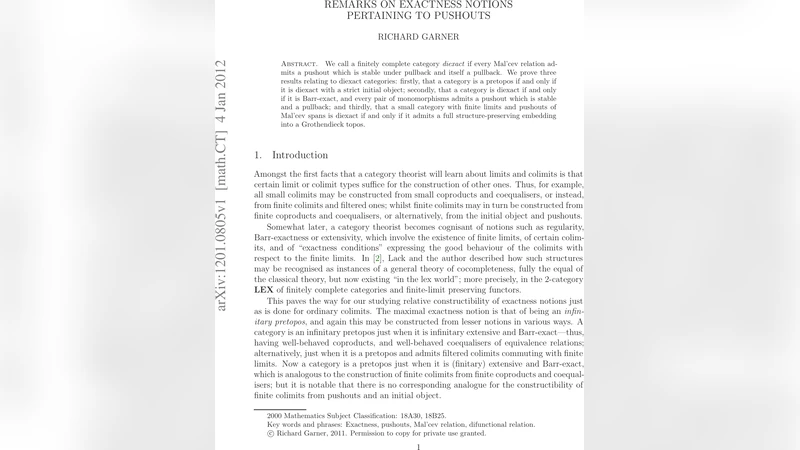
We call a finitely complete category diexact if every Mal’cev relation admits a pushout which is stable under pullback and itself a pullback. We prove three results relating to diexact categories: firstly, that a category is a pretopos if and only if it is diexact with a strict initial object; secondly, that a category is diexact if and only if it is Barr-exact, and every pair of monomorphisms admits a pushout which is stable and a pullback; and thirdly, that a small category with finite limits and pushouts of Mal’cev spans is diexact if and only if it admits a full structure-preserving embedding into a Grothendieck topos.
💡 Research Summary
The paper introduces a new exactness condition for finitely complete categories, called “diexactness”. A category C is defined to be diexact if every Mal’cev relation in C admits a pushout that is stable under pullback and, moreover, the pushout square itself is a pullback. A Mal’cev relation is a span R → X ← S satisfying a certain internal composition law; it generalizes equivalence relations and other familiar relational structures. The authors investigate how this condition interacts with classical exactness notions and with the structure of Grothendieck toposes.
The first main theorem establishes an equivalence between diexactness (together with the existence of a strict initial object) and the notion of a pretopos. A pretopos is a finitely complete, extensive category in which every equivalence relation is effective. The paper shows that if a diexact category possesses a strict initial object—meaning the initial object behaves like a zero object with respect to coproducts—then the stability and pullback properties of Mal’cev pushouts guarantee the existence of effective quotients and disjoint coproducts, thereby satisfying the definition of a pretopos. Conversely, any pretopos automatically satisfies the diexact condition because its extensive structure ensures that pushouts of Mal’cev spans are both pullbacks and stable.
The second theorem connects diexactness with Barr‑exactness. Recall that a Barr‑exact category is regular and every internal equivalence relation is effective. The authors prove that a finitely complete category C is diexact if and only if it is Barr‑exact and, in addition, every pair of monomorphisms admits a pushout that is stable under pullback and is itself a pullback. The forward direction uses the fact that Mal’cev relations include spans of monomorphisms; the diexact hypothesis forces the corresponding pushouts to have the required stability, which in turn yields the regularity and exactness conditions of Barr. The reverse direction shows that, under Barr‑exactness, the extra hypothesis on monomorphism pushouts supplies precisely the data needed to construct stable pullback pushouts for arbitrary Mal’cev relations, thereby establishing diexactness. This result clarifies that diexactness can be viewed as a strengthening of Barr‑exactness focused on the behavior of monic spans.
The third theorem addresses the embedding of small diexact categories into Grothendieck toposes. Suppose C is a small category with finite limits and pushouts of Mal’cev spans. The authors prove that C is diexact if and only if there exists a full, faithful, limit‑preserving functor J : C → E where E is a Grothendieck topos, and J also preserves the relevant pushouts. The “only‑if” direction constructs a sheaf topos over C using the canonical topology generated by the diexact pushouts; the stability of these pushouts guarantees that the Yoneda embedding lands in sheaves and reflects the exactness structure. Conversely, any such embedding forces C to inherit the exactness properties of the ambient topos, in particular the stability of pushouts of Mal’cev spans, which by definition makes C diexact. This embedding theorem situates diexact categories as precisely those small exact categories that can be realized as full subcategories of a topos, thereby linking the abstract exactness condition to concrete model‑theoretic representations.
Throughout the paper, the authors provide detailed proofs, often reducing the diexact condition to familiar categorical constructions such as kernel pairs, regular epimorphisms, and extensive coproducts. They also discuss examples illustrating that not every Barr‑exact category is diexact (the missing monomorphism pushout condition) and that the strict initial object requirement in the first theorem is essential. The work thus enriches the landscape of exactness notions by highlighting the role of Mal’cev relations and by offering a unifying perspective that connects pretoposes, Barr‑exact categories, and Grothendieck toposes under the umbrella of diexactness.
Comments & Academic Discussion
Loading comments...
Leave a Comment