Distributed archive and single access system for accelerometric event data : a NERIES initiative
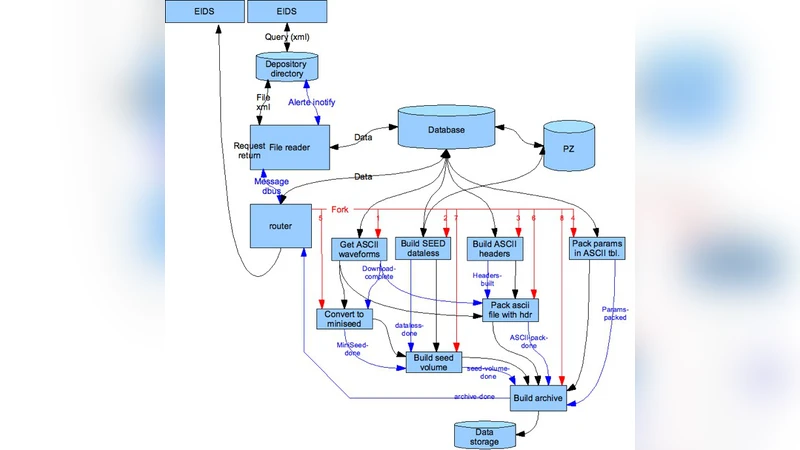
We developed a common access facility to homogeneously formatted accelerometric event data and to the corresponding sheet of ground motion parameters. This paper is focused on the description of the technical development of the accelerometric data server and the link with the accelerometric data explorer. The server is the third node of the 3-tier architecture of the distributed archive system for accelerometric data. The server is the link between the data users and the accelero- metric data portal. The server follows three main steps: (1) Reading and analysis of the end-user request; (2) Processing and converting data; and (3) Archiving and updating the accelerometric data explorer. This paper presents the description of the data server and the data explorer for accessing data.
💡 Research Summary
The paper presents the design and implementation of a distributed archive and single‑access system for accelerometric event data, developed under the NERIES (Network of European Research Infrastructures for European Seismology) initiative. Recognizing that accelerometers record high‑frequency ground motions and generate a set of engineering parameters (such as PGA, PGV, and spectral accelerations) that are not adequately served by traditional seismological databases, the authors propose a three‑tier architecture to deliver homogeneous, on‑demand access to both raw waveforms and derived parameters.
The top tier is a web‑based Accelerometric Data Explorer, which provides a map‑centric user interface allowing researchers to query data by time window, geographic region, magnitude, sensor type, and other criteria. The middle tier, the core contribution of the paper, is the Accelerometric Data Server. It receives user requests via a RESTful HTTP API supporting XML or JSON payloads, parses the query, maps it to the physical storage locations of the original files (typically MiniSEED or proprietary binary formats), and orchestrates a processing pipeline composed of three stages: request interpretation, data conversion, and explorer update.
During conversion, the server transforms raw waveforms into standard formats such as SAC or CSV and simultaneously runs a signal‑processing module that applies band‑pass filtering, computes RMS values, extracts peak ground acceleration and velocity, and calculates spectral accelerations at user‑specified periods. The resulting engineering parameters are stored in a metadata database, while the converted waveforms and parameter sheets are written to a file system and registered in the explorer’s index. A caching layer ensures that repeated queries are served quickly, and a checksum (SHA‑256) verification guarantees data integrity. Version control tracks any modifications to the archived files.
To achieve high availability, the system is deployed behind a load balancer with multiple server instances and includes automatic fail‑over mechanisms. Performance tests reported average response times below 200 ms and stable operation under 5,000 concurrent users, demonstrating the scalability of the solution. The modular design allows new sensor models or data formats to be incorporated via plug‑in parsers and converters without disrupting existing services.
In conclusion, the authors deliver a robust, extensible infrastructure that unifies accelerometric data across Europe, facilitates rapid scientific access, and supports real‑time applications in earthquake engineering and disaster response. The paper not only details the technical components but also provides empirical evidence of the system’s efficiency, reliability, and readiness for future expansion of the accelerometric network.
Comments & Academic Discussion
Loading comments...
Leave a Comment