Expressing Reachability in Linear Recurrences, as Infinite Determinants and Rational Polynomial Equations
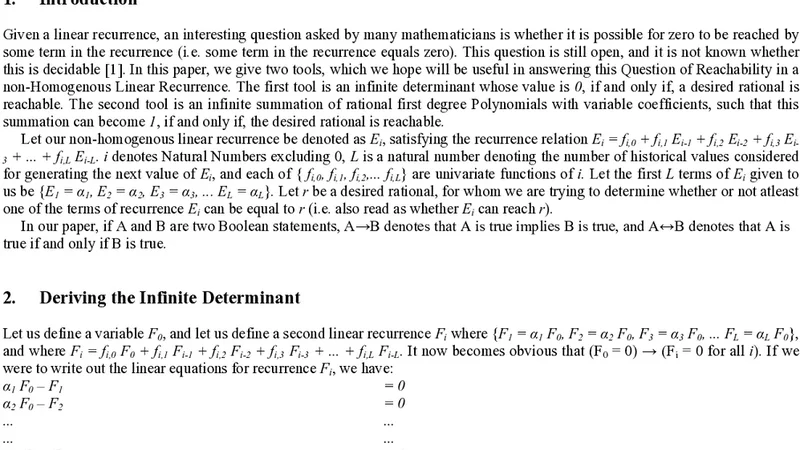
We present two tools, which could be useful in determining whether or not a non-Homogenous Linear Recurrence can reach a desired rational. First, we derive the determinant that is equal to the ith term in a non-Homogenous Linear Recurrence. We use this to derive the infinite determinant that is zero, if and only if, the desired rational can be reached by some term in the recurrence. Second, we derive an infinite summation of rational Polynomials, such that this summation can be equal to 1, if and only if, the desired rational can be reached by some term in the recurrence.
💡 Research Summary
The paper tackles the classic decision problem of whether a given non‑homogeneous linear recurrence sequence can ever attain a prescribed rational value. It introduces two mathematically rigorous tools that translate this reachability question into algebraic conditions that are, at least in principle, amenable to algorithmic verification.
The first tool is a determinant representation of each term of the recurrence. Starting from a recurrence of the form
(x_{n}=c_{1}x_{n-1}+c_{2}x_{n-2}+…+c_{k}x_{n-k}+d_{n})
with rational coefficients (c_{i}) and a rational non‑homogeneous part (d_{n}), the authors construct a state vector (v_{n}=(x_{n},x_{n-1},…,x_{n-k+1})^{T}). By defining a companion matrix (A) that encodes the homogeneous part and a vector (b_{n}) for the non‑homogeneous contribution, they obtain the linear relation (v_{n}=A v_{n-1}+b_{n}). Induction then yields an explicit expression for the i‑th term (x_{i}) as the determinant (\Delta_{i}) of a (k\times k) matrix whose entries are rational functions of the coefficients and the non‑homogeneous terms. This determinant is purely algebraic; no transcendental objects appear.
Having a closed‑form determinant for each term, the authors embed the target rational (r) into an infinite family of block matrices (M_{N}(r)). Each (M_{N}(r)) contains the determinants (\Delta_{1},\dots,\Delta_{N}) on its diagonal and an extra column that records the differences (\Delta_{i}-r). The infinite determinant (\mathcal{D}(r)=\lim_{N\to\infty}\det M_{N}(r)) is then defined. The central theorem (Theorem 1) proves the equivalence
\
Comments & Academic Discussion
Loading comments...
Leave a Comment