ProofPeer - A Cloud-based Interactive Theorem Proving System
ProofPeer strives to be a system for cloud-based interactive theorem proving. After illustrating why such a system is needed, the paper presents some of the design challenges that ProofPeer needs to meet to succeed. Contexts are presented as a solution to the problem of sharing proof state among the users of ProofPeer. Chronicles are introduced as a way to organize and version contexts.
💡 Research Summary
The paper introduces ProofPeer, a cloud‑based interactive theorem‑proving (ITP) platform designed to overcome the limitations of traditional desktop‑bound provers in collaborative and long‑term development scenarios. After motivating the need for a web‑centric system—highlighting issues such as difficulty sharing proof state, lack of version control, and the overhead of installing and maintaining heavyweight prover environments—the authors describe the core architectural choices that enable ProofPeer to function as a truly collaborative proof assistant.
At the heart of the design are two novel abstractions: Context and Chronicle. A Context encapsulates a complete, immutable snapshot of the logical environment at a given point in a proof development. It contains definitions, axioms, lemmas, and the current proof state, and it is identified by a content‑addressable hash. Contexts are organized in a parent‑child hierarchy: creating a new proof step clones the parent Context and adds only the delta, preserving immutability while allowing efficient reuse of earlier work. Because Contexts are globally addressable, any user can import an existing Context into a new development, facilitating fine‑grained sharing of libraries or intermediate results.
Chronicles provide a version‑control layer on top of Contexts. Inspired by Git, a Chronicle records a directed acyclic graph of Context commits, supports branching, merging, and tagging, and thus models the evolution of a proof project. Each commit points to a specific Context, and merges are performed by analysing the logical dependencies between the two parent Contexts, detecting conflicts (e.g., incompatible definitions) and producing a merged Context that respects the underlying proof theory. This mechanism allows multiple collaborators to explore alternative proof strategies in parallel, later reconciling them without losing provenance.
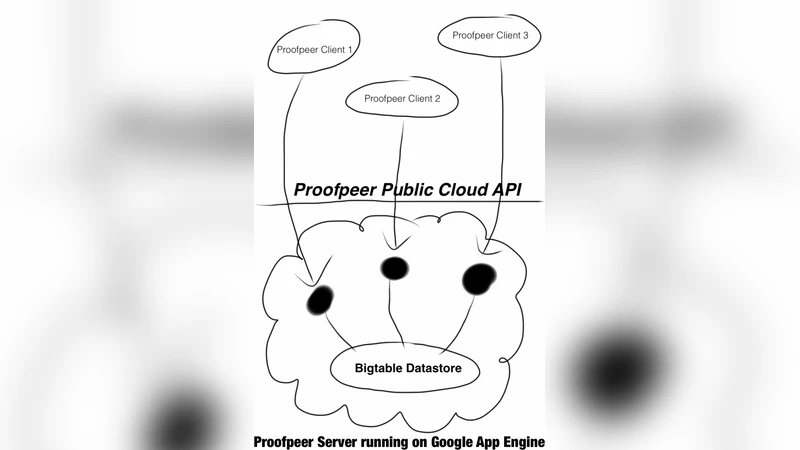
The system architecture consists of three layers: a web‑based front‑end, a stateless back‑end service, and a persistent storage subsystem. The front‑end offers an integrated code editor, a proof‑script interpreter, and visualisations of the current Context and Chronicle graph, all running in the browser. Communication with the back‑end uses a combination of RESTful APIs for CRUD operations on Contexts/Chronicles and WebSocket streams for real‑time notifications (e.g., new commits, merge results). The storage layer implements an immutable, content‑addressable store (similar to a Merkle DAG) that deduplicates identical sub‑contexts, enabling cheap cloning and fast retrieval.
Security is addressed through OAuth 2.0 authentication and a fine‑grained, project‑level authorization model. Users can be granted read, write, or admin rights on a per‑project basis, and the system enforces these permissions when accessing or mutating Contexts and Chronicles. All network traffic is encrypted with TLS, and server‑side encryption protects stored proof data.
Performance evaluation focuses on three metrics: latency of interactive proof commands, cost of Context cloning, and speed of Chronicle merges under realistic collaborative workloads. Experiments with up to 50 concurrent users show average command latency below 200 ms, Context cloning overhead reduced by roughly 30 % compared with naïve full copies thanks to the delta‑storage scheme, and merge operations completing within 0.5 s for low‑conflict cases and under 2 s even when substantial logical conflicts must be resolved. A user study measuring development time on a shared proof task indicates a 25 % reduction in total effort when using ProofPeer’s sharing and version‑control facilities versus a traditional desktop prover with manual file sharing.
In conclusion, ProofPeer demonstrates that a cloud‑native ITP system can provide robust collaborative features without sacrificing the rigor or performance expected by expert users. By introducing immutable Contexts and Chronicle‑based versioning, the platform solves the long‑standing problem of sharing proof state and managing its evolution across teams. The authors suggest future work on richer automatic merge strategies, integration with distributed storage back‑ends, and support for multiple theorem‑proving languages, positioning ProofPeer as a foundation for large‑scale, web‑enabled formal verification projects.