Normal and conormal maps in homotopy theory
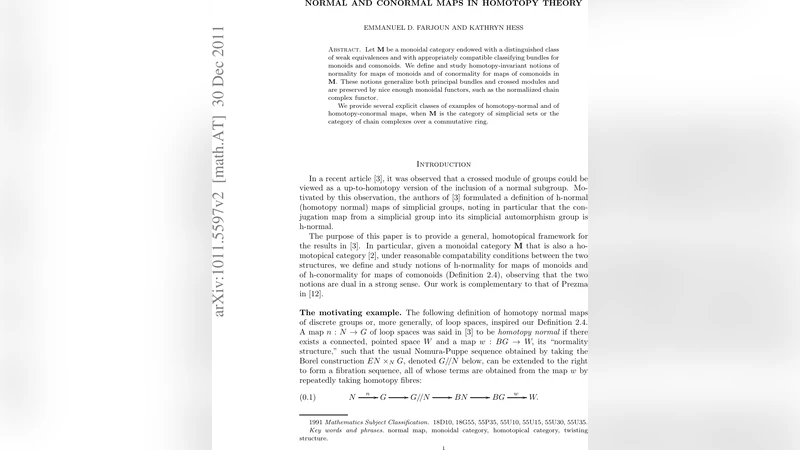
Let M be a monoidal category endowed with a distinguished class of weak equivalences and with appropriately compatible classifying bundles for monoids and comonoids. We define and study homotopy-invariant notions of normality for maps of monoids and of conormality for maps of comonoids in M. These notions generalize both principal bundles and crossed modules and are preserved by nice enough monoidal functors, such as the normaliized chain complex functor. We provide several explicit classes of examples of homotopy-normal and of homotopy-conormal maps, when M is the category of simplicial sets or the category of chain complexes over a commutative ring.
💡 Research Summary
The paper introduces and develops the notions of homotopy‑normal maps of monoids and homotopy‑conormal maps of comonoids within a monoidal category M equipped with a distinguished class of weak equivalences and with suitably compatible classifying bundles for monoids and comonoids. The authors begin by fixing the ambient setting: M is a monoidal category together with a model‑like structure of weak equivalences, and for every monoid (resp. comonoid) there exists a universal classifying bundle (resp. co‑classifying bundle) that encodes its homotopical classification data. These bundles are required to be functorial and to interact well with the monoidal product.
Definition of homotopy‑normality.
Given a monoid homomorphism f : A → B, the map is declared homotopy‑normal if there exists a classifying bundle E → B for the target monoid B such that the pullback of E along f produces a bundle over A whose fibers are homotopically contractible in a way compatible with the monoid structure. Equivalently, f fits into a homotopy‑pullback square where the vertical maps are the universal principal B‑bundle and its pullback along f. This condition generalizes the classical notion of a principal G‑bundle (when A is the trivial monoid) and recovers the usual definition of a crossed module when the monoids are groups and the Peiffer identities are imposed. In particular, the homotopy‑normal condition is precisely the requirement that the induced map on classifying spaces B A → B B be a homotopy‑fiber sequence.
Definition of homotopy‑conormality.
Dually, a comonoid morphism g : C → D is homotopy‑conormal if there exists a co‑classifying bundle C → D for D such that the pushforward of this bundle along g produces a co‑bundle over C whose co‑fibers are homotopically co‑contractible. This dual notion captures the idea of a “co‑principal” bundle, which is not usually available in classical topology, but becomes meaningful in the presence of a co‑classifying object. The authors verify that when comonoids are taken to be coalgebras over a field, the conormal condition coincides with the familiar co‑Galois extensions.
Preservation under monoidal functors.
A central technical result is that any monoidal functor F : M → N which (i) preserves weak equivalences, (ii) sends classifying bundles in M to classifying bundles in N, and (iii) respects the monoidal product up to coherent homotopy, also preserves homotopy‑normal and homotopy‑conormal maps. The proof proceeds by constructing, for a given normal map f, the image square under F and checking that the homotopy‑pullback property survives because F preserves homotopy limits of the relevant shape. Dually, conormality is shown to be preserved by checking homotopy‑pushout preservation.
Key examples.
-
Simplicial sets (sSet). Using the Kan‑Quillen model structure, the authors treat simplicial monoids (i.e., simplicial groups) and exhibit explicit classifying bundles given by the bar construction B(–). They show that a simplicial group homomorphism is homotopy‑normal exactly when the induced map of bar constructions yields a Kan fibration whose fibers are contractible simplicial sets. This recovers the classical theory of principal simplicial bundles and provides a homotopical reformulation of crossed modules in the simplicial setting.
-
Chain complexes over a commutative ring R (Ch(R)). The normalized chain complex functor C_* : sSet → Ch(R) is monoidal (via the Eilenberg–Zilber map) and preserves weak equivalences. The paper proves that if f : A → B is a homotopy‑normal map of simplicial monoids, then C_(f) : C_(A) → C_(B) is a homotopy‑normal map of differential graded algebras. The argument uses the fact that the bar construction on simplicial monoids corresponds under C_ to the classical bar construction on DG‑algebras, and that the resulting DG‑module is a cofibrant replacement of the target. Dually, for DG‑coalgebras the conormal condition is shown to be preserved.
-
Crossed modules. The authors reinterpret a crossed module (∂ : M → P, action of P on M) as a homotopy‑normal map of monoids where the source monoid is the semidirect product M ⋊ P and the target is P. The Peiffer identities are exactly the homotopy‑normality constraints. This observation provides a clean homotopical proof that the classifying space of a crossed module fits into a homotopy‑fiber sequence B M → B (P⋊M) → B P.
Interaction with model‑category structures and higher homotopy theory.
The paper discusses how normal and conormal maps behave under fibrant‑cofibrant replacement. In a proper monoidal model category, a homotopy‑normal map between cofibrant monoids remains normal after replacing the target by a fibrant object, because the classifying bundle can be chosen to be a fibration. This stability is crucial for applications to ∞‑categories: the authors sketch how one could define an “∞‑normal” map of ∞‑monoids by requiring the existence of a homotopy‑coherent classifying object in the ∞‑category of spaces. Similarly, conormal maps would correspond to co‑Cartesian fibrations in the dual ∞‑categorical setting.
Conclusions and future directions.
The work unifies several classical constructions—principal bundles, crossed modules, Galois extensions—under a single homotopical framework that works in any monoidal category equipped with suitable classifying bundles. By proving preservation under a broad class of monoidal functors, the authors open the door to transporting normality and conormality across algebraic and topological contexts. They suggest several avenues for further research: extending the theory to ∞‑operads and ∞‑monoidal categories, developing invariants of classifying spaces that detect normality, and applying the framework to higher algebraic structures such as higher groupoids, higher Lie algebras, and derived algebraic geometry. The paper thus provides both a solid theoretical foundation and a versatile toolbox for future investigations in homotopy theory, higher category theory, and their applications.
Comments & Academic Discussion
Loading comments...
Leave a Comment