Quartic Curves and Their Bitangents
A smooth quartic curve in the complex projective plane has 36 inequivalent representations as a symmetric determinant of linear forms and 63 representations as a sum of three squares. These correspond
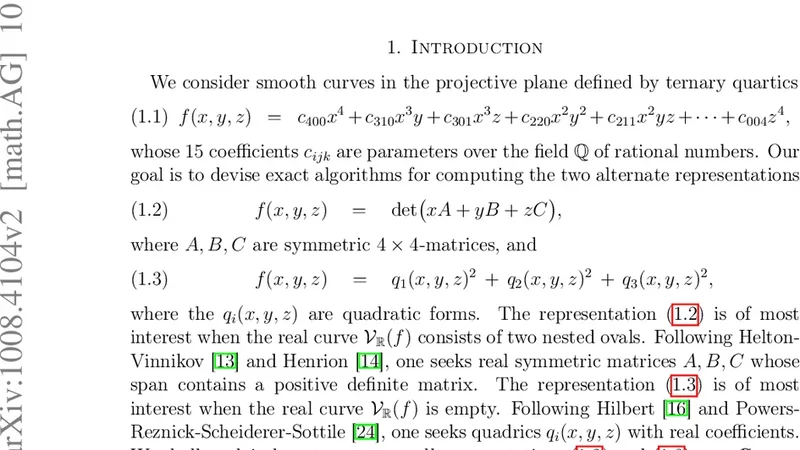
A smooth quartic curve in the complex projective plane has 36 inequivalent representations as a symmetric determinant of linear forms and 63 representations as a sum of three squares. These correspond to Cayley octads and Steiner complexes respectively. We present exact algorithms for computing these objects from the 28 bitangents. This expresses Vinnikov quartics as spectrahedra and positive quartics as Gram matrices. We explore the geometry of Gram spectrahedra and we find equations for the variety of Cayley octads. Interwoven is an exposition of much of the 19th century theory of plane quartics.
💡 Research Summary
The paper investigates the deep interplay between smooth plane quartic curves in the complex projective plane and their 28 bitangents, providing both a historical overview and modern computational tools. It is shown that every smooth quartic admits exactly 36 inequivalent symmetric determinantal representations of the form det L(x)=0, where L(x)=x₀A₀+x₁A₁+x₂A₂ is a linear combination of four‑by‑four symmetric matrices. These 36 representations correspond bijectively to the so‑called Cayley octads – collections of eight points satisfying a specific cubic relation – and to the 2‑torsion theta‑characteristics on the curve.
In parallel, the same quartic can be expressed as a sum of three squares of quadratic forms, f(x)=q₁²+q₂²+q₃², in exactly 63 distinct ways. Each such expression is encoded by a Steiner complex, i.e. a configuration of six bitangents that determines a three‑dimensional Gram matrix G≥0 with f(x)=v(x)ᵀGv(x), where v(x) collects the three quadrics. The authors develop exact algorithms that start from the explicit equations of the 28 bitangents, construct all admissible 8‑point octads and all admissible 6‑bitangent Steiner complexes, and then recover the corresponding matrices A_i and G. The algorithms rely on Gröbner‑basis elimination, linear algebra over the field of rational functions, and careful bookkeeping of the combinatorial incidence relations among bitangents.
A major application concerns Vinnikov quartics, i.e. real quartics that admit a definite symmetric determinantal representation. The paper proves that for such curves the matrix L(x) can be chosen real and positive semidefinite on the real locus, thus realizing the curve as a spectrahedron {x∈ℝ³ | L(x)⪰0}. Consequently, every positive definite quartic can also be written as a Gram matrix of three real quadrics, giving a concrete description of its Gram spectrahedron. The geometry of these Gram spectrahedra is explored: the 63 rank‑one extreme points correspond to the 63 square‑sum representations, while higher‑dimensional faces arise from linear dependencies among the quadrics.
The authors further derive explicit equations for the variety of Cayley octads. This variety lives in (ℙ²)⁸ modulo the diagonal action of PGL₃(ℂ) and is cut out by 14 cubic equations, exactly matching the classical description found in 19th‑century works of Clebsch, Gordan, and later Dolgachev. By solving these equations the paper exhibits a parametrisation of the moduli space of quartics equipped with a chosen octad, and analyses the natural PGL₃‑action on the set of 36 octads.
Throughout, the paper interweaves historical exposition with concrete examples. It implements the algorithms in SageMath/Macaulay2, demonstrates them on the Vinnikov quartic x₀⁴+x₁⁴+x₂⁴−3x₀²x₁²=0, and provides explicit matrices for all 36 determinantal and 63 sum‑of‑squares representations. The results not only give a computational bridge to classical invariant theory but also open the way for applications in convex algebraic geometry, optimization (via spectrahedral descriptions), and the study of real quartic curves.
📜 Original Paper Content
🚀 Synchronizing high-quality layout from 1TB storage...