Magneto-elastic torsional oscillations of magnetars
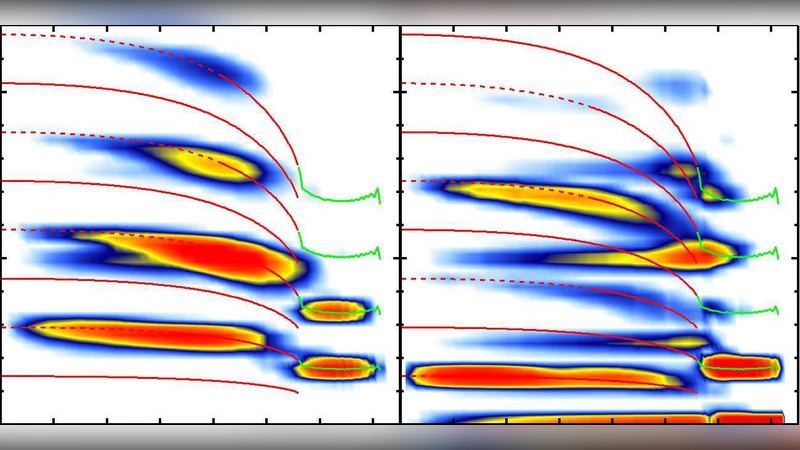
We extend a general-relativistic ideal magneto-hydrodynamical code to include the effects of elasticity. Using this numerical tool we analyse the magneto-elastic oscillations of highly magnetised neutron stars (magnetars). In simulations without magnetic field we are able to recover the purely crustal shear oscillations within an accuracy of about a few per cent. For dipole magnetic fields between 5 x 10^13 and 10^15 G the Alfv'en oscillations become modified substantially by the presence of the crust. Those quasi-periodic oscillations (QPOs) split into three families: Lower QPOs near the equator, Edge QPOs related to the last open field line and Upper QPOs at larger distance from the equator. Edge QPOs are called so because they are related to an edge in the corresponding Alfv'en continuum. The Upper QPOs are of the same kind, while the Lower QPOs are turning-point QPOs, related to a turning point in the continuous spectrum.
💡 Research Summary
The authors present a state‑of‑the‑art numerical study of torsional oscillations in highly magnetised neutron stars (magnetars) by extending a general‑relativistic ideal magnetohydrodynamics (GR‑MHD) code to include elastic stresses in the solid crust. After validating the extended code against pure crustal shear modes (recovering eigenfrequencies within a few percent), they explore a wide range of dipolar magnetic field strengths, from 5 × 10¹³ G up to 10¹⁵ G. In the weak‑field regime the Alfvén continuum resides mainly in the fluid core and the crust oscillates essentially independently. As the field exceeds ≈10¹⁴ G, the Alfvén speed becomes comparable to the shear speed, and the core‑crust coupling produces a rich spectrum of magneto‑elastic quasi‑periodic oscillations (QPOs).
Three distinct families of QPOs emerge from the simulations. “Lower QPOs” appear near the equator at frequencies corresponding to turning points of the Alfvén continuum; energy piles up at these points, producing sharp, long‑lived peaks. “Edge QPOs” are associated with the last open magnetic field line, i.e., the edge of the continuum, and their frequencies shift rapidly with magnetic field strength because they trace the boundary where Alfvén waves either reflect or escape. “Upper QPOs” occur at higher latitudes, also linked to continuum edges but at larger angular distances from the equator. The authors demonstrate that the frequencies of all three families scale roughly with the square root of the magnetic field strength, yet they are also sensitive to crustal parameters such as shear modulus and thickness. Thinner crusts raise the Lower QPO frequencies, while Edge and Upper QPOs are comparatively less affected.
By comparing the simulated frequency bands (tens to thousands of hertz) with the QPOs observed in the giant flares of SGR 1806‑20 and SGR 1900+14, the authors argue that the observed low‑frequency QPOs (≈30–90 Hz) can be identified with Lower turning‑point modes, while the higher‑frequency components (≈150–1800 Hz) correspond to Edge and Upper modes. The study thus provides a unified physical framework that resolves previous ambiguities in QPO classification and links observed phenomenology directly to the internal magneto‑elastic structure of magnetars.
Importantly, the simulations are performed in the linear regime, yet the resulting QPO lifetimes and spectral shapes agree with the observed decay times (seconds to tens of seconds). This suggests that non‑linear effects, while present, play a secondary role in shaping the dominant QPO features. The paper concludes by outlining future extensions: inclusion of non‑linear damping mechanisms, more complex magnetic topologies (multipolar fields), and coupling to radiative processes that could translate internal oscillations into the observed X‑ray modulations. Overall, the work represents a significant step forward in the theoretical modelling of magnetar oscillations and offers concrete predictions that can be tested with forthcoming high‑time‑resolution X‑ray missions.
Comments & Academic Discussion
Loading comments...
Leave a Comment