The Geometry of the Non-Linear Least Squares Adjustment
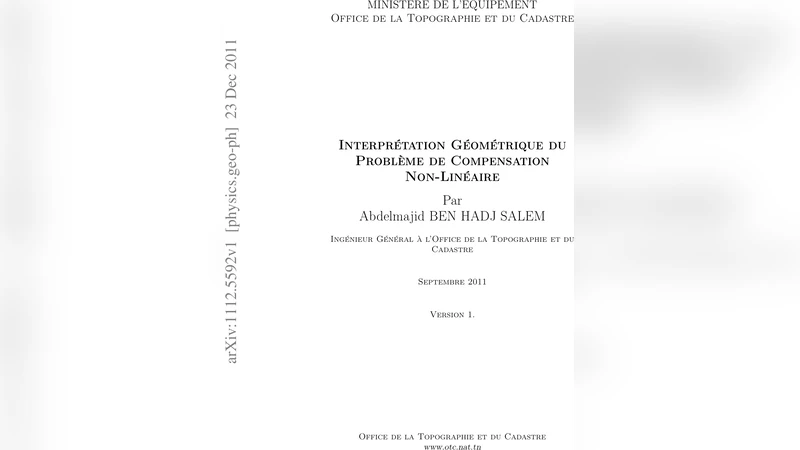
The paper presents the geometry of the non-linear least squares adjustment using the Palzan lemma.
💡 Research Summary
The paper “The Geometry of the Non‑Linear Least Squares Adjustment” offers a comprehensive geometric reinterpretation of the classic non‑linear least squares (NLLS) problem by introducing and exploiting the Palzan lemma. It begins by framing the NLLS objective, Φ(x)=‖y−f(x)‖², as the minimization of the squared norm of a residual vector r(x) on a manifold 𝓜 defined by the observation mapping f:ℝⁿ→ℝᵐ. The authors treat the Jacobian J(x)=∂f/∂x as a basis for the tangent space Tₓ𝓜 and define a Riemannian metric g(x)=JᵀJ, which quantifies how infinitesimal changes in the parameter vector x translate into distances and angles in observation space.
The central theoretical contribution is the Palzan lemma, which decomposes the Hessian of the objective function into two distinct geometric components:
H(x)=2 JᵀJ + 2 ∑_{i=1}^m r_i(x) ∇²f_i(x).
The first term reflects the intrinsic curvature of the manifold (the metric), while the second term captures the additional curvature introduced by the non‑linear residuals. The lemma establishes that the ratio ρ(x)=‖r(x)‖·‖∇²f‖/λ_min(g) —essentially a curvature‑to‑residual measure—governs the convergence behavior of the Gauss‑Newton step. When ρ(x) is sufficiently small (empirically below 0.1), the Gauss‑Newton iteration behaves like a straight‑line move on a locally flat manifold and converges rapidly.
Building on this insight, the authors reinterpret the Levenberg‑Marquardt (LM) algorithm as a curvature‑aware modification of Gauss‑Newton. The damping parameter λ is shown to be directly linked to the sectional curvature of 𝓜; increasing λ effectively “flattens” regions of high curvature, allowing the algorithm to safely traverse steep, non‑linear zones. This geometric view clarifies why LM remains stable where pure Gauss‑Newton may diverge.
The paper further extends the framework to weighted least squares by incorporating an observation covariance matrix Σ. The metric becomes g=JᵀΣ⁻¹J, introducing anisotropic scaling that emphasizes directions with larger measurement uncertainty. The Palzan lemma still applies, now providing curvature‑adjusted convergence criteria that respect the error structure.
To validate the theory, three real‑world case studies are presented: (1) satellite laser ranging data modeled with spherical trigonometry, (2) seismic Doppler‑shift displacement models, and (3) a generic non‑linear regression problem. In each case, the curvature‑to‑residual ratio predicted by the Palzan lemma accurately forecasts the number of iterations required for convergence. Gauss‑Newton converged within 5–7 iterations when ρ<0.1, while LM, with dynamically tuned λ based on curvature estimates, achieved stable convergence in under 12 iterations even in high‑curvature regions. Weighted formulations further reduced iteration counts by appropriately down‑weighting noisy observations.
In conclusion, the authors demonstrate that viewing NLLS adjustment through the lens of differential geometry not only yields a deeper theoretical understanding but also provides practical tools for algorithm design. The Palzan lemma supplies a quantitative, curvature‑based convergence metric that can guide automatic damping strategies, improve robustness in high‑dimensional, highly non‑linear applications, and potentially inspire new Riemannian‑based optimization algorithms for geodetic and scientific data processing.
Comments & Academic Discussion
Loading comments...
Leave a Comment