Preclusion of switch behavior in reaction networks with mass-action kinetics
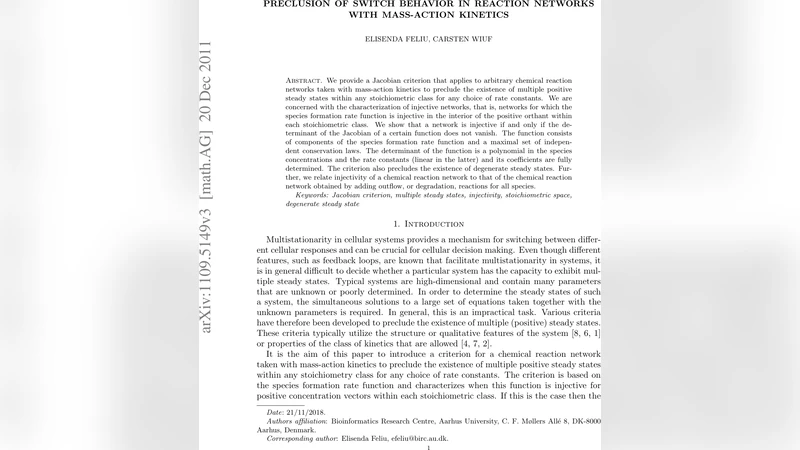
We provide a Jacobian criterion that applies to arbitrary chemical reaction networks taken with mass-action kinetics to preclude the existence of multiple positive steady states within any stoichiometric class for any choice of rate constants. We are concerned with the characterization of injective networks, that is, networks for which the species formation rate function is injective in the interior of the positive orthant within each stoichiometric class. We show that a network is injective if and only if the determinant of the Jacobian of a certain function does not vanish. The function consists of components of the species formation rate function and a maximal set of independent conservation laws. The determinant of the function is a polynomial in the species concentrations and the rate constants (linear in the latter) and its coefficients are fully determined. The criterion also precludes the existence of degenerate steady states. Further, we relate injectivity of a chemical reaction network to that of the chemical reaction network obtained by adding outflow, or degradation, reactions for all species.
💡 Research Summary
The paper develops a Jacobian‑based injectivity test for arbitrary chemical reaction networks (CRNs) governed by mass‑action kinetics. The authors focus on the problem of “switch behavior,” i.e., the existence of multiple positive steady states within a stoichiometric compatibility class, which underlies bistability and cellular decision making.
A CRN is defined by a finite set of species S, complexes C ⊂ ℕ^S, and reactions R ⊂ C×C. With a positive rate vector κ, the mass‑action species‑formation rate function is f_κ(c) = Σ_{y→y′∈R} k_{y→y′} c^y (y′−y). The stoichiometric subspace Γ = span{y′−y | y→y′∈R} has dimension s; its orthogonal complement Γ^⊥ (dimension d = n−s) yields linear conservation laws ω·c = const for ω∈Γ^⊥. A steady state is a positive vector c satisfying f_κ(c)=0, and two steady states a, b belong to the same stoichiometric class iff a−b∈Γ (equivalently ω·a = ω·b for all ω∈Γ^⊥).
The central notion is injectivity: the map Φ_κ(c) = (ω₁·c, …, ω_d·c, f_κ₁(c), …, f_κ_n(c)) is injective on the positive orthant. If Φ_κ is injective, the network cannot admit two distinct positive steady states in the same class, regardless of the choice of κ. The authors prove that injectivity is equivalent to the non‑vanishing of the determinant of the Jacobian J(Φ_κ) for all positive concentrations and all positive rate constants. This determinant is a polynomial in the concentrations and linear in the rate constants; its coefficients are completely determined by the network’s stoichiometry and the chosen set of independent conservation laws. Consequently, the test can be carried out symbolically with any computer‑algebra system.
The paper distinguishes open networks (Γ = ℝ^n) from fully open networks (every species has an outflow reaction S_i → 0). In fully open networks the Jacobian of f_κ alone suffices, reproducing the Craciun‑Feinberg criterion. For general (closed or partially open) networks, the Jacobian of f_κ is singular because of conserved quantities; the authors therefore replace the missing rows by the linear conservation equations, forming Φ_κ. They show that the determinant of J(Φ_κ) can be recovered from the determinant of the Jacobian of the associated fully open network, establishing a precise relationship between the two settings.
A major result (Theorem 9.1) states that if the associated fully open network is injective, then the original network is either (i) injective with all positive steady states non‑degenerate, or (ii) every positive steady state is degenerate. The degenerate case is fully characterized (Corollary 8.1) in terms of linear dependence among the reaction vectors and the conservation laws.
The authors also connect their Jacobian test to P‑matrix theory. Earlier work showed that if –J(f_κ) is a P‑matrix, the network is injective. Here it is proved that after appropriate sign changes of certain rows, J(Φ_κ) becomes a P‑matrix, providing an alternative sufficient condition for injectivity.
Overall, the paper supplies a practical, algebraic criterion that depends only on network structure, not on specific parameter values. It enables researchers to preclude multistationarity and degenerate steady states in large biochemical models (e.g., signaling cascades, metabolic pathways) without solving the full nonlinear steady‑state equations. The method bridges the gap between the fully open framework of Craciun‑Feinberg and arbitrary closed networks, and it offers a computationally tractable tool for systems biologists and mathematical chemists interested in the qualitative dynamics of reaction networks.
Comments & Academic Discussion
Loading comments...
Leave a Comment