Ricean Shadowed Statistical Characterization of Shallow Water Acoustic Channels for Wireless Communications
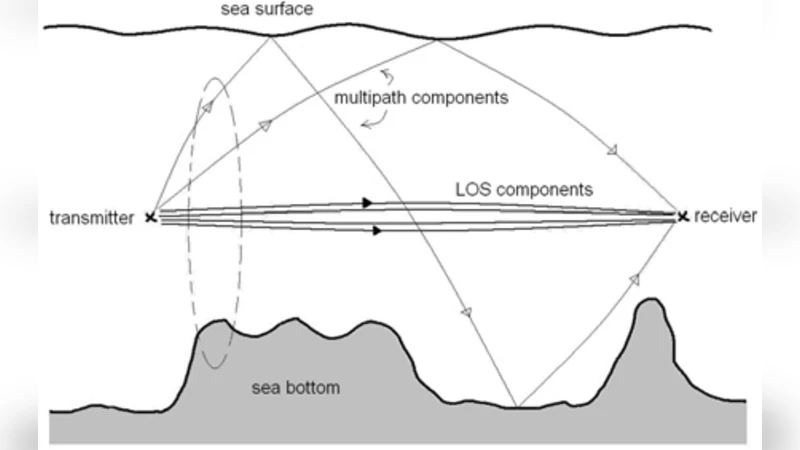
In this letter, the statistical behaviour of the shallow water acoustic channel for wireless communications is shown to be well characterized by the Ricean shadowed distribution, which has never been proposed for communication purposes on this type of channel. This characterization is clearly motivated from statistical and physical perspectives and has both theoretical and practical advantages compared to previously proposed models.
💡 Research Summary
The paper introduces the Ricean‑shadowed distribution as a new statistical model for shallow‑water acoustic channels used in wireless communications. The authors begin by highlighting the challenges inherent to underwater acoustic propagation in coastal environments: rapid spatial and temporal variations in sound speed caused by temperature, salinity, surface waves, and bottom topography generate complex multipath fading that is difficult to capture with traditional models. Existing approaches—Rayleigh (no line‑of‑sight component), Rice (fixed line‑of‑sight component), and K‑distribution (captures shadowing but does not separate the deterministic and random parts of the dominant path)—each have limitations. Rayleigh fails when a strong direct path exists, Rice assumes a constant direct‑path power, and the K‑distribution, while flexible, mixes the deterministic and random contributions, making physical interpretation and parameter estimation cumbersome.
The Ricean‑shadowed model augments the classic Rice distribution by introducing a shadowing parameter m that governs the random fluctuation of the dominant (often line‑of‑sight) component. In this formulation the channel envelope R follows
f_R(r) = (2 m^m (1+K)^{m+1} r^{2m‑1} / (Γ(m) Ω^m)) exp
Comments & Academic Discussion
Loading comments...
Leave a Comment