Parameter estimation for the discretely observed fractional Ornstein-Uhlenbeck process and the Yuima R package
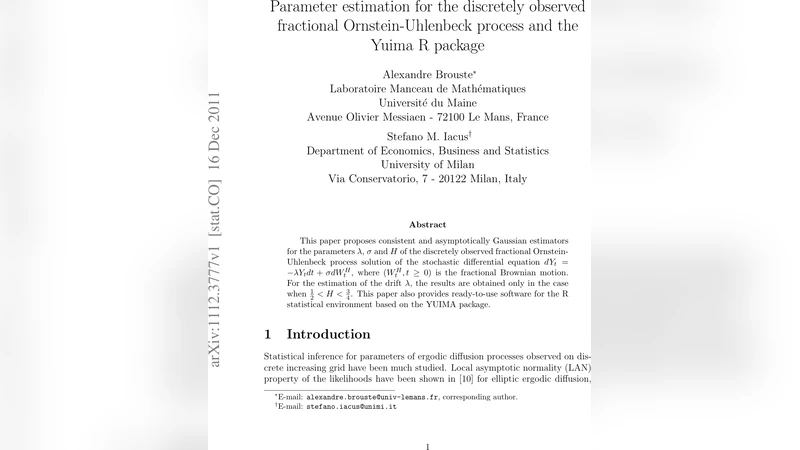
This paper proposes consistent and asymptotically Gaussian estimators for the drift, the diffusion coefficient and the Hurst exponent of the discretely observed fractional Ornstein-Uhlenbeck process. For the estimation of the drift, the results are obtained only in the case when 1/2 < H < 3/4. This paper also provides ready-to-use software for the R statistical environment based on the YUIMA package.
💡 Research Summary
The paper addresses the problem of estimating the three fundamental parameters of a discretely observed fractional Ornstein‑Uhlenbeck (fOU) process: the mean‑reversion (drift) coefficient θ, the diffusion coefficient σ, and the Hurst exponent H. The fOU dynamics are given by the stochastic differential equation
dXₜ = –θ Xₜ dt + σ dBₜᴴ,
where Bₜᴴ denotes a fractional Brownian motion with Hurst index H∈(0,1). Because Bₜᴴ exhibits long‑range dependence, the process is non‑Markovian and standard maximum‑likelihood techniques for the classical Ornstein‑Uhlenbeck model are not directly applicable.
The authors consider observations X₀, X₁,…,Xₙ taken at equally spaced times tᵢ = iΔ, with Δ fixed. They develop three separate estimators, each proved to be consistent and asymptotically normal under appropriate conditions.
-
Drift estimator (θ̂ₙ).
A modified least‑squares approach is employed: the discrete increment ΔXᵢ = X_{i+1} – Xᵢ is approximated by –θ Xᵢ Δ plus a residual term that inherits the dependence structure of the fractional noise. By constructing a generalized method‑of‑moments (GMM) criterion with a weight matrix that accounts for the autocovariance of the residuals, the estimator θ̂ₙ is obtained as the minimizer of this criterion. The authors prove that, when the Hurst exponent lies in the interval (½, ¾), the estimator is √n‑consistent and satisfies
√n(θ̂ₙ – θ) → 𝒩(0, V_θ),
where V_θ is an explicit function of θ, σ, H, and Δ. The restriction H < ¾ is essential because the autocovariance of the increments decays only as Δ^{2H‑2}; for H ≥ ¾ the dependence is too strong for the standard GMM asymptotics to hold. -
Diffusion estimator (σ̂ₙ).
The second‑order moment of the increments provides a natural estimator. Define
Sₙ = (1/n) ∑_{i=0}^{n‑1} (ΔXᵢ)².
Since E
Comments & Academic Discussion
Loading comments...
Leave a Comment