Matroids and Integrality Gaps for Hypergraphic Steiner Tree Relaxations
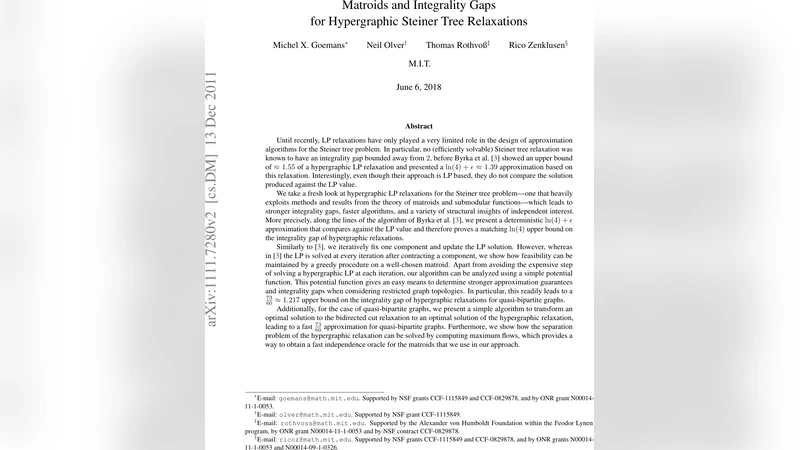
Until recently, LP relaxations have played a limited role in the design of approximation algorithms for the Steiner tree problem. In 2010, Byrka et al. presented a ln(4)+epsilon approximation based on a hypergraphic LP relaxation, but surprisingly, their analysis does not provide a matching bound on the integrality gap. We take a fresh look at hypergraphic LP relaxations for the Steiner tree problem - one that heavily exploits methods and results from the theory of matroids and submodular functions - which leads to stronger integrality gaps, faster algorithms, and a variety of structural insights of independent interest. More precisely, we present a deterministic ln(4)+epsilon approximation that compares against the LP value and therefore proves a matching ln(4) upper bound on the integrality gap. Similarly to Byrka et al., we iteratively fix one component and update the LP solution. However, whereas they solve an LP at every iteration after contracting a component, we show how feasibility can be maintained by a greedy procedure on a well-chosen matroid. Apart from avoiding the expensive step of solving a hypergraphic LP at each iteration, our algorithm can be analyzed using a simple potential function. This gives an easy means to determine stronger approximation guarantees and integrality gaps when considering restricted graph topologies. In particular, this readily leads to a 73/60 bound on the integrality gap for quasi-bipartite graphs. For the case of quasi-bipartite graphs, we present a simple algorithm to transform an optimal solution to the bidirected cut relaxation to an optimal solution of the hypergraphic relaxation, leading to a fast 73/60 approximation for quasi-bipartite graphs. Furthermore, we show how the separation problem of the hypergraphic relaxation can be solved by computing maximum flows, providing a fast independence oracle for our matroids.
💡 Research Summary
The Steiner tree problem asks for a minimum‑cost tree that spans a given set of terminals R in a weighted undirected graph. While a trivial 2‑approximation follows from the minimum spanning tree, breaking the factor‑2 barrier has been a long‑standing challenge. In 2010, Byrka, Grandoni, Rothvoß and Sanitá introduced a hypergraphic linear programming (LP) relaxation—also known as the component‑based LP—and obtained a ln 4 + ε ≈ 1.39 approximation. However, their analysis did not compare the output to the LP value, so it did not yield a matching integrality‑gap bound.
This paper revisits the hypergraphic relaxation using tools from matroid theory and submodular functions, achieving three major advances. First, the authors present a deterministic ln 4 + ε algorithm whose performance is measured directly against the optimal LP solution, thereby proving that the integrality gap of the component‑based relaxation is at most ln 4 (≈ 1.386). Second, they replace the costly step of re‑solving the LP after each component contraction with a greedy procedure that operates on a carefully constructed matroid, dramatically speeding up the algorithm. Third, they obtain stronger bounds for special graph classes, most notably a 73/60 ≈ 1.217 integrality‑gap (and matching approximation) for quasi‑bipartite graphs.
The technical core relies on representing any fractional LP solution x as a “blow‑up graph” X. For a scaling factor N that clears denominators, X consists of N copies of each component C weighted by x_C, with all copies of each terminal identified. Feasibility of x translates into a combinatorial condition on X. When a component Q is contracted, the graph X is augmented by N fresh copies of Q, producing X ⊕ Q, which is infeasible. Restoring feasibility amounts to deleting a minimal set of edges B ⊆ E(X). The authors prove (Theorem 2.1) that the family of all such minimal deletion sets for a fixed Q forms the set of bases of a matroid M_Q. Moreover, M_Q can be described by a submodular rank function and is in fact a gammoid, allowing flow‑based algorithms to test independence.
To control the cost reduction after each contraction, the authors consider the Minkowski sum of the base polytopes of the matroids M_Q over all components Q present in X. This sum is a polymatroid B_rem. By restricting attention to a “splitting set” K—a minimal edge set whose removal disconnects all terminals—they obtain a restricted polymatroid B_K_rem that is non‑empty for every Q. Selecting removal probabilities from B_K_rem guarantees that the expected total scaled cost of deleted edges is at least a constant fraction of the cost of the contracted component. Careful analysis shows that this constant can be taken as 1/ln 4, yielding the ln 4 + ε approximation guarantee.
For quasi‑bipartite graphs, the paper exploits the known equivalence between the bidirected cut relaxation and the hypergraphic relaxation. The authors give a simple, strongly polynomial algorithm that transforms an optimal solution of the bidirected cut LP into an optimal solution of the hypergraphic LP. Since the bidirected cut LP admits a compact extended formulation, this transformation provides a fast way to solve the hypergraphic LP in the quasi‑bipartite case. Combining this with the deterministic algorithm yields a 73/60 approximation, improving upon the previous best bound of 4/3.
Finally, the separation problem for the hypergraphic LP is reduced to a series of maximum‑flow computations. Because each matroid M_Q is a gammoid, checking whether a candidate edge set is independent reduces to testing the existence of a flow of a certain value, which can be done in polynomial time. This gives an efficient independence oracle for the matroids used in the greedy update step, eliminating the need for ellipsoid‑type methods or huge extended formulations.
In summary, the paper makes four key contributions: (1) a matroid‑based framework that updates the hypergraphic LP solution without re‑solving the LP, (2) a deterministic ln 4 + ε algorithm that directly proves an ln 4 integrality‑gap bound, (3) a fast 73/60 algorithm for quasi‑bipartite graphs via a bidirected‑cut‑to‑hypergraphic conversion, and (4) a flow‑based separation oracle for the hypergraphic relaxation. These results deepen the theoretical understanding of LP relaxations for Steiner trees and open the door to more efficient and tighter approximation algorithms for this classic network design problem.
Comments & Academic Discussion
Loading comments...
Leave a Comment