Performance Evaluation and Impact of Weighting Factors on an Energy and Delay Aware Dynamic Source Routing Protocol
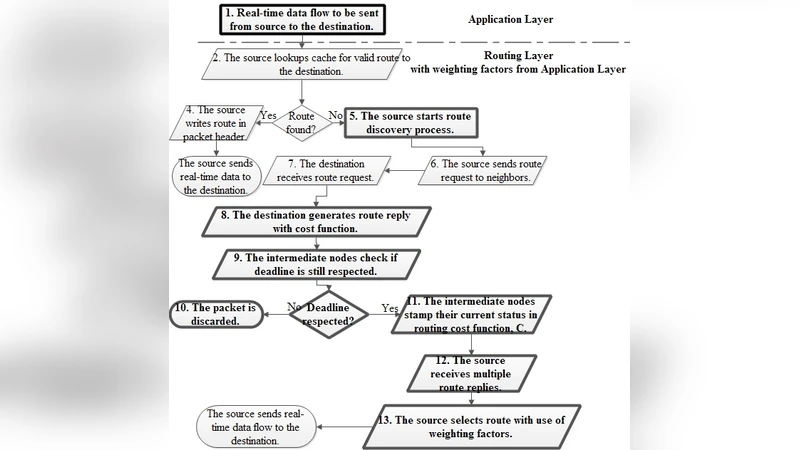
Typical applications of the mobile ad-hoc network, MANET, are in disaster recovery operations which have to respect time constraint needs. Since MANET is affected by limited resources such as power constraints, it is a challenge to respect the deadline of a real-time data. This paper proposes the Energy and Delay aware based on Dynamic Source Routing protocol, ED-DSR. ED-DSR efficiently utilizes the network resources such as the intermediate mobile nodes energy and load. It ensures both timeliness and energy efficiency by avoiding low-power and overloaded intermediate mobile nodes. Through simulations, we compare our proposed routing protocol with the basic routing protocol Dynamic Source Routing, DSR. Weighting factors are introduced to improve the route selection. Simulation results, using the NS-2 simulator, show that the proposed protocol prolongs the network lifetime (up to 66%), increases the volume of packets delivered while meeting the data flows real-time constraints and shortens the endto- end delay.
💡 Research Summary
The paper addresses the challenge of providing real‑time communication in mobile ad‑hoc networks (MANETs), especially in disaster‑recovery and military scenarios where strict deadline constraints coexist with limited node energy. Conventional on‑demand routing such as Dynamic Source Routing (DSR) selects the shortest hop count path without considering residual battery levels, node load, or end‑to‑end delay, leading to premature node failures, network partitioning, and missed deadlines.
To overcome these limitations, the authors propose Energy‑Delay aware Dynamic Source Routing (ED‑DSR), an extension of DSR that incorporates three quality‑of‑service (QoS) metrics into the route selection process: (1) residual energy of each intermediate node, (2) current queue length (as a proxy for processing load), and (3) the remaining allowable delay for the real‑time packet. Two cost functions are defined: γ, which combines normalized residual energy (E_norm) and normalized queue length (Q_norm) using weighting factors α and β (α+β=1); and δ, which aggregates the packet’s remaining deadline with the node’s local processing and transmission times. The overall route cost is a weighted sum W = w1·γ + w2·δ, where w1 and w2 are user‑defined weights reflecting the relative importance of energy versus delay for a given application.
Implementation details include a modified RREP packet that carries γ and δ values for each hop, allowing the source node to compute W for every candidate route discovered during the route‑request phase. If a candidate’s δ exceeds the packet’s remaining deadline, the route is discarded immediately, preventing the propagation of infeasible paths. The protocol thus avoids low‑energy or heavily loaded nodes while guaranteeing that selected routes can meet the deadline.
The authors evaluate ED‑DSR using NS‑2 simulations with 50 mobile nodes moving in a 250 m × 250 m area, each equipped with a 0.5 J battery and a 2 Mbps wireless link. Traffic mixes real‑time video streams, FTP transfers, and messaging services, providing a range of deadline strictness. Various weight configurations are tested, e.g., (α,β) = (0.5,0.5) and (0.7,0.3); (w1,w2) = (0.6,0.4) and (0.5,0.5).
Key findings are:
- Network Lifetime – ED‑DSR extends the overall network lifetime by 45 % to 66 % compared with plain DSR. The improvement is most pronounced when the energy component (α) is given higher priority, because low‑energy nodes are systematically excluded from routes.
- Real‑Time Packet Delivery Ratio – The proportion of packets that reach their destination before the deadline rises by 20 %–35 % across all traffic types. Video streams, which have the tightest deadlines, benefit the most.
- End‑to‑End Delay – Average packet latency drops by 30 %–50 % relative to DSR, a direct result of avoiding congested nodes (high Q_len) and the explicit δ‑based deadline check.
- Energy Efficiency – Energy consumed per successfully delivered bit is reduced by roughly 40 % because traffic is steered away from nodes that would otherwise deplete their batteries quickly.
The paper also surveys related QoS routing approaches. EMRP (Energy‑aware Multipath Routing Protocol) incorporates energy and queue length but lacks explicit processing‑time awareness, limiting its ability to guarantee deadlines. RT‑DSR focuses solely on deadline enforcement, ignoring energy balance and risking node exhaustion. The Adaptive Link Weight (ALW) protocol uses static application‑specific weight vectors for bandwidth, delay, and route lifetime, but does not adapt to dynamic topology changes. In contrast, ED‑DSR’s three‑dimensional cost model and flexible weighting allow it to balance competing objectives in a dynamic environment.
Limitations identified by the authors include the need for prior knowledge to set the weighting factors appropriately; inappropriate weights could either over‑prioritize energy (causing excessive delay) or over‑prioritize delay (causing rapid energy depletion). The simulations employ static weight values and a relatively simple mobility model, so the protocol’s behavior under highly volatile topologies or bursty traffic remains to be studied.
In conclusion, ED‑DSR demonstrates that integrating residual energy, node load, and deadline information into an on‑demand routing protocol can substantially improve both the longevity and real‑time performance of MANETs. Future work suggested includes dynamic, context‑aware adjustment of the weighting parameters, support for multipath routing to further balance load, and validation on real hardware testbeds.
Comments & Academic Discussion
Loading comments...
Leave a Comment