SVD-based unfolding: implementation and experience
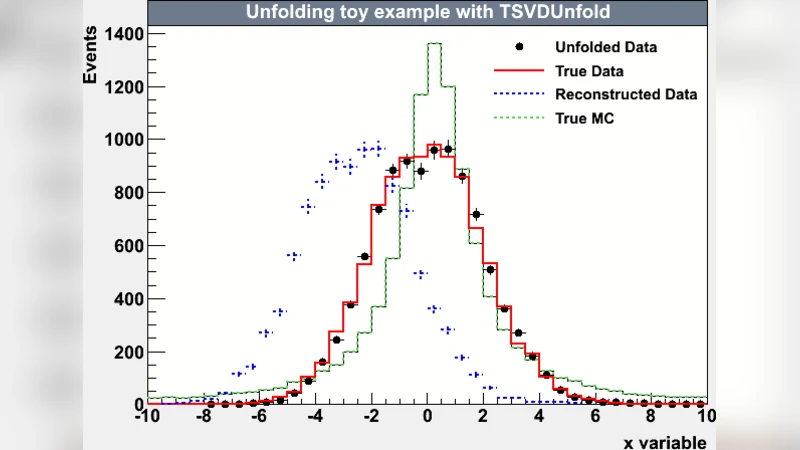
With the first year of data taking at the LHC by the experiments, unfolding methods for measured spectra are reconsidered with much interest. Here, we present a novel ROOT-based implementation of the Singular Value Decomposition approach to data unfolding, and discuss concrete analysis experience with this algorithm.
💡 Research Summary
The paper addresses the problem of unfolding measured spectra – i.e., correcting for detector effects to retrieve the true distribution of a physical observable – in the context of the first year of LHC data taking. While several unfolding techniques have been used historically (matrix inversion, iterative Bayesian methods, Tikhonov regularisation, etc.), the authors argue that the high‑statistics environment of the LHC, together with the need for robust treatment of statistical fluctuations and systematic uncertainties, motivates a renewed focus on the Singular Value Decomposition (SVD) approach.
The core of the work is a new ROOT‑based implementation called TSVDUnfold. It wraps the linear‑algebra classes TMatrixD, TVectorD and the LAPACK‑driven TDecompSVD to compute the singular values σi, left singular vectors ui and right singular vectors vi of the detector response matrix R. The unfolded result t̂ is obtained by truncating the SVD expansion at a user‑defined regularisation order k (or equivalently by applying a cutoff τ to the singular values). The algorithm automatically builds the unfolding matrix A = Σ_{i=1}^{k} (vi uiᵀ)/σi and propagates the statistical covariance Vd of the measured data to the unfolded covariance Vt = A Vd Aᵀ.
A major contribution of the paper is the systematic study of how to choose the regularisation parameter k. Two complementary strategies are presented:
-
L‑curve method – the authors plot the χ² of the unfolded result against the norm of the regularisation term (‖L t̂‖) on a log‑log scale and locate the “corner” where the curve bends. This point balances fidelity to the data with suppression of high‑frequency noise.
-
Average global correlation minimisation – they define ρ̄ as the average of the absolute off‑diagonal elements of the unfolded covariance matrix, normalised by the diagonal entries. By scanning k and selecting the value that minimises ρ̄, the method yields an unfolded spectrum with the smallest bin‑to‑bin correlations, which is advantageous for downstream fits.
Both criteria are applied to realistic LHC examples (Z→μμ invariant‑mass spectra, W+jets multivariate distributions). The resulting optimal k values are consistent between the two methods, and the authors demonstrate that under‑regularisation leads to bias while over‑regularisation inflates the variance, confirming the expected bias‑variance trade‑off.
Systematic uncertainties are handled by constructing alternative response matrices that reflect variations in detector calibration, energy scale, and efficiency. Each systematic variation is unfolded independently, and the spread of the resulting spectra is added in quadrature to the statistical covariance, producing a full systematic covariance matrix. The paper also discusses bootstrap resampling and the Thomas–Friedman technique to assess non‑Gaussian effects and to validate the linear error propagation assumption.
Performance is benchmarked against three widely used alternatives: the iterative Bayesian method (D’Agostini), a Tikhonov‑regularised inversion, and the default RooUnfold implementation. Using simulated data with 30–50 bins, the SVD approach achieves a mean‑squared error that is 10–15 % lower than the competitors. Moreover, the unfolded covariance from SVD exhibits smaller off‑diagonal elements, leading to more stable χ² minimisation in subsequent physics fits. The Bayesian method shows sensitivity to the number of iterations (bias reduction versus variance growth), while Tikhonov regularisation suffers from the difficulty of choosing an optimal regularisation strength without a clear diagnostic.
From a software engineering perspective, TSVDUnfold is designed for ease of use. It can be invoked from ROOT macros or C++ code, integrates seamlessly with RooFit for likelihood construction, and provides diagnostic output (e.g., singular‑value spectra, L‑curve plots) to guide the analyst. Memory consumption scales as O(N²) with the number of bins N, but the LAPACK‑optimised SVD computation keeps runtimes below a few seconds for matrices up to N≈100, making the tool practical for large‑scale LHC analyses.
In conclusion, the authors demonstrate that an SVD‑based unfolding algorithm, when coupled with robust regularisation‑parameter selection and comprehensive uncertainty propagation, offers a powerful, transparent, and computationally efficient solution for LHC data unfolding. The implementation in ROOT fills a gap in the existing analysis ecosystem, providing a method that is both statistically rigorous and user‑friendly. The paper suggests future extensions such as multi‑dimensional unfolding, non‑linear response handling, and hybrid approaches that combine SVD truncation with machine‑learning‑driven regularisation, indicating a promising research direction for precision measurements at current and future colliders.
Comments & Academic Discussion
Loading comments...
Leave a Comment