Derived Azumaya algebras and generators for twisted derived categories
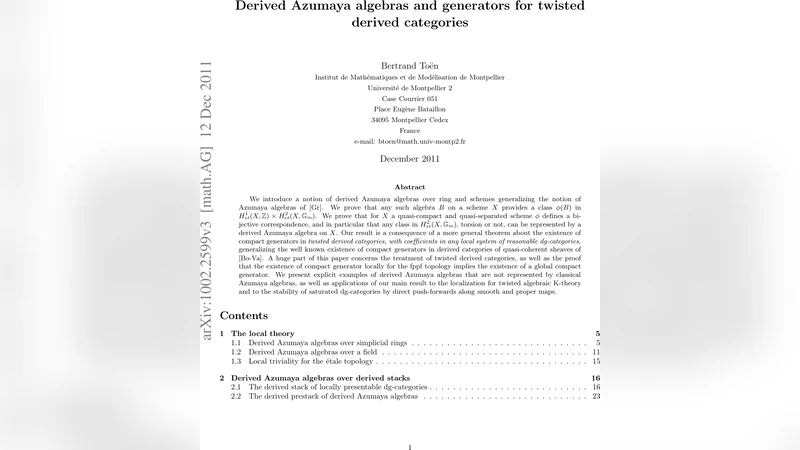
We introduce a notion of derived Azumaya’s algebras over rings and schemes. We prove that any such algebra $B$ on a scheme $X$ provides a class $\phi(B)$ in $H^{1}{et}(X,\mathbb{Z})\times H^{2}{et}(X,\mathbb{G}{m})$. We prove that for $X$ a quasi-compact and quasi-separated scheme $\phi$ defines a bijective correspondence, and in particular that any class in $H^{2}{et}(X,\mathbb{G}_{m})$, torsion or not, can be represented by a derived Azumaya’s algebra on $X$. Our result is a consequence of a more general theorem about the existence of compact generators in \emph{twisted derived categories, with coefficients in any local system of reasonable dg-categories}, generalizing the well known existence of compact generators in derived categories of quasi-coherent sheaves of \cite{bv} (corresponding to the trivial local system of dg-categories). A huge part of this paper concerns the correct treatment of these twisted derived categories, as well as the proof that the existence of compact generators locally for the fppf topology implies the existence of a global compact generator.
💡 Research Summary
The paper introduces the concept of derived Azumaya algebras, a homotopical generalisation of classical Azumaya algebras, and shows how they provide a complete description of the étale cohomology group (H^{1}{\text{et}}(X,\mathbb Z)\times H^{2}{\text{et}}(X,\mathbb G_m)) for a scheme (X). A derived Azumaya algebra (B) over a ringed space (X) is defined by the condition that the derived tensor product (B\otimes^{\mathbb L}_A B^{\mathrm{op}}) is quasi‑isomorphic to the structure sheaf (A). This condition captures a derived Morita equivalence rather than a strict algebraic one, allowing non‑torsion Brauer classes to be represented.
The authors construct a class map
\
Comments & Academic Discussion
Loading comments...
Leave a Comment