Hot gas flows on global and nuclear galactic scales
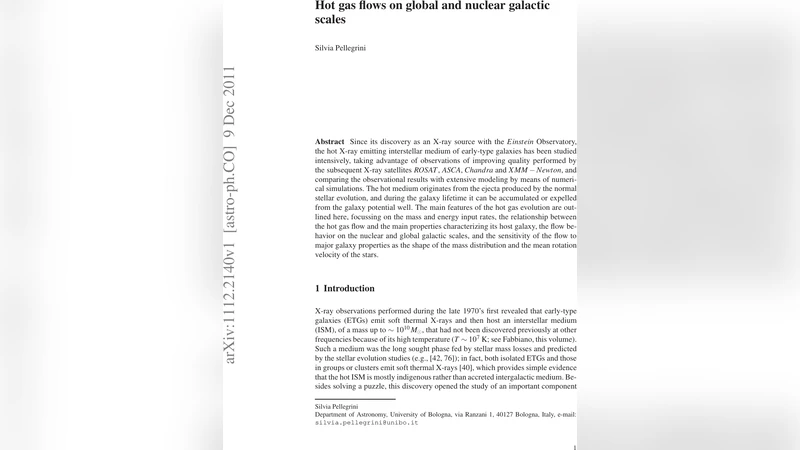
Since its discovery as an X-ray source with the Einstein Observatory, the hot X-ray emitting interstellar medium of early-type galaxies has been studied intensively, with observations of improving quality, and with extensive modeling by means of numerical simulations. The main features of the hot gas evolution are outlined here, focussing on the mass and energy input rates, the relationship between the hot gas flow and the main properties characterizing its host galaxy, the flow behavior on the nuclear and global galactic scales, and the sensitivity of the flow to the shape of the stellar mass distribution and the mean rotation velocity of the stars.
💡 Research Summary
The paper provides a comprehensive review of the hot, X‑ray emitting interstellar medium (ISM) that pervades early‑type galaxies (ETGs). Since its discovery with the Einstein Observatory, increasingly sophisticated X‑ray observations (ROSAT, ASCA, Chandra, XMM‑Newton) have revealed that the hot gas, with temperatures of order 10⁷ K, exhibits a wide range of X‑ray luminosities (L_X) at a given optical luminosity (L_B). The author examines the physical processes that feed and heat this gas, the gravitational energy budget that determines whether the gas flows outward in a wind or inward in a cooling inflow, and how these flows differ on global (galaxy‑wide) and nuclear (central few parsecs) scales.
Mass input – Evolved stars lose mass through red‑giant, asymptotic‑giant‑branch, and planetary‑nebula phases. Observations (e.g., ISO far‑infrared data) give a specific mass‑loss rate of ≈7.8 × 10⁻¹² L_B (L_B,⊙) M_⊙ yr⁻¹, which can be expressed as Ṁ_* ≈ 10⁻¹² A M_* t⁻¹ (Eq. 1) with A≈2 (Salpeter IMF) or 3.3 (Kroupa IMF). The rate declines roughly as t⁻¹ after a few Gyr.
Energy input – Type Ia supernovae (SNIa) dominate the heating. The SNIa rate scales with the blue luminosity as R_SN ≈ 1.6 × 10⁻¹² L_B t^{-s} yr⁻¹ (Eq. 2), with s≈1.3–1.5. Each event injects 1.4 M_⊙ of ejecta and ≈10⁵¹ erg of kinetic energy. Consequently, the specific heating L_SN/Ṁ_* ≈ 8 × 10⁴⁸ erg M_⊙⁻¹, far exceeding the modest heating supplied by the thermalization of stellar velocity dispersion (L_σ).
Gravitational energy budget – Two key terms are introduced. For inflow, the work done by gravity as gas falls from the galaxy’s potential well to the centre is L_+ grav (Eq. 6). For outflow, the minimum power required to lift the gas out of the potential is L_- grav (Eq. 7). Both can be written in compact form L_± grav = Ṁ_* σ_c² Γ_±(R,β), where σ_c is the central stellar velocity dispersion, R the dark‑to‑stellar mass ratio, β the ratio of dark‑halo to stellar scale radii, and Γ_± are dimensionless functions that vary modestly for realistic galaxy models.
Time evolution of the flow regime – The ratio L_- grav/L_SN evolves as t^{s‑1.33} σ_c² Γ_‑ (Eq. 9). Because s ≈ 1.3–1.5, this ratio generally declines with time: early in a galaxy’s life SNIa heating exceeds the gravitational binding, driving a supersonic wind; later, as the SNIa rate falls, gravity dominates and the flow transitions to a subsonic inflow. This picture naturally explains the observed L_X–L_B correlation: low‑luminosity galaxies (L_B ≲ 3 × 10¹⁰ L_⊙) have L_- grav < L_SN and thus host winds, producing low L_X; massive galaxies have the opposite inequality, leading to gas accumulation and high L_X.
Nuclear scales and the role of the central black hole – The presence of a supermassive black hole (MBH) adds a deep central potential and an additional heating channel (radiative and mechanical feedback). Even if SNIa heating alone cannot prevent early massive inflows, the combined effect of SNIa plus MBH feedback can suppress excessive central gas buildup, consistent with observations of modest nuclear X‑ray luminosities in many ETGs.
Impact of galaxy shape and rotation – Flattening reduces the depth of the potential (lower Γ_‑), making outflows easier; thus, flattened, fast‑rotating galaxies tend to have lower L_X at a given L_B. Rotation introduces centrifugal support, further inhibiting inflow and favoring the formation of a cool gas disc, which can fuel residual star formation.
Observational comparison – Figure 2 juxtaposes the theoretical L_SN, L_- grav, and the observed L_X–L_B data from Chandra and XMM‑Newton, showing good agreement. The model reproduces the large scatter in L_X as a consequence of variations in σ_c, galaxy flattening, rotation, and MBH mass.
Conclusions – The hot‑gas flow in ETGs is governed by a delicate balance among stellar mass loss, SNIa heating, gravitational binding, central black‑hole feedback, and the galaxy’s structural and kinematic properties. Low‑mass, flattened, rapidly rotating systems favor winds and weak X‑ray emission, whereas massive, round, slowly rotating galaxies retain hot gas, develop inflows, and become X‑ray bright. This framework unifies a broad range of observational phenomena and provides a solid basis for future hydrodynamical simulations and multi‑wavelength studies.
Comments & Academic Discussion
Loading comments...
Leave a Comment