Topologies on $X$ as points in $2^{mathcal{P}(X)}$
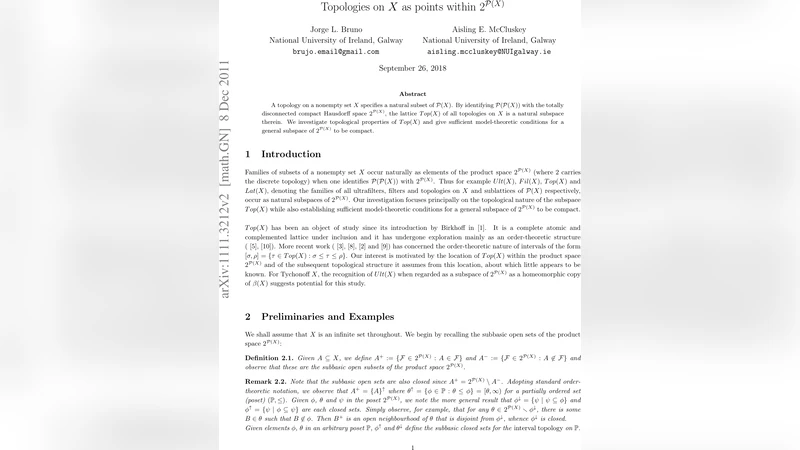
A topology on a nonempty set $X$ specifies a natural subset of $\mathcal{P}(X)$. By identifying $\mathcal{P}(\mathcal{P}(X))$ with the totally disconnected compact Hausdorff space $2^{\mathcal{P}(X)}$, the lattice $Top(X)$ of all topologies on $X$ is a natural subspace therein. We investigate topological properties of $Top(X)$ and give sufficient model-theoretic conditions for a general subspace of $2^{\mathcal{P}(X)}$ to be compact.
💡 Research Summary
The paper studies the collection Top(X) of all topologies on an infinite set X by embedding it into the product space 2^{𝒫(X)} (the set of all subsets of 𝒫(X) equipped with the product of the discrete two‑point space). This identification treats each topology as a point of 2^{𝒫(X)} and uses the basic open sets
A⁺ = {F ∈ 2^{𝒫(X)} | A ∈ F} and A⁻ = {F ∈ 2^{𝒫(X)} | A ∉ F}. These are both open and closed, reflecting the order‑theoretic “up‑set” and “down‑set” constructions in the Boolean algebra 𝒫(X).
The authors first give several natural closed subsets of Top(X). For example, the set of all T₁ topologies is closed because every T₁ topology must contain the co‑finite topology, which can be expressed as an intersection of basic open sets. Similarly, for any function f :X→X, the families of topologies that make f continuous, open, or closed are all closed in Top(X). These examples illustrate that while Top(X) itself is not closed, many interesting subfamilies are.
Next, the paper introduces several families of sublattices of 𝒫(X):
- Lat(X) = all sublattices,
- Lat(X,∨) and Lat(X,∧) = join‑complete and meet‑complete sublattices, respectively, and
- Lat_B(X) = sublattices containing both ∅ and X.
Lemma 3.2 shows that Lat(X) is closed in 2^{𝒫(X)} and that the join‑complete and meet‑complete families are dense in Lat(X). Proposition 3.3 proves that Lat_B(X) is a compactification of Top(X); it is closed (hence compact) and Top(X) is dense in it.
From this, Corollary 3.4 deduces that Top(X) is not closed in 2^{𝒫(X)} and therefore not compact. Lemma 3.5 shows that Top(X) has empty interior inside Lat_B(X); any basic neighbourhood of a topology can be enlarged to a sublattice that fails to be join‑complete, so it lies outside Top(X). Consequently, Top(X) is not locally compact (Corollary 3.6). Corollary 3.7 states that Top(X) is both dense and co‑dense in Lat_B(X), meaning its complement is also dense.
The second major part of the paper uses model theory. Working in the first‑order language L of Boolean algebras, the authors add a unary predicate P to obtain L(P). A set F ⊆ 2^{𝒫(X)} is said to be defined by a sentence Φ if (𝒫(X),F) models Φ. Theorem 3.9 proves that any subspace defined by a universal sentence (a sentence of the form ∀x₁…∀xₙ ψ) is compact in 2^{𝒫(X)}. The proof reduces the universal sentence to a conjunction of atomic or negated atomic formulas; failure of any such formula yields a basic open set disjoint from the defined subspace, establishing compactness. Corollary 3.10 extends this to finite or infinite collections of universal sentences.
However, Corollary 3.11 shows that Top(X) cannot be defined by any set of universal sentences; thus the compactness result does not apply to Top(X). The authors discuss that some compact subsets (e.g., families of almost‑disjoint subsets A_κ) require the unary predicate to express cardinality constraints, illustrating the necessity of the expanded language.
In summary, the paper establishes that Top(X) as a subspace of 2^{𝒫(X)} is neither closed nor compact nor locally compact, yet it sits densely and co‑densely inside the natural compactification Lat_B(X). Moreover, it demonstrates a clear model‑theoretic criterion: universal definability guarantees compactness, but Top(X) lies beyond this class. The work blends order‑theoretic, topological, and logical perspectives to give a nuanced picture of the space of all topologies on a set.
Comments & Academic Discussion
Loading comments...
Leave a Comment