SLA Establishment with Guaranteed QoS in the Interdomain Network: A Stock Model
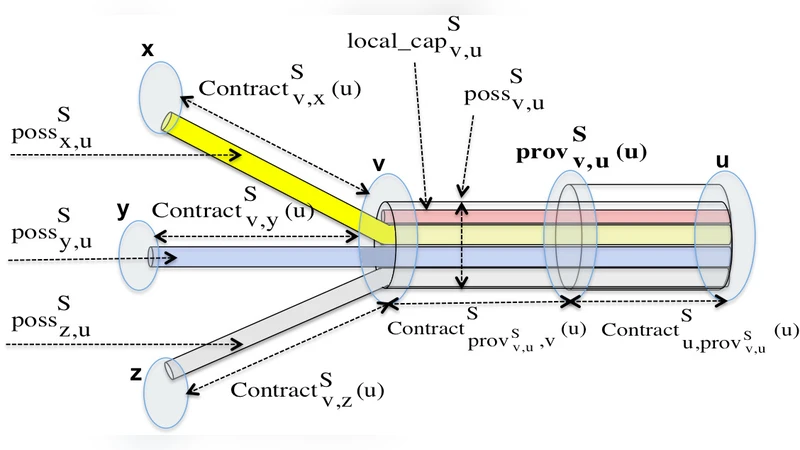
The new model that we present in this paper is introduced in the context of guaranteed QoS and resources management in the inter-domain routing framework. This model, called the stock model, is based on a reverse cascade approach and is applied in a distributed context. So transit providers have to learn the right capacities to buy and to stock and, therefore learning theory is applied through an iterative process. We show that transit providers manage to learn how to strategically choose their capacities on each route in order to maximize their benefits, despite the very incomplete information. Finally, we provide and analyse some simulation results given by the application of the model in a simple case where the model quickly converges to a stable state.
💡 Research Summary
The paper introduces a novel “stock model” for establishing Service Level Agreements (SLAs) with guaranteed Quality of Service (QoS) in inter‑domain routing. Traditional approaches to SLA negotiation in the Internet often rely on centralized mechanisms or single‑stage negotiations, which do not reflect the distributed nature of autonomous systems (ASes) that have only partial information about the network. To address these shortcomings, the authors propose a reverse‑cascade, distributed framework in which each AS independently learns how much capacity to purchase, retain, and resell to its neighbors.
Network and Contract Modeling
The inter‑domain network is represented as an undirected graph G(V,E). Each vertex v (an AS) is characterized by a maximum capacity cap(v) and a transmission delay d(v). An SLA contract between two neighboring ASes contains six attributes: minimum and maximum capacity, availability period, start time, transmission delay, and unit price. Capacity usage at a node is split into three categories: cap_IN (traffic forwarded from other ASes), cap_OUT (traffic generated locally), and cap_IN_OUT (traffic that passes through the node toward other destinations). The sum of these three must not exceed cap(v).
Stock Model and Reverse Cascade
When an AS purchases a route to a destination, it divides the acquired capacity into “local_cap” (kept for its own traffic) and “unused_cap” (available for resale). The unused portion can be offered to neighboring ASes, but an AS may never sell a route back to its own provider. The reverse‑cascade approach means that the provider at the top of the path (the destination’s service provider) first acquires capacity, then each downstream AS successively purchases a portion of that capacity and may resell the remainder to its own customers. This creates a chain of contracts that propagate from the destination toward the source.
Negotiation Protocol
Four message exchanges constitute a negotiation round:
- Offer – the provider advertises available capacity, time block, and price.
- Demand – the customer replies with a desired amount within the advertised min/max range.
- Confirmation – the provider validates the request and confirms the price.
- Contract – both parties sign a contract that records capacity, delay, cost, availability, and start time.
These steps are executed iteratively for each adjacent pair, moving backward along the path (reverse cascade). The process repeats until every AS’s utility (benefit per unit capacity) exceeds the incurred cost and the route delay stays below the node’s max_delay threshold.
Learning Theory Integration
Because each AS possesses only local information, the authors embed a reinforcement‑style learning rule into the negotiation loop. After each round, an AS updates its strategy (the amount it will offer or request in the next round) based on the observed payoff: if the previous contract yielded a positive surplus (utility – cost) and satisfied delay constraints, the AS slightly increases its offered quantity; otherwise, it reduces it. This adaptive rule is proven to converge to a Nash equilibrium in similar games with incomplete information (citing prior work
Comments & Academic Discussion
Loading comments...
Leave a Comment