The Dynamics of Internet Traffic: Self-Similarity, Self-Organization, and Complex Phenomena
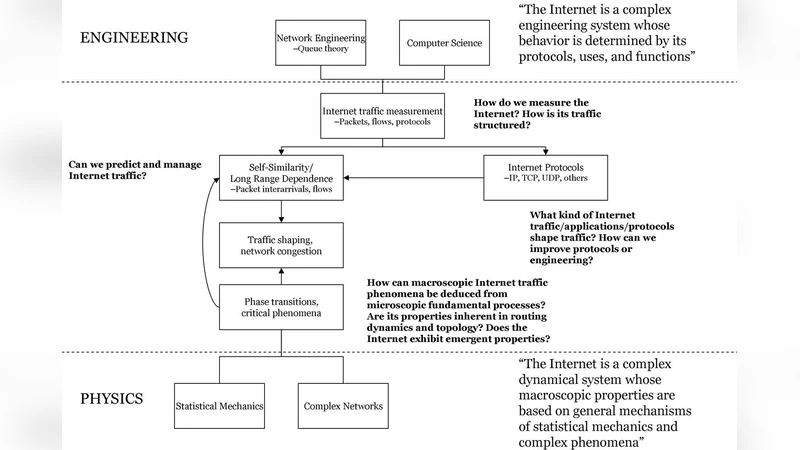
The Internet is the most complex system ever created in human history. Therefore, its dynamics and traffic unsurprisingly take on a rich variety of complex dynamics, self-organization, and other phenomena that have been researched for years. This paper is a review of the complex dynamics of Internet traffic. Departing from normal treatises, we will take a view from both the network engineering and physics perspectives showing the strengths and weaknesses as well as insights of both. In addition, many less covered phenomena such as traffic oscillations, large-scale effects of worm traffic, and comparisons of the Internet and biological models will be covered.
💡 Research Summary
The paper presents a comprehensive review of Internet traffic dynamics from both network engineering and physics perspectives, emphasizing the system’s status as the most complex man‑made structure. It begins by outlining the historical development of interdisciplinary research, noting that physicists have applied tools from statistical mechanics, percolation theory, spectral graph analysis, and complex‑network science to study Internet topology (small‑world, scale‑free) and traffic behavior, while engineers have focused on protocol design, performance measurement, and operational issues. The authors argue that a persistent gap exists: each community often works in isolation, publishing in discipline‑specific venues and rarely cross‑citing relevant work from the other field, which hampers the synthesis of theory and practice.
The review then provides a detailed primer on the fundamentals of Internet traffic. It explains the OSI seven‑layer model, packet structure (link, IP, TCP/UDP headers, payload), and the distinction between raw throughput, goodput, packet flow rate, session, flow, packet loss, and round‑trip time (RTT). Precise definitions are crucial because many physics‑based models assume idealized packet sizes and ignore protocol overhead, leading to mismatches when comparing with real‑world measurements.
A major focus is on self‑similarity and multifractality in traffic. The authors trace the discovery of long‑range dependence (Hurst parameter) in the mid‑1990s and summarize measurement techniques such as R/S analysis, power‑spectral density, wavelet‑based multifractal spectra, and detrended fluctuation analysis. They discuss how TCP congestion control mechanisms (slow start, additive increase/multiplicative decrease, ACK pacing, ECN, modern algorithms like BBR) interact with traffic bursts, potentially moving the system toward or away from a critical point. From the physics side, the paper links these observations to concepts of phase transitions, scaling laws, and universality classes, suggesting that Internet traffic may exhibit a kind of non‑equilibrium criticality.
Beyond well‑studied phenomena, the review highlights two relatively under‑explored topics: traffic oscillations and large‑scale worm epidemics. Traffic oscillations are described as emergent periodicities arising from nonlinear feedback between router buffer dynamics and TCP window adjustments. The authors reference Hopf bifurcation analysis to identify stability boundaries and predict oscillation frequencies. Worm traffic is modeled analogously to epidemiological SIR models, capturing rapid packet bursts, network saturation, and the effectiveness of containment strategies. Both cases illustrate the limits of mean‑field approximations and the need for agent‑based simulations coupled with real‑time monitoring.
The paper also draws parallels between Internet traffic and biological networks, noting that self‑organization and critical phenomena appear in neuronal spike propagation, vascular flow regulation, and ecological food webs. These analogies reinforce the idea that similar feedback mechanisms can generate complex, scale‑free patterns across disparate domains, opening avenues for cross‑disciplinary theory transfer.
In the concluding section, the authors propose concrete steps to bridge the engineering‑physics divide: joint workshops, special issues in cross‑disciplinary journals, shared open‑source traffic datasets, and standardized benchmark scenarios. They outline a future research roadmap that includes (1) upgrading real‑time traffic measurement infrastructures, (2) rigorously validating physics‑based models against packet‑level traces from modern protocols, (3) developing integrated simulation platforms that can capture oscillations, worm spread, and multifractal scaling simultaneously, and (4) exploring bio‑inspired control mechanisms for congestion management.
Overall, the review synthesizes a broad body of literature, clarifies terminology, identifies gaps, and offers a strategic vision for advancing the scientific understanding of Internet traffic as a complex, self‑organizing system.
Comments & Academic Discussion
Loading comments...
Leave a Comment