Spectra of sparse regular graphs with loops
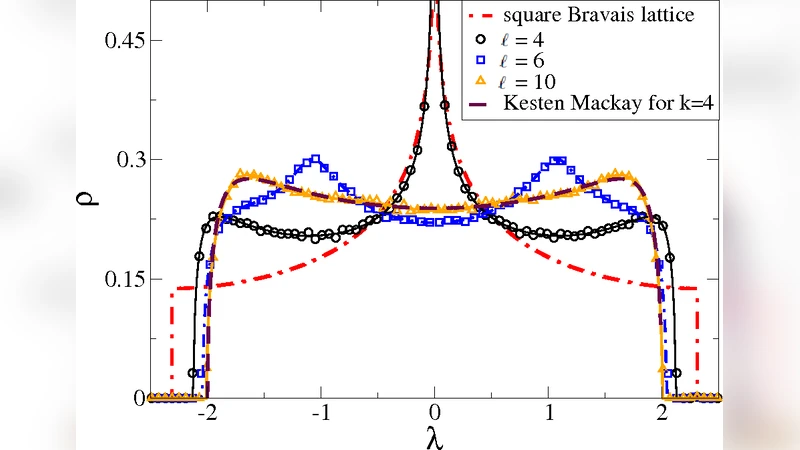
We derive exact equations that determine the spectra of undirected and directed sparsely connected regular graphs containing loops of arbitrary length. The implications of our results to the structural and dynamical properties of networks are discussed by showing how loops influence the size of the spectral gap and the propensity for synchronization. Analytical formulas for the spectrum are obtained for specific length of the loops.
💡 Research Summary
The paper presents an exact analytical treatment of the eigenvalue spectra of sparse regular graphs that contain short loops, focusing on both undirected and directed versions of the so‑called Husimi (or cactus) graphs. A (ℓ, k)‑regular Husimi graph is defined as a random ensemble where each vertex belongs to exactly k loops, each loop comprising ℓ vertices. In the thermodynamic limit (N → ∞) the graph is locally tree‑like at the level of loops, which enables the use of cavity‑type methods to compute the resolvent of the adjacency matrix.
For undirected graphs the authors introduce the resolvent G(z) = (z − J)⁻¹ with a complex argument z = λ − iε. They derive a self‑consistency equation for the diagonal element Gₛ that involves the inversion of an (ℓ − 1)×(ℓ − 1) matrix containing the identity and a matrix L_{ℓ‑1} that encodes the loop connectivity. The spectral density follows from ρ(λ) = (1/π) Im
Comments & Academic Discussion
Loading comments...
Leave a Comment