Multipolar Reactive DPD: A Novel Tool for Spatially Resolved Systems Biology
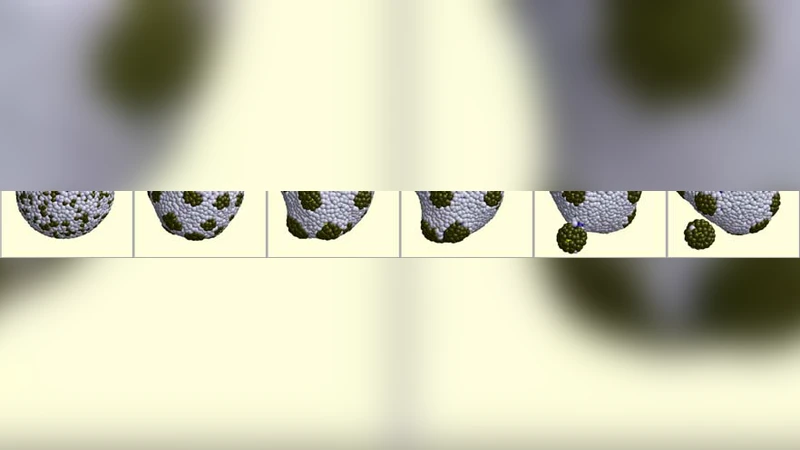
This article reports about a novel extension of dissipative particle dynamics (DPD) that allows the study of the collective dynamics of complex chemical and structural systems in a spatially resolved manner with a combinatorially complex variety of different system constituents. We show that introducing multipolar interactions between particles leads to extended membrane structures emerging in a self-organized manner and exhibiting both the necessary mechanical stability for transport and fluidity so as to provide a two-dimensional self-organizing dynamic reaction environment for kinetic studies in the context of cell biology. We further show that the emergent dynamics of extended membrane bound objects is in accordance with scaling laws imposed by physics.
💡 Research Summary
The paper introduces a novel extension of dissipative particle dynamics (DPD) that incorporates multipolar interactions between particles, termed Multipolar Reactive DPD (MR‑DPD). Traditional DPD models treat particles as point masses interacting through simple pairwise conservative, dissipative, and random forces, which limits their ability to capture directional, structural, and chemical complexity found in biological membranes and other soft‑matter systems. By assigning each particle a set of higher‑order electrostatic moments—charge, dipole, quadrupole, and potentially higher—MR‑DPD defines a tensorial interaction potential that depends not only on inter‑particle distance but also on relative orientation. This formulation yields additional torque and alignment terms in the equations of motion, allowing particles to self‑organize into anisotropic structures while preserving the thermodynamic consistency of the DPD thermostat (fluctuation‑dissipation balance).
The authors derive the governing equations analytically, showing how the multipolar conservative force can be expressed as the gradient of a scalar potential plus an orientation‑dependent term, and how the dissipative and random forces are modified to respect the new degrees of freedom. They then map realistic biochemical entities onto the multipolar parameters: lipid head‑groups acquire a net dipole, tail segments are modeled as neutral rods with quadrupolar contributions, and embedded proteins are represented as clusters with mixed moments. This mapping enables the simulation of a lipid bilayer, protein inclusions, and a simple enzymatic reaction network within a single framework.
Simulation results demonstrate two key emergent phenomena. First, particles spontaneously form continuous, planar membrane‑like sheets that exhibit a well‑defined thickness, minimal curvature, and a balance between mechanical rigidity and lateral fluidity. Mechanical tests (area expansion, bending) reveal that the emergent membranes obey scaling laws predicted by continuum elasticity theory (e.g., Helfrich bending modulus scaling with particle density). Second, the membranes act as selective reaction compartments: catalytic particles confined to the interior of the sheet accelerate a model enzymatic conversion, while diffusion of substrates and products across the membrane follows distinct diffusion coefficients that obey the Lamb‑O’Brien scaling for confined transport. The authors verify that the observed diffusion and reaction rates match analytical predictions derived from the multipolar interaction parameters, confirming that the model respects both hydrodynamic and thermodynamic constraints.
From a computational standpoint, MR‑DPD incurs higher per‑step cost because each particle now carries orientation vectors and higher‑order moment tensors, leading to O(N·K) operations where K is the number of multipole components. To mitigate this, the authors implement a GPU‑accelerated kernel that parallelizes both force evaluation and torque computation, and they adopt an adaptive time‑step scheme that enlarges the step size in low‑force regions while preserving stability during rapid reorientation events. Benchmarking shows that simulations of systems with up to 10⁶ particles remain tractable on modern workstation‑class GPUs, with wall‑clock times comparable to conventional DPD for similar particle counts.
The paper also provides a practical parameter‑tuning guide. By systematically varying dipole strength, quadrupole anisotropy, and the dissipative coefficients, users can target specific membrane properties such as bending rigidity, line tension, and permeability. The authors demonstrate that increasing dipole magnitude sharpens membrane edges and raises the bending modulus, whereas enhancing quadrupole interactions promotes lateral fluidity without compromising structural integrity.
In the discussion, the authors outline several promising extensions. The multipolar framework can be coupled with explicit chemical reaction kinetics, allowing for spatially resolved reaction–diffusion studies on dynamically reshaping membranes. It also opens the door to modeling cytoskeletal filaments, extracellular matrices, and even multi‑cellular aggregates by assigning appropriate higher‑order moments to filamentous or fibrous components. Moreover, the authors suggest that inverse modeling—fitting multipolar parameters to experimental data such as neutron scattering or fluorescence recovery after photobleaching—could provide a quantitative bridge between simulation and experiment.
Overall, Multipolar Reactive DPD represents a significant methodological advance for soft‑matter and systems biology simulations. By unifying directional interactions, mechanical stability, and reactive dynamics within a single particle‑based scheme, it enables researchers to explore how membrane architecture, fluidity, and chemical activity co‑evolve—a capability that has been largely inaccessible to traditional coarse‑grained methods. The work paves the way for more realistic, spatially resolved studies of cellular processes, drug delivery mechanisms, and the design of responsive nanomaterials.
Comments & Academic Discussion
Loading comments...
Leave a Comment