Global Transients in ultraviolet and red-infrared ranges from data of the "Universitetsky-Tatiana-2" satellite
Detectors of fast flashes (duration of 1-128 ms) in near ultraviolet (240-400 nm) and red-infrared (>610 nm) ranges on board the “Universitetsky-Tatiana-2” satellite have measured transient luminous events global distribution. Events with number of photons 10^20-5{\cdot}10^21 radiated in the atmosphere are uniformly distributed over latitudes and longitudes. Events with number of photons more than 5{\cdot}10^21 are concentrated near the equator above continents. Measured ratio of photons number radiated in red-IR range to photons number radiated in UV related to excitation of nitrogen molecular indicates a high altitude (>50 km) of the atmospheric electric discharges responsible for the observed transients. Series of every minute transients (from 3 to 16 transients in the series) were observed. The detection of transients out of thunderstorm area, in cloudless region- sometimes thousands km away of thunderstorms is remarkable. The obtained data allow us to assume that transient events are not only consequences of lightning in event-by-event way but they are the result of “long distance” influence of thunderstorm electric activity causing breakdowns in the upper atmosphere (at altitudes >50 km).
💡 Research Summary
The paper presents a comprehensive analysis of transient luminous events (TLEs) observed from the “Universitetsky‑Tatiana‑2” satellite during the period October 2009 – January 2010. The satellite, in a sun‑synchronous polar orbit at 820‑850 km altitude, carried two photomultiplier‑tube (PMT) detectors: one sensitive to near‑ultraviolet (240‑400 nm) and the other to red‑infrared (>610 nm). Each detector viewed a nadir‑directed circular area of about 300 km diameter (≈7 × 10⁴ km²). Signals were digitized every microsecond and summed over 128 ms intervals, with a 1 ms sub‑sample used for event triggering. Every minute the detector selected the trace with the largest 1 ms signal; a threshold of N > 80 ADC counts (≈5 σ above the background) defined a genuine transient.
From 797 night‑side orbits, 2628 transient events were extracted. The raw PMT counts were converted to atmospheric photon numbers (Qₐ) using the known quantum efficiencies (≈20 % for UV, ≈2 % for RI) and a geometric factor (Qₐ/Q ≈ 2.2 × 10¹⁷ for UV). The resulting Qₐ spanned 10²⁰‑10²⁶ photons, corresponding to emitted energies of 5 × 10¹‑5 × 10⁷ J. The differential photon‑number distribution follows a power law with exponent –1 for 10²¹ < Qₐ < 10²³, steepening to –2 above 10²³.
Temporal profiles fell into three categories: (a) short single pulses (1‑5 ms), (b) multiple short pulses within the 128 ms window, and (c) longer, structured flashes lasting tens to hundreds of milliseconds. Low‑photon events (Qₐ < 3 × 10²¹) were predominantly type‑a, whereas high‑photon events (Qₐ > 10²⁴) were mostly type‑c.
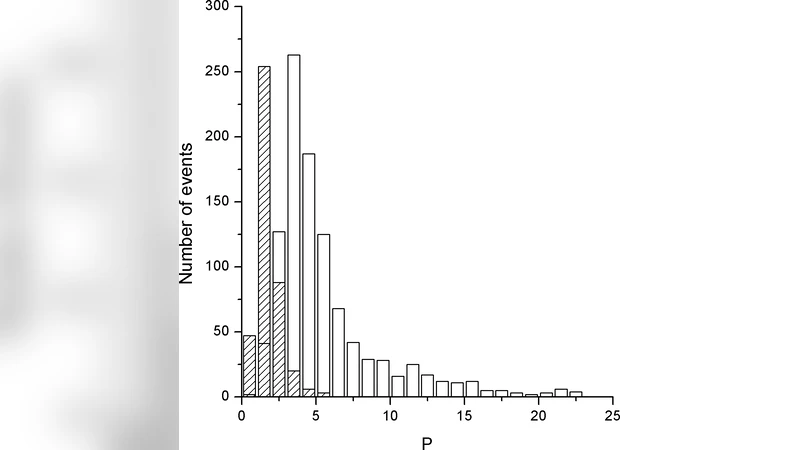
A key diagnostic is the ratio of RI to UV photons (P‑ratio). For short pulses the P‑ratio peaks at 3.6 ± 1.5; for the full 128 ms integration the peak shifts to 1.5 ± 1.5. These values are far below the typical P ≈ 10 measured for lightning return strokes, indicating that the observed emissions are dominated by molecular nitrogen (N₂) band systems (1PN₂ and 2PN₂) rather than atomic oxygen lines. By modeling collisional quenching and altitude‑dependent atmospheric density, the authors related the measured P‑ratio to emission altitude, finding consistency with 50‑80 km, i.e., the lower ionosphere.
Geographically, events with Qₐ < 5 × 10²¹ are distributed relatively uniformly across latitudes and longitudes. In contrast, events exceeding this photon threshold cluster near the equator (0‑30° N/S) above continental masses (America, Africa, Indo‑China). Notably, deserts (Sahara, Australian) and high‑latitude Siberia show a paucity of events. Comparison with infrared cloud maps (3‑hour cadence) revealed that roughly half of the transients occur in cloud‑free regions, challenging the conventional view that each TLE is directly tied to a local lightning discharge.
A striking new phenomenon reported is the occurrence of “series” of transients: sequences of ≥3 events detected at one‑minute intervals along a single orbit. Over 50 % of all transients belong to such series. Series events are more likely to be high‑photon (Qₐ > 5 × 10²¹) and to exhibit longer temporal structures. Importantly, many series extend into cloud‑free areas far (up to several thousand kilometers) from the nearest thunderstorm activity, suggesting a mechanism where lightning-generated electromagnetic pulses propagate upward and trigger breakdowns in the upper atmosphere at considerable horizontal distances. This “long‑distance influence” hypothesis aligns with earlier reports of distant sprites and elves but provides statistical evidence on a global scale.
In summary, the study demonstrates that satellite‑based UV and RI photometry can quantitatively characterize high‑altitude atmospheric discharges. The photon‑number distributions, P‑ratio analysis, and global mapping collectively indicate that a substantial fraction of observed transients originate at 50‑80 km altitude, are not strictly co‑located with thunderstorms, and can occur in organized series possibly driven by remote lightning activity. These findings have significant implications for our understanding of atmospheric electrodynamics, the coupling between tropospheric storms and the ionosphere, and for modeling the global electrical circuit.
Comments & Academic Discussion
Loading comments...
Leave a Comment