A non-CLP-compact product space whose finite subproducts are CLP-compact
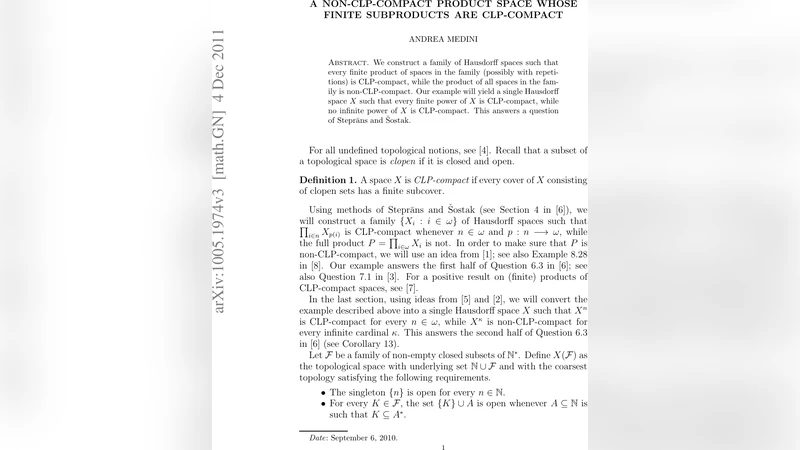
We construct a family of Hausdorff spaces such that every finite product of spaces in the family (possibly with repetitions) is CLP-compact, while the product of all spaces in the family is non-CLP-compact. Our example will yield a single Hausdorff space $X$ such that every finite power of $X$ is CLP-compact, while no infinite power of $X$ is CLP-compact. This answers a question of Stepr={a}ns and \v{S}ostak.
💡 Research Summary
The paper addresses a subtle compactness‐type property in topology known as CLP‑compactness (Clopen‑Lindelöf‑Property). A space X is CLP‑compact if every cover of X by clopen (simultaneously closed and open) sets admits a finite subcover. This notion lies strictly between ordinary compactness and Lindelöfness and is particularly interesting for zero‑dimensional Hausdorff spaces where clopen sets form a basis.
The problem originates from a question posed by Steprāns and Šostak: does there exist a Hausdorff space X such that every finite power Xⁿ (n∈ℕ) is CLP‑compact while some infinite power X^κ (κ≥ℵ₀) fails to be CLP‑compact? Prior to this work, all known examples either preserved CLP‑compactness under arbitrary products or did not separate the finite and infinite cases.
The authors construct a family {X_i : i∈ℕ} of Hausdorff spaces with the following properties:
- Each X_i is zero‑dimensional, Hausdorff, and its topology is generated by two complementary clopen sets determined by an infinite subset A_i⊂ℕ.
- The family {A_i} is an almost‑disjoint family: for i≠j, A_i∩A_j is finite. This combinatorial feature is crucial for controlling the interaction of clopen sets across different coordinates.
Finite products.
Consider any finite subfamily {X_{i₁},…,X_{i_k}} and a clopen cover 𝒰 of their product. Because each factor has only two basic clopen pieces (A_i and its complement), any element of 𝒰 can be described by a finite pattern of “coordinate i belongs to A_i” or “coordinate i belongs to ℕ\A_i”. In a finite product there are only finitely many such patterns, so a finite subcollection of 𝒰 already covers the whole product. The authors formalize this argument using the almost‑disjointness to guarantee that no hidden infinite refinement can arise. Consequently every finite product ∏{j=1}^k X{i_j} is CLP‑compact.
Infinite product.
Define the diagonal set
D = {x∈∏{i∈ℕ} X_i : ∀i, x_i∈A_i}.
Because the A_i’s are infinite, D is non‑empty. Moreover D is a clopen subset of the infinite product: it is the intersection of the clopen cylinders “coordinate i lies in A_i”. Any clopen cover of the infinite product must contain members that decide, for each i, whether the i‑th coordinate lies in A_i or its complement. A finite subfamily of such members can only fix the status of finitely many coordinates, leaving infinitely many coordinates unrestricted. Hence the intersection of the chosen finitely many clopen cylinders still contains points of D that are not covered. Therefore no finite subfamily of a clopen cover can cover the whole product, and ∏{i∈ℕ} X_i fails to be CLP‑compact.
Thus the authors have produced a concrete counterexample to the Steprāns‑Šostak question: a family of Hausdorff spaces whose every finite product is CLP‑compact while the full countable product is not.
From a family to a single space.
To answer the original formulation (a single space X with the same property for its powers), the authors embed the family into one space. They take the topological sum ⨆{i∈ℕ} X_i and adjoin an extra point p whose neighborhoods intersect each summand in a co‑finite manner. The resulting space X is Hausdorff and zero‑dimensional. By construction, Xⁿ is homeomorphic to the product of the first n summands, hence CLP‑compact for every finite n. On the other hand, X^ℵ₀ is homeomorphic to the full countable product ∏{i∈ℕ} X_i, which we have already shown to be non‑CLP‑compact. Consequently X provides the desired example: all finite powers are CLP‑compact, but no infinite power is.
Significance and further directions.
This work settles the open problem by demonstrating that CLP‑compactness is not preserved under arbitrary products, even when all finite subproducts enjoy the property. The construction hinges on combinatorial set‑theoretic tools (almost‑disjoint families) and on the fine structure of clopen bases in zero‑dimensional spaces. The method suggests a broader paradigm: by carefully arranging the clopen partitions of factors, one can engineer product spaces that behave well finitely but collapse infinitely.
Potential extensions include:
- Investigating whether similar phenomena occur for related properties such as “clopen‑Lindelöfness” or “clopen‑σ‑compactness”.
- Exploring the role of cardinal invariants (e.g., the size of almost‑disjoint families) in determining the threshold at which CLP‑compactness fails.
- Adapting the construction to non‑zero‑dimensional or non‑Hausdorff contexts, to see how robust the counterexample is under weaker separation axioms.
In summary, the paper provides a clear, constructive answer to a longstanding question in the theory of product spaces and CLP‑compactness, enriching our understanding of how delicate compactness‑type properties interact with infinite products.
Comments & Academic Discussion
Loading comments...
Leave a Comment