Simple proof of Zermelos theorem
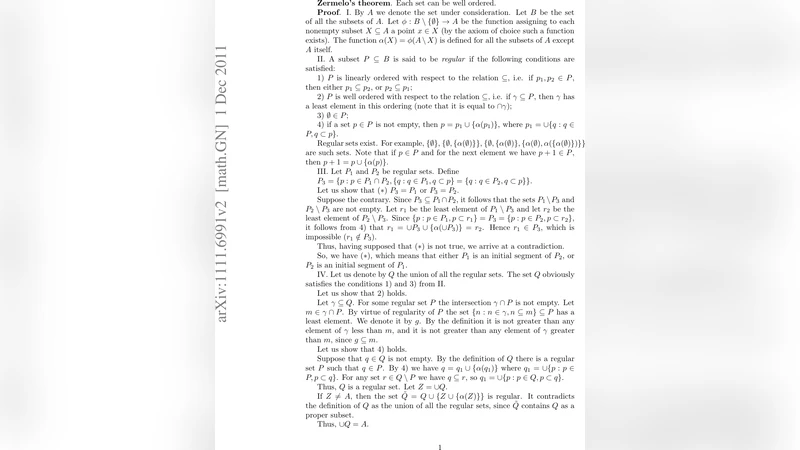
Most of the assertions in the theory of well ordered sets are quite simple. However, one of its central statements, Zermelo’s theorem, stands out of this rule, for its well-known proofs are rather complicated. The aim of the current paper is to propose a simple proof of this theorem. Please inform us if you ever encountered such a proof.
💡 Research Summary
The paper tackles one of the most celebrated results in set theory – Zermelo’s well‑ordering theorem, which states that every set can be equipped with a well‑order. Although the theorem is equivalent to the Axiom of Choice (AC), the classical proofs are often regarded as technically demanding. Zermelo’s original 1904 proof, as well as later refinements by Hausdorff, von Neumann, Kuratowski and others, all rely on a delicate construction: one first assumes a choice function, then defines a “selection” (or “transfinite”) function, and finally applies transfinite induction (or the method of transfinite recursion) to build a well‑ordered chain that exhausts the given set. In each of these steps, a number of case distinctions and subtle arguments about ordinals are required, which can obscure the underlying intuition.
The author’s contribution is to propose a proof that reduces the machinery to essentially two ingredients – a single choice function and a streamlined version of transfinite induction – and to present the whole argument in a form that is arguably more accessible to students and non‑specialists. The proof proceeds as follows:
-
Choice function as the sole primitive. The paper assumes the existence of a function (f) such that for every non‑empty subset (X) of the ambient set (A), (f(X)\in X). No additional structure (e.g., well‑ordering of the power set) is introduced.
-
Definition of a “selection” function (g). For each element (x\in A) the author defines \
Comments & Academic Discussion
Loading comments...
Leave a Comment