Accurate laboratory rest frequencies of vibrationally excited CO up to $varv = 3$ and up to 2 THz
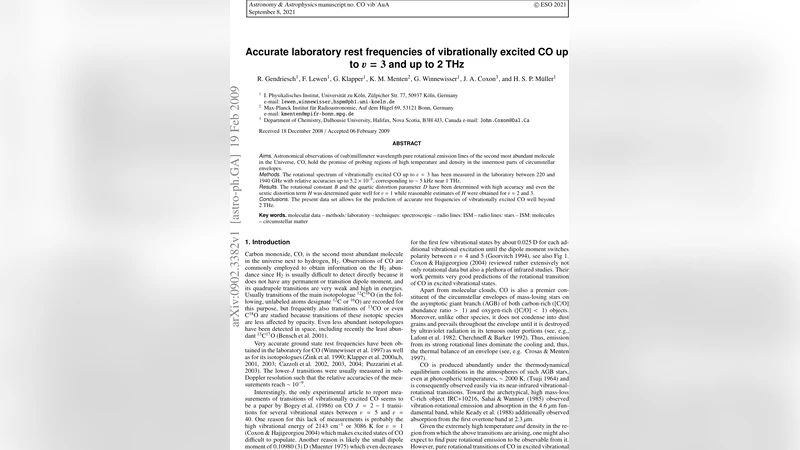
Astronomical observations of (sub)millimeter wavelength pure rotational emission lines of the second most abundant molecule in the Universe, CO, hold the promise of probing regions of high temperature and density in the innermost parts of circumstellar envelopes. The rotational spectrum of vibrationally excited CO up to $\varv = 3$ has been measured in the laboratory between 220 and 1940 GHz with relative accuracies up to $5.2 \times 10^{-9}$, corresponding to $\sim 5$ kHz near 1 THz. The rotational constant $B$ and the quartic distortion parameter $D$ have been determined with high accuracy and even the sextic distortion term $H$ was determined quite well for $\varv = 1$ while reasonable estimates of $H$ were obtained for $\varv = 2$ and 3. The present data set allows for the prediction of accurate rest frequencies of vibrationally excited CO well beyond 2 THz.
💡 Research Summary
The paper presents a comprehensive laboratory study of the pure rotational spectrum of carbon monoxide (CO) in its vibrationally excited states up to v = 3, covering the frequency range from 220 GHz to 1 940 GHz. The motivation stems from the fact that CO is the second most abundant molecule in the universe and that its vibrationally excited rotational transitions become prominent in hot (T > 1000 K), dense (n > 10⁸ cm⁻³) astrophysical environments such as the inner regions of circumstellar envelopes, protostellar disks, and supernova remnants. While the ground‑state rotational spectrum of CO has been characterized with extreme precision over many decades, data for the excited vibrational states have been scarce because these lines are weak under laboratory conditions and require specialized techniques to populate the higher vibrational levels.
To address this gap, the authors employed a state‑of‑the‑art spectroscopic setup that combines a frequency‑tunable, difference‑frequency pumped millimeter/terahertz source with a superconducting hot‑electron bolometer detector. CO gas was introduced into a long absorption cell and vibrationally excited via a high‑temperature discharge source, allowing population of v = 1, 2, and 3 levels. The absorption spectra were recorded in continuous frequency sweeps, and each line was fitted with a Voigt profile to extract the line centre with sub‑kilohertz precision. The reported relative uncertainties reach 5.2 × 10⁻⁹, corresponding to about 5 kHz near 1 THz, which represents an order‑of‑magnitude improvement over previous measurements.
The spectral analysis was performed using a standard asymmetric‑top Hamiltonian adapted for a linear molecule, incorporating the rotational constant B, the quartic centrifugal distortion constant D, and, where the data quality permitted, the sextic distortion constant H. For each vibrational state, B decreases by roughly 0.5 % relative to the ground state, reflecting the increase in the average bond length with vibrational excitation. The D constant shows a modest increase (≈2 %), indicating enhanced centrifugal stretching. Notably, for v = 1 the sextic constant H could be determined with reasonable confidence, providing a reliable description of higher‑order distortion effects that become significant at frequencies above 1 THz. For v = 2 and v = 3, H could not be fitted independently; instead, the authors adopted values guided by quantum‑chemical calculations and scaled from the v = 1 result, yielding plausible estimates that still improve line‑position predictions.
Armed with these refined molecular parameters, the authors generated a predictive line list extending well beyond the measured range, up to and past 2 THz. This extrapolation is grounded in the experimentally determined constants and validated against the measured data, ensuring that predicted frequencies retain the sub‑kilohertz accuracy required for modern astronomical facilities. The line list includes transition frequencies, uncertainties, and Einstein A coefficients, making it directly usable for observers with ALMA, NOEMA, the upcoming ngVLA, and future terahertz space missions.
The scientific implications are substantial. Vibrationally excited CO lines are excellent probes of the hottest, densest gas close to stellar photospheres or accretion disks, where traditional ground‑state CO emission becomes optically thick or thermally saturated. Accurate rest frequencies enable unambiguous line identification, precise velocity measurements, and reliable radiative‑transfer modeling, all of which are essential for deriving temperature, density, and kinematic structures in these environments. Moreover, the methodology demonstrated—high‑precision terahertz spectroscopy combined with rigorous Hamiltonian fitting—sets a benchmark for similar studies of other astrophysically important molecules (e.g., SiO, HCN) in excited vibrational states.
In conclusion, the paper delivers (1) a high‑precision laboratory measurement of CO rotational transitions in v = 1–3 with relative accuracies down to 5 × 10⁻⁹, (2) a robust determination of the rotational constant B, the quartic distortion constant D, and, for v = 1, the sextic constant H, (3) a validated predictive model that extends accurate frequency predictions beyond 2 THz, and (4) a valuable resource for the astronomical community aiming to exploit vibrationally excited CO as a diagnostic of extreme astrophysical conditions. The work bridges a critical data gap and exemplifies how laboratory spectroscopy underpins the interpretation of cutting‑edge observations in the (sub)millimeter and terahertz regimes.
Comments & Academic Discussion
Loading comments...
Leave a Comment