ODE, RDE and SDE Models of Cell Cycle Dynamics and Clustering in Yeast
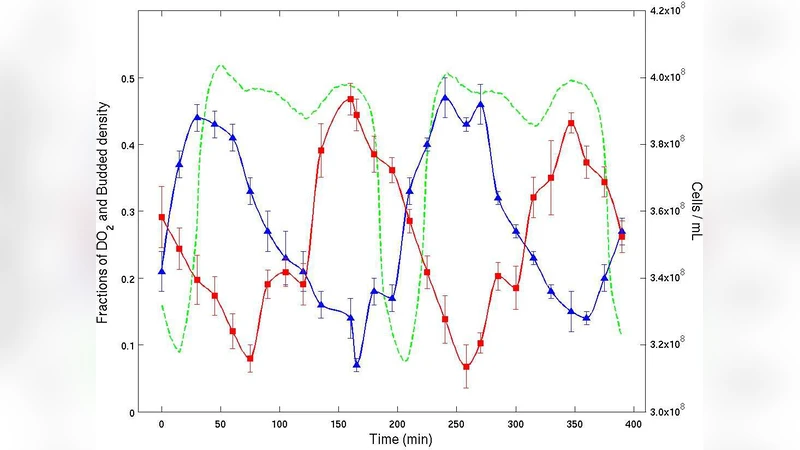
Biologists have long observed periodic-like oxygen consumption oscillations in yeast populations under certain conditions and several unsatisfactory explanations for this phenomenon have been proposed. These “autonomous oscillations” have often appeared with periods that are nearly integer divisors of the calculated doubling time of the culture. We hypothesize that these oscillations could be caused by a weak form of cell cycle synchronization that we call clustering. We develop some novel ordinary differential equation models of the cell cycle. For these models, and for random and stochastic perturbations, we give both rigorous proofs and simulations showing that both positive and negative growth rate feedback within the cell cycle are possible agents that can cause clustering of populations within the cell cycle. It occurs for a variety of models and for a broad selection of parameter values. These results suggest that the clustering phenomenon is robust and is likely to be observed in nature. Since there are necessarily an integer number of clusters, clustering would lead to periodic-like behavior with periods that are nearly integer divisors of the period of the cell cycle.
💡 Research Summary
The paper addresses a long‑standing puzzle in yeast physiology: under certain growth conditions yeast cultures exhibit quasi‑periodic oscillations in dissolved oxygen consumption, often with periods that are close to integer fractions of the measured doubling time. Traditional explanations—metabolic cycles, external environmental cues, or quorum‑sensing mechanisms—have failed to account for the robustness and the near‑integer relationship between the oscillation period and the cell‑cycle time. The authors propose that these oscillations arise from a weak form of cell‑cycle synchronization they term “clustering,” in which subpopulations of cells become concentrated in specific phases of the cell‑cycle, forming a discrete number of clusters. Because the number of clusters must be an integer, the collective behavior naturally yields oscillations whose periods are integer divisors of the cell‑cycle duration.
To test this hypothesis, the authors construct three families of mathematical models: deterministic ordinary differential equations (ODEs), random differential equations (RDEs) incorporating external noise, and stochastic differential equations (SDEs) that also model intrinsic cellular variability. In the ODE framework, the cell‑cycle is represented by a continuous phase variable x∈
Comments & Academic Discussion
Loading comments...
Leave a Comment