Nested Canalyzing Functions And Their Average Sensitivities
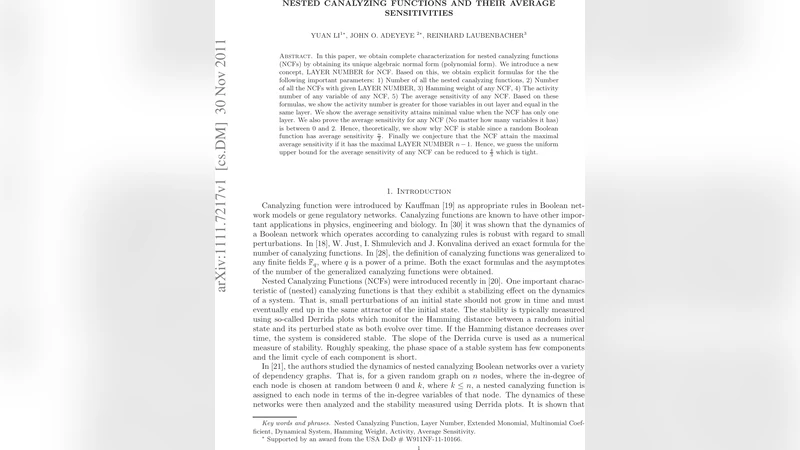
In this paper, we obtain complete characterization for nested canalyzing functions (NCFs) by obtaining its unique algebraic normal form (polynomial form). We introduce a new concept, LAYER NUMBER for NCF. Based on this, we obtain explicit formulas for the the following important parameters: 1) Number of all the nested canalyzing functions, 2) Number of all the NCFs with given LAYER NUMBER, 3) Hamming weight of any NCF, 4) The activity number of any variable of any NCF, 5) The average sensitivity of any NCF. Based on these formulas, we show the activity number is greater for those variables in out layer and equal in the same layer. We show the average sensitivity attains minimal value when the NCF has only one layer. We also prove the average sensitivity for any NCF (No matter how many variables it has) is between 0 and 2. Hence, theoretically, we show why NCF is stable since a random Boolean function has average sensitivity $\frac{n}{2}$. Finally we conjecture that the NCF attain the maximal average sensitivity if it has the maximal LAYER NUMBER $n-1$. Hence, we guess the uniform upper bound for the average sensitivity of any NCF can be reduced to 4/3 which is tight.
💡 Research Summary
This paper provides a comprehensive algebraic and combinatorial study of nested canalyzing functions (NCFs), a class of Boolean functions that play a central role in gene regulatory networks, digital circuit design, and other complex systems. The authors first recall that any Boolean function f : F₂ⁿ → F₂ can be uniquely expressed in algebraic normal form (ANF). They then revisit the classical definition of a canalyzing function—one that, for a given variable xi, returns a fixed output b whenever xi takes a specific value a, regardless of the other inputs—and extend it to the nested case, where a sequence of variables (possibly after a permutation) each has its own canalyzing input–output pair (ai, bi).
The main novelty is the introduction of the Layer Number (denoted r). By carefully analysing the ANF of an NCF, the authors prove that every NCF can be written uniquely as a nested composition of extended monomials:
f(x₁,…,xₙ) = M₁( M₂( … ( M_r ⊕ 1) ⊕ 1) … ) ⊕ b,
where each Mi = ∏{j=1}^{k_i}(x{i_j} ⊕ a_{i_j}) is a product of distinct variables (an “extended monomial”), the sets of variables belonging to different Mi are disjoint, k₁+…+k_r = n, and k_r ≥ 2. The integer r is precisely the Layer Number; the variables appearing in M₁ constitute the first (most dominant) layer, those in M₂ the second layer, and so on. This decomposition is both constructive and unique, providing a canonical representation for any NCF.
Using this representation the authors derive explicit formulas for several important quantitative characteristics:
-
Number of NCFs – By counting the ways to partition the n variables into r ordered blocks of sizes k₁,…,k_r, choosing the a‑parameters for each variable (2 choices each), and selecting the final constant b (2 choices), they obtain a closed‑form expression. For a fixed layer number r the count simplifies to
N_{n,r} = 2^{n‑r} · C(n‑1, k₁‑1, …, k_r‑1),
summed over all compositions (k₁,…,k_r) of n with k_r ≥ 2. -
Hamming weight – The number of input vectors for which f evaluates to 1 is shown to be
wt_H(f) = 2^{n‑1} − 2^{n‑r}.
Thus the weight decreases as the layer number grows, reflecting the increasing “bias” toward the constant output. -
Variable activity – The activity (or influence) of a variable xi depends only on the layer ℓ(i) to which it belongs. If the ℓ‑th layer contains k_ℓ variables, then each of those variables has activity
A_i = 2^{n‑k_ℓ‑1}.
Consequently, variables in more dominant (outer) layers have larger activity, while all variables within the same layer share identical activity. -
Average sensitivity – The average sensitivity S(f) is the sum of all variable activities. Substituting the activity formula yields the remarkably simple expression
S(f) = 2 − 2^{1‑r}.
Hence the minimal sensitivity (S = 0) occurs when r = 1, i.e., the function is a single extended monomial plus a constant; the maximal sensitivity is bounded above by 2 for any r. The authors conjecture that the true maximal average sensitivity among NCFs is attained when r = n‑1 (the maximal possible layer number) and equals 4/3, a value they argue is tight.
These results have immediate implications for dynamical stability. In Boolean network theory, the average sensitivity of a random Boolean function is n/2, which grows linearly with the number of variables and typically leads to chaotic dynamics. By contrast, any NCF has average sensitivity bounded between 0 and 2, independent of n, explaining why networks built from NCFs exhibit robust, ordered behavior (as measured by Derrida plots). The paper also shows that the more layers an NCF possesses, the larger its sensitivity, yet it never exceeds the universal bound of 2.
Beyond the theoretical contributions, the Layer Number framework offers a practical tool for classifying variables by dominance, estimating their influence, and designing Boolean networks with prescribed stability properties. The authors discuss potential applications in systems biology (modeling gene regulation where many rules are empirically observed to be nested canalyzing), digital logic synthesis (where NCFs correspond to decision diagrams with minimal average path length), and complexity theory (where NCFs are linked to unate cascade functions).
In summary, the paper delivers a complete algebraic characterization of NCFs, introduces a novel hierarchical classification (Layer Number), and provides closed‑form formulas for enumeration, Hamming weight, variable activity, and average sensitivity. These results not only deepen the mathematical understanding of NCFs but also substantiate their empirical success in producing stable dynamics across a wide range of scientific and engineering domains.
Comments & Academic Discussion
Loading comments...
Leave a Comment