Non-monotony and Boolean automata networks
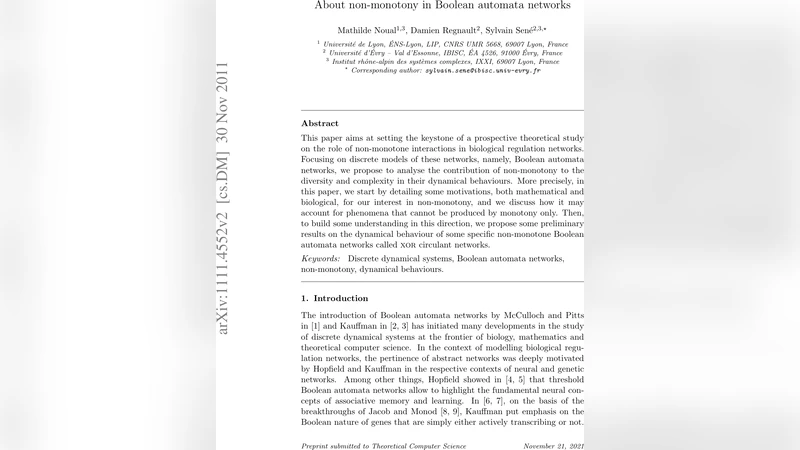
This paper aims at setting the keystone of a prospective theoretical study on the role of non-monotone interactions in biological regulation networks. Focusing on discrete models of these networks, namely, Boolean automata networks, we propose to analyse the contribution of non-monotony to the diversity and complexity in their dynamical behaviours. More precisely, in this paper, we start by detailing some motivations, both mathematical and biological, for our interest in non-monotony, and we discuss how it may account for phenomena that cannot be produced by monotony only. Then, to build some understanding in this direction, we propose some preliminary results on the dynamical behaviour of some specific non-monotone Boolean automata networks called XOR circulant networks.
💡 Research Summary
The paper “Non‑monotony and Boolean automata networks” sets out a research agenda to investigate how non‑monotone interactions affect the dynamics of Boolean automata networks (BANs), which are widely used as discrete models of genetic regulatory systems. The authors begin by reviewing the historical development of Boolean network models, noting that most previous work has focused on monotone networks where each regulatory edge is either purely activating or purely inhibiting. They argue that this assumption overlooks important biological phenomena in which a single gene can act as an activator under some conditions (e.g., low protein concentration) and as an inhibitor under others (high concentration). Such context‑dependent behavior corresponds mathematically to a local transition function that is not monotone with respect to one of its inputs.
To explore the consequences of non‑monotonicity, the authors introduce a concrete class of networks called XOR circulant networks. In these networks each node updates according to an XOR of its two neighbors, and the interaction graph is circulant, meaning every node has the same pattern of connections. The XOR function is inherently non‑monotone because flipping one input can either increase or decrease the output depending on the state of the other input. By focusing on this simple yet representative family, the authors can isolate the effect of non‑monotone logic from other structural complexities.
The paper systematically studies the dynamics of XOR circulant networks under several updating schemes: (i) parallel (synchronous) updating, where all nodes are updated simultaneously; (ii) asynchronous updating, where at each step a single node is chosen arbitrarily; (iii) block‑sequential updating, where subsets of nodes are updated in a fixed order; and (iv) the most general transition graph that includes all possible non‑empty subsets of nodes updated simultaneously. For each scheme the authors examine (a) convergence time (the maximal number of steps needed to reach an attractor from any initial configuration) and (b) the nature of the attractors (fixed points or limit cycles).
Key findings include: under parallel updating every initial configuration falls into a period‑2 limit cycle (alternating 0‑1 patterns), reflecting the global inversion property of the XOR rule when applied simultaneously. Under asynchronous updating the dynamics become richer: the network exhibits an 8‑state cycle that persists regardless of the order of single‑node updates, demonstrating that non‑monotonicity can generate longer periodic behavior even when only one node changes at a time. Block‑sequential schedules also avoid fixed points and produce cycles of length 2 or 4 depending on the order of updates. The authors observe that convergence times grow at most linearly (or logarithmically in some cases) with the network size, and that configurations with higher density of 1’s tend to converge faster because the XOR operation flips more bits per step.
These results illustrate that non‑monotone interactions dramatically expand the repertoire of possible dynamical behaviors compared with monotone BANs, which typically exhibit only fixed points or short cycles under similar update regimes. The presence of non‑monotone functions allows the same input pattern to produce opposite outputs in different contexts, leading to multiple coexisting attractors. This property aligns with biological observations such as bistable switches, multistability in cell‑type decisions, and concentration‑dependent regulation (e.g., the λ‑phage Cro protein acting as both activator and repressor depending on its concentration).
The authors conclude by emphasizing that XOR circulant networks represent only a first step. They propose several future research directions: (1) extending the analysis to broader families of non‑monotone functions (multiple XORs, mixed monotone/non‑monotone gates); (2) investigating the computational complexity of decision problems (reachability, attractor enumeration) in non‑monotone BANs; (3) exploring modularity, i.e., how non‑monotone sub‑networks can be combined while preserving or altering overall dynamics; and (4) validating the theoretical predictions against empirical gene‑regulatory data where concentration‑dependent regulation is known. Overall, the paper argues that incorporating non‑monotone logic is essential for a more realistic and expressive modeling of biological regulatory networks, and it provides initial mathematical tools and concrete examples to launch this line of inquiry.
Comments & Academic Discussion
Loading comments...
Leave a Comment