Spreadsheet on Cloud -- Framework for Learning and Health Management System
Cloud Computing has caused a paradigm shift in the world of computing. Several use case scenarios have been floating around the programming world in relation to this. Applications such as Spreadsheets have the capability to use the Cloud framework to create complex web based applications. In our effort to do the same, we have proposed a Spreadsheet on the cloud as the framework for building new web applications, which will be useful in various scenarios, specifically a School administration system and governance scenarios, such as Health and Administration. This paper is a manifestation of this work, and contains some use cases and architectures which can be used to realize these scenarios in the most efficient manner.
💡 Research Summary
The paper presents a novel approach to repurposing traditional spreadsheet applications as a cloud‑based framework for building complex web services, with a focus on educational administration and health‑care management. The authors begin by describing SocialCalc, a JavaScript‑implemented spreadsheet activity originally designed for the Sugar environment of the One Laptop Per Child (OLPC) project. To enable cloud deployment, they created the XOCOM library, which bridges JavaScript client code with Python server code, allowing seamless integration of features such as real‑time collaborative editing, file import/export, and chat.
The cloud version, named SocialCalcNet, is hosted on Google App Engine. User authentication can be performed via Google accounts or native application accounts, and each login creates a session that tracks the user’s sheets. The system supports opening legacy spreadsheet formats (.xls, .wk4) by converting them into an internal string representation that the spreadsheet engine can manipulate. Collaboration is facilitated through JSON‑based Remote Procedure Calls (RPC): client‑side changes are packaged as command strings and sent to the server, which records them and distributes them to other participants. Currently, the client polls the server at fixed intervals to retrieve updates, a design that could be replaced by push‑based mechanisms in future work.
Beyond the basic collaborative spreadsheet, the authors propose three additional architectural components to enhance scalability and functionality:
-
RPC Connection Port – Acts as a distributed middleware layer, allowing multiple client instances to offload computation and storage to a central server, thereby reducing the load on individual machines.
-
Local Cache/Mirror – Addresses bandwidth constraints inherent in cloud streaming by maintaining a selective cache of frequently accessed data on the RPC server, ensuring that only essential information traverses the network.
-
Auto‑Pilot Engine – Performs server‑side data preprocessing, analytics, and predictive modeling. It synchronizes processed results with a database and delivers them to end‑users in a ready‑to‑display format.
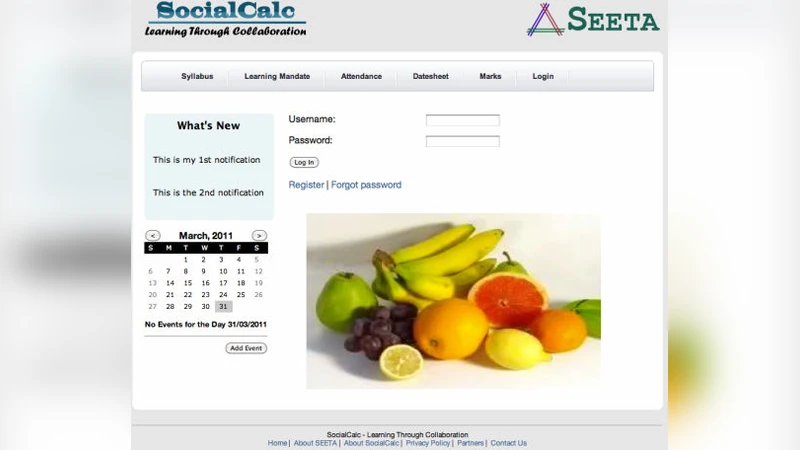
These components collectively enable the spreadsheet to serve as a “chassis” for more sophisticated applications. As a concrete demonstration, the authors built a School Administration System that leverages the collaborative spreadsheet as the core data engine while using CSS and HTML for presentation. The system provides distinct dashboards for students, teachers, and administrators, supporting functionalities such as:
- Learning Mandate – Teachers upload lessons, assignments, and tests; students view and submit work.
- Attendance Management – Real‑time attendance tracking, leave applications, and teacher‑initiated roll calls.
- Calendar Management – Dynamic scheduling of exams, events, and school activities.
- Performance Management – Continuous grade recording and analytics, refreshed as teachers upload marks.
- Collaboration Tools – Real‑time chat and shared spreadsheet editing during classroom sessions.
File interoperability is maintained by allowing uploads of .xls and .wk4 files, which are converted to the internal string format for editing within the web interface. The system thus combines the computational strengths of spreadsheets (formula evaluation, data aggregation) with the collaborative and design capabilities of modern web technologies.
In conclusion, the paper demonstrates that a spreadsheet, when extended with cloud‑native services, RPC mechanisms, and server‑side analytics, can become a versatile platform for building domain‑specific web applications. The proposed architecture offers scalability, modularity, and ease of integration with existing office file formats. Future research directions identified include transitioning from polling to WebSocket‑based push notifications for lower latency collaboration, strengthening security through robust authentication and authorization schemes, optimizing the system for mobile devices, and conducting extensive performance testing under large‑scale user loads. The work contributes a practical blueprint for developers seeking to harness familiar spreadsheet paradigms within contemporary cloud ecosystems.
Comments & Academic Discussion
Loading comments...
Leave a Comment