Minimizing the Risk of Architectural Decay by using Architecture-Centric Evolution Process
Software systems endure many noteworthy changes throughout their life-cycle in order to follow the evolution of the problem domains. Generally, the software system architecture cannot follow the rapid evolution of a problem domain which results in the discrepancies between the implemented and designed architecture. Software architecture illustrates a system’s structure and global properties and consequently determines not only how the system should be constructed but also leads its evolution. Architecture plays an important role to ensure that a system satisfies its business and mission goals during implementation and evolution. However, the capabilities of the designed architecture may possibly be lost when the implementation does not conform to the designed architecture. Such a loss of consistency causes the risk of architectural decay. The architectural decay can be avoided if architectural changes are made as early as possible. The paper presents the Process Model for Architecture-Centric Evolution which improves the quality of software systems through maintaining consistency between designed architecture and implementation. It also increases architecture awareness of developers which assists in minimizing the risk of architectural decay. In the proposed approach consistency checks are performed before and after the change implementation.
💡 Research Summary
The paper addresses the problem of architectural decay that occurs when a software system’s implementation diverges from its intended architecture during the course of evolution. Recognizing that rapid changes in the problem domain often outpace the ability of the architecture to adapt, the authors propose an “Architecture‑Centric Evolution Process” (ACEP) that explicitly integrates architecture evolution with code evolution and enforces consistency checks before and after each change.
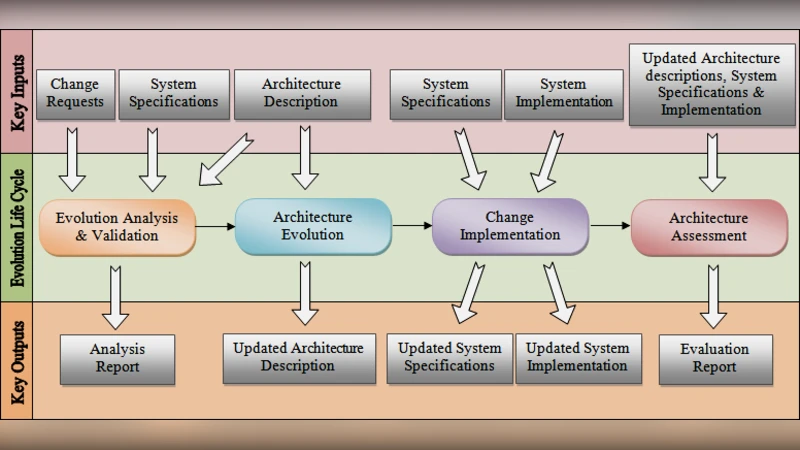
The ACEP model consists of four sequential activities:
-
Evolution Analysis and Validation – Change requests are collected, impact analysis is performed, and the proposed modifications are evaluated against the current architectural description. The analysis yields a risk‑severity assessment and a change plan, ensuring that any potential for architectural decay is identified early.
-
Architecture Evolution – Based on the validation results, the architectural model is updated and versioned. This step modifies architectural artifacts (e.g., component diagrams, connectors, style constraints) to reflect the new requirements while preserving existing constraints.
-
Change Implementation – The updated architecture is realized in the code base and configuration files. Although the paper mentions the possibility of model‑to‑code transformations, it does not provide concrete tooling, implying a largely manual implementation phase.
-
Architecture Assessment – After implementation, the system is re‑examined to verify that the realized code still conforms to the updated architecture. The assessment produces a report highlighting any inconsistencies and quantifying the residual risk of decay.
Each activity is described with explicit inputs and outputs (e.g., change requests, impact analysis reports, architecture descriptions, implementation artifacts) and is illustrated in Figures 3 and 4, which map the data flow across the lifecycle. Table 1 enumerates sub‑activities, reinforcing the systematic nature of the approach.
The authors argue that by iterating these steps, developers maintain a continuous alignment between design and implementation, thereby reducing the likelihood of costly refactoring later in the maintenance phase. The process also aims to raise developers’ awareness of architectural concerns, fostering a culture where architecture is treated as a living artifact rather than a static document.
While the conceptual model is clear and well‑structured, the paper suffers from several notable shortcomings. First, there is no empirical validation: no case studies, benchmarks, or quantitative measurements are presented to demonstrate that ACEP actually reduces maintenance effort or defect rates. Second, the consistency checks are described at a high level, lacking concrete metrics, automated analysis tools, or integration with existing development environments. This raises concerns about scalability to large, industrial‑scale systems. Third, the treatment of non‑functional requirements (performance, security, scalability) is superficial; the paper does not model how changes in these attributes affect architectural stability or how to prioritize refactoring decisions based on them. Fourth, the process assumes that architects can manually keep the architecture model up‑to‑date, which may be unrealistic in fast‑paced agile settings without strong tool support.
In summary, the paper contributes a systematic, four‑stage process for architecture‑centric evolution that emphasizes early detection of architectural drift and continuous alignment between design and code. Its strengths lie in the clear articulation of activities, the emphasis on versioning, and the intent to embed architectural thinking throughout the development lifecycle. However, to become practically valuable, the approach needs empirical evidence, automated consistency‑checking mechanisms, and deeper integration with non‑functional quality attributes. Future work should focus on tool development, large‑scale case studies, and quantitative evaluation of risk reduction to substantiate the claimed benefits.
Comments & Academic Discussion
Loading comments...
Leave a Comment