Constraint Satisfaction Tractability from Semi-lattice Operations on Infinite Sets
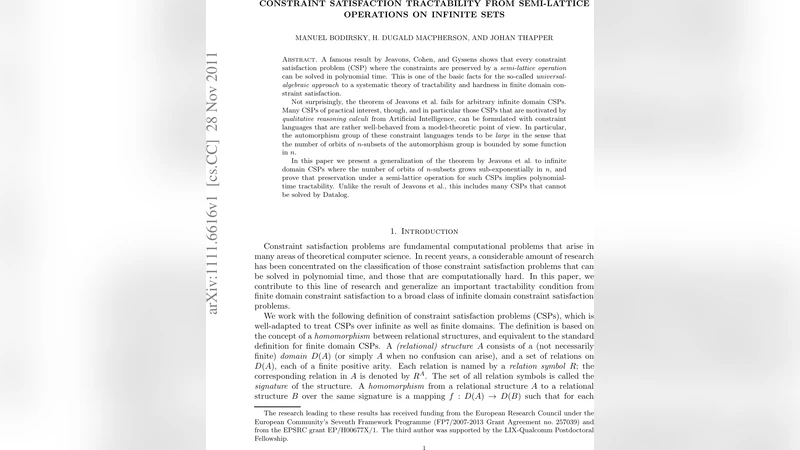
A famous result by Jeavons, Cohen, and Gyssens shows that every constraint satisfaction problem (CSP) where the constraints are preserved by a semi-lattice operation can be solved in polynomial time. This is one of the basic facts for the so-called universal-algebraic approach to a systematic theory of tractability and hardness in finite domain constraint satisfaction. Not surprisingly, the theorem of Jeavons et al. fails for arbitrary infinite domain CSPs. Many CSPs of practical interest, though, and in particular those CSPs that are motivated by qualitative reasoning calculi from Artificial Intelligence, can be formulated with constraint languages that are rather well-behaved from a model-theoretic point of view. In particular, the automorphism group of these constraint languages tends to be large in the sense that the number of orbits of n-subsets of the automorphism group is bounded by some function in n. In this paper we present a generalization of the theorem by Jeavons et al. to infinite domain CSPs where the number of orbits of n-subsets grows sub-exponentially in n, and prove that preservation under a semi-lattice operation for such CSPs implies polynomial-time tractability. Unlike the result of Jeavons et al., this includes many CSPs that cannot be solved by Datalog.
💡 Research Summary
The paper “Constraint Satisfaction Tractability from Semi‑lattice Operations on Infinite Sets” extends a cornerstone result in the algebraic theory of constraint satisfaction problems (CSPs) from finite to certain infinite domains. The classic theorem of Jeavons, Cohen, and Gyssens (1997) states that if a finite relational structure Γ admits a binary semi‑lattice polymorphism—i.e., an operation that is commutative, associative, and idempotent—then the CSP defined by Γ can be solved in polynomial time. This result hinges on the fact that such a polymorphism guarantees that the simple arc‑consistency (or k‑consistency) algorithm is complete for Γ.
When the domain is infinite, the situation changes dramatically. The automorphism group of an infinite structure can have an enormous number of orbits on n‑element subsets, and the original proof technique breaks down. The authors therefore introduce two new ingredients that together restore tractability for a broad class of infinite‑domain CSPs.
1. Sub‑exponential orbit growth.
For a relational structure Γ, let Oₙ(Γ) denote the number of orbits of n‑element subsets under Aut(Γ). The paper calls Γ sub‑exponential if there exists a constant c>1 such that Oₙ(Γ) < cⁿ for all sufficiently large n; equivalently, the orbit count grows slower than any exponential function. All finite structures are trivially sub‑exponential (for n larger than the domain size there are no n‑subsets). The rational order (ℚ;<) and any structure first‑order definable over it are also sub‑exponential because every n‑subset is in a single orbit. By contrast, structures like (ℕ; successor, a distinguished subset U) have exponentially many 2‑subset orbits and are not covered by the theorem.
2. Totally symmetric polymorphisms.
A k‑ary operation f is totally symmetric if its value depends only on the underlying set of arguments, not on their order or multiplicities. Any binary semi‑lattice operation f yields a family of totally symmetric operations fⁿ defined recursively:
fⁿ(x₁,…,xₙ) = f(x₁, f(x₂, …, f(xₙ₋₁, xₙ)…)).
Thus the existence of a semi‑lattice polymorphism implies the existence of totally symmetric polymorphisms of all arities.
The authors’ algorithmic framework consists of two stages:
Sampling stage.
Given an instance A of CSP(Γ) with |A| = n, the algorithm must construct a finite substructure B ⊆ Γ such that for every instance A of size n,
A → Γ ⇔ A → B.
The paper proves that for any countable, sub‑exponential Γ possessing totally symmetric polymorphisms of all arities, such a sampling algorithm exists and runs in time polynomial in n. The construction uses the bounded orbit property: one selects a bounded number of representatives from each orbit of k‑subsets (k being the maximal relation arity). Because the number of orbits is sub‑exponential, the total number of representatives needed is polynomial in n, yielding a finite B of polynomial size.
Consistency stage.
Once B is obtained, the algorithm runs the standard arc‑consistency procedure AC(A,B). The presence of totally symmetric polymorphisms guarantees that AC is complete for the finite template B (Theorem 2.1). Consequently, AC accepts exactly when A maps homomorphically into B, which by the sampling property is equivalent to A mapping into Γ. Since AC runs in O(|A|·|B|) time, the whole procedure runs in polynomial time.
The main formal result (Theorem 1.1) states:
If Γ is a countable relational structure with a finite signature, sub‑exponential orbit growth, and a semi‑lattice polymorphism (equivalently, totally symmetric polymorphisms of all arities), then CSP(Γ) is solvable in polynomial time.
The paper also discusses several important corollaries and limitations:
-
Beyond Datalog.
Some sub‑exponential structures (e.g., (ℚ; {(x,y,z) | x>y ∨ x>z})) are known not to be solvable by any fixed‑arity Datalog program. Nevertheless, they admit a min (or max) semi‑lattice polymorphism, and the authors’ method yields a polynomial‑time algorithm, demonstrating that the new tractability criterion strictly extends Datalog‑based tractability. -
Necessity of the orbit bound.
The authors construct a family of structures Γ_U = (ℕ; successor, 0, U) where min and max are semi‑lattice polymorphisms, but the number of 2‑subset orbits is exponential. By encoding arbitrary subsets U ⊆ ℕ into CSP instances, they show that for some U the problem becomes undecidable. This illustrates that the sub‑exponential orbit condition cannot be dropped. -
Relation to ω‑categoricity.
Every ω‑categorical structure has finitely many orbits of n‑subsets for each n, but not necessarily sub‑exponential growth. The paper proves that for ω‑categorical Γ, the existence of totally symmetric polymorphisms still implies that every finite substructure S satisfies P(S) → Γ (Lemma 2.3). However, a full classification of tractable ω‑categorical CSPs with semi‑lattice polymorphisms remains open; the authors conjecture that any ω‑categorical Γ with a semi‑lattice polymorphism yields a polynomial‑time CSP. -
Algorithmic contribution.
The sampling technique introduced here is a novel tool for infinite‑domain CSPs. It reduces an infinite‑domain instance to a finite one without loss of solutions, provided the structure’s symmetry is sufficiently rich. This reduction, combined with the well‑understood arc‑consistency machinery, gives a clean, uniform algorithmic framework that can be applied to many qualitative reasoning calculi used in AI (e.g., Allen’s interval algebra variants, RCC‑8, etc.) that satisfy the required symmetry conditions.
In summary, the paper bridges a gap between finite‑domain universal algebraic CSP theory and infinite‑domain applications. By identifying sub‑exponential orbit growth as the right structural restriction and leveraging the power of totally symmetric polymorphisms, it extends the classic semi‑lattice tractability theorem to a large and practically relevant class of infinite CSPs, while also clarifying the limits of this approach. The results open new avenues for studying tractability in infinite domains, especially for ω‑categorical structures and qualitative reasoning frameworks.
Comments & Academic Discussion
Loading comments...
Leave a Comment