The gas pixel detector as a solar X-ray polarimeter and imager
The Sun is the nearest astrophysical source with a very intense emission in the X-ray band. The study of energetic events, such as solar flares, can help us to understand the behaviour of the magnetic field of our star. There are in the literature numerous studies published about polarization predictions, for a wide range of solar flares models involving the emission from thermal and/or non-thermal processes, but observations in the X-ray band have never been exhaustive. The gas pixel detector (GPD) was designed to achieve X-ray polarimetric measurements as well as X-ray images for far astrophysical sources. Here we present the possibility to employ this instrument for the observation of our Sun in the X-ray band.
💡 Research Summary
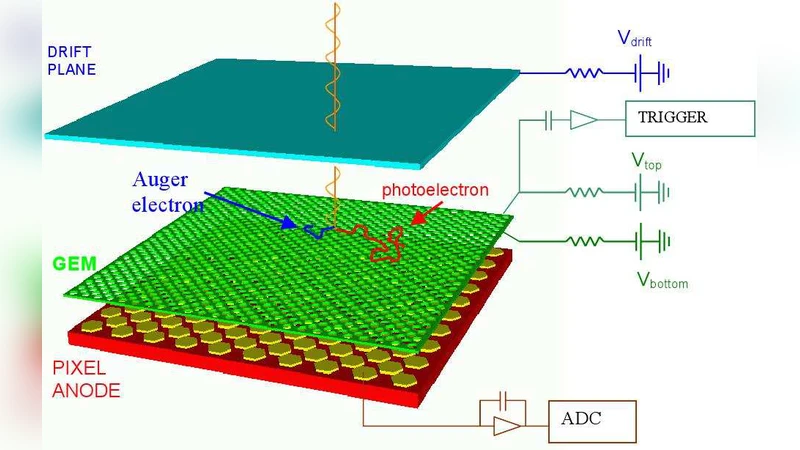
The paper proposes the use of the Gas Pixel Detector (GPD), originally developed for polarimetric imaging of distant astrophysical sources, as a solar X‑ray polarimeter and imager. The GPD operates by allowing X‑ray photons to enter a thin beryllium window and be absorbed in a gas cell (typically a mixture of argon and dimethyl ether). The photo‑electron emitted by the photo‑electric effect creates a track of ionisation electrons that are amplified by a Gas Electron Multiplier (GEM) and read out by a finely pixelated ASIC (105 600 pixels of 50 µm size). Because the azimuthal emission angle φ of the photo‑electron follows a sin²θ cos 2φ distribution, the statistical analysis of many tracks yields both the degree of linear polarization and the polarization angle of the incident radiation. The detector provides an energy resolution of ~20 % at 6 keV, a spatial resolution of ~150 µm (derived from track reconstruction), and does not require mechanical rotation, which simplifies long‑duration observations.
Solar flares emit X‑rays over a broad energy range: soft X‑rays (<10 keV) are dominated by thermal bremsstrahlung from hot plasma, while hard X‑rays (>20 keV) arise from non‑thermal electron beams. Theoretical models predict that non‑thermal emission can be highly polarized (up to 30–40 % at ~20 keV) especially when the flare is near the solar limb, whereas thermal emission is only weakly polarized (a few percent). Detecting this transition in polarization as a function of energy would provide direct insight into particle acceleration and magnetic field geometry during flares.
The authors evaluate the Minimum Detectable Polarization (MDP) for the GPD using the standard formula MDP(99 %) = 4.29 √
Comments & Academic Discussion
Loading comments...
Leave a Comment