Gadgets and Anti-Gadgets Leading to a Complexity Dichotomy
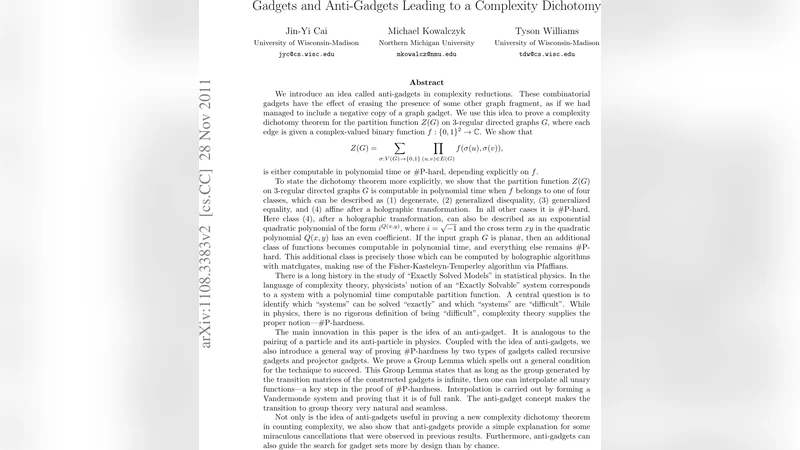
We introduce an idea called anti-gadgets in complexity reductions. These combinatorial gadgets have the effect of erasing the presence of some other graph fragment, as if we had managed to include a negative copy of a graph gadget. We use this idea to prove a complexity dichotomy theorem for the partition function $Z(G)$ on 3-regular directed graphs $G$, where each edge is given a complex-valued binary function $f: {0,1}^2 \rightarrow \mathbb{C}$. We show that [Z(G) = \sum_{\sigma: V(G) \to {0,1}} \prod_{(u,v) \in E(G)} f(\sigma(u), \sigma(v)),] is either computable in polynomial time or #P-hard, depending explicitly on $f$.
💡 Research Summary
The paper introduces a novel concept called an “anti‑gadget” into the toolkit of complexity‑theoretic reductions. Traditional gadget constructions allow one to embed a positive copy of a small graph fragment into an instance, thereby transforming one counting problem into another. An anti‑gadget, by contrast, behaves as if a negative copy of a gadget were inserted: its transition matrix is the inverse (up to a non‑zero scalar) of the matrix of the original gadget. This idea is inspired by particle–antiparticle annihilation in physics and provides a powerful algebraic mechanism for cancelling the effect of a gadget in a reduction.
The authors focus on the partition function
\
Comments & Academic Discussion
Loading comments...
Leave a Comment