The Sheaf-Theoretic Structure Of Non-Locality and Contextuality
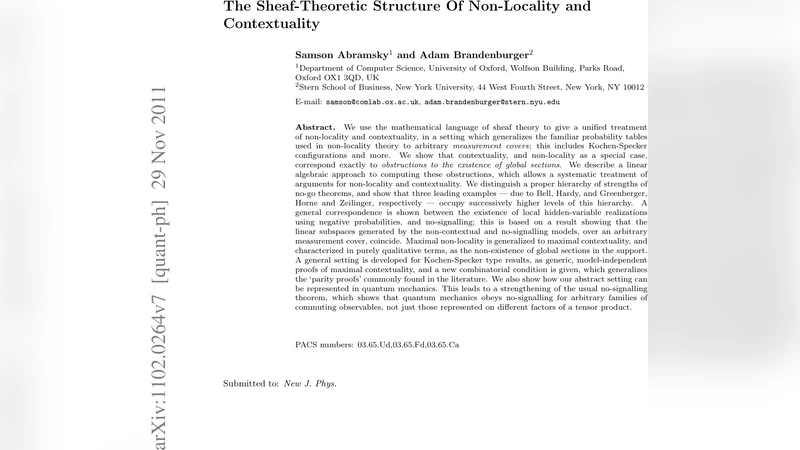
We use the mathematical language of sheaf theory to give a unified treatment of non-locality and contextuality, in a setting which generalizes the familiar probability tables used in non-locality theory to arbitrary measurement covers; this includes Kochen-Specker configurations and more. We show that contextuality, and non-locality as a special case, correspond exactly to obstructions to the existence of global sections. We describe a linear algebraic approach to computing these obstructions, which allows a systematic treatment of arguments for non-locality and contextuality. We distinguish a proper hierarchy of strengths of no-go theorems, and show that three leading examples — due to Bell, Hardy, and Greenberger, Horne and Zeilinger, respectively — occupy successively higher levels of this hierarchy. A general correspondence is shown between the existence of local hidden-variable realizations using negative probabilities, and no-signalling; this is based on a result showing that the linear subspaces generated by the non-contextual and no-signalling models, over an arbitrary measurement cover, coincide. Maximal non-locality is generalized to maximal contextuality, and characterized in purely qualitative terms, as the non-existence of global sections in the support. A general setting is developed for Kochen-Specker type results, as generic, model-independent proofs of maximal contextuality, and a new combinatorial condition is given, which generalizes the `parity proofs’ commonly found in the literature. We also show how our abstract setting can be represented in quantum mechanics. This leads to a strengthening of the usual no-signalling theorem, which shows that quantum mechanics obeys no-signalling for arbitrary families of commuting observables, not just those represented on different factors of a tensor product.
💡 Research Summary
The paper “The Sheaf‑Theoretic Structure of Non‑Locality and Contextuality” develops a unified, mathematically rigorous framework for the two hallmark quantum phenomena—non‑locality and contextuality—by exploiting the language of sheaf theory. The authors begin by fixing a finite set X of measurements and a finite outcome set O (typically {0,1}). For any subset U⊆X a section is a function s:U→O, representing the joint outcomes that would be observed if the measurements in U were performed together. The collection of sections over all subsets, together with the natural restriction maps (s↦s|V for V⊆U), forms a presheaf E:𝒫(X)ᵒᵖ→Set. Because sections are simply functions on a discrete set, the usual gluing (sheaf) condition holds: compatible families of local sections uniquely determine a global section over the union.
Experimental data are modelled as empirical models: for each measurement context C (a maximal compatible subset of X) a probability distribution (or more generally an R‑distribution, where R is any commutative semiring) is assigned to the set of sections E(C). The family of contexts is captured by a measurement cover M⊆𝒫(X) that is an antichain and whose union is X. The restriction maps on distributions correspond to taking marginals.
The central insight is that non‑locality and contextuality are precisely the failure of these local distributions to glue into a single global distribution. If a global section (or global distribution) exists, the empirical model admits a deterministic hidden‑variable explanation; if not, the model is contextual (or non‑local, when the cover reflects spatial separation). This reformulation turns the existence problem into a linear‑algebraic one: each local distribution can be represented as a vector, and the marginalisation maps become linear matrices. The question “does a global distribution exist?” becomes “does the linear system A·x = b have a solution?” where b encodes the observed marginals. This method yields a systematic way to compute obstructions for any cover, far beyond the traditional Bell‑scenario.
Using this machinery the authors classify three increasingly strong notions of non‑locality/contextuality:
- Probabilistic non‑locality – a global probability distribution does not exist, but the observed probabilities are internally consistent. This is the case for the standard Bell‑CHSH scenario.
- Possibilistic non‑locality – even if we forget the exact probabilities and keep only the support (which events are possible), no global support exists. Hardy’s paradox exemplifies this level.
- Strong contextuality – the support itself cannot be glued; there is no global section at all. GHZ‑type arguments for three or more parties achieve this strongest form.
These three levels form a strict hierarchy (Bell < Hardy < GHZ). The paper also shows that, for bipartite no‑signalling boxes, the only devices attaining strong contextuality are the PR‑boxes, providing a new characterisation of these supra‑quantum resources.
A further major contribution is the equivalence between hidden‑variable models that allow negative probabilities (i.e., distributions over the reals rather than the non‑negative reals) and the no‑signalling condition. By working over the full real semiring, the authors prove that the linear subspace generated by all non‑contextual models coincides with the subspace generated by all no‑signalling models, for any measurement cover. Consequently, a model admits a negative‑probability hidden‑variable representation if and only if it satisfies no‑signalling, and vice‑versa.
The paper also abstracts the Kochen‑Specker theorem. By encoding a Kochen‑Specker configuration as a KS‑graph (vertices = measurements, edges = compatibility), the authors identify a purely combinatorial condition—generalising the familiar parity proofs—that guarantees maximal contextuality (i.e., the impossibility of any global section). This graph‑theoretic perspective links contextuality to classic results in graph colouring and hypergraph theory.
In the quantum‑mechanical section the authors show how the abstract sheaf‑theoretic setting is realised by families of commuting observables on a Hilbert space. The compatibility relation among observables yields a measurement cover, and the Born rule supplies the local distributions. Importantly, they prove a generalised no‑signalling theorem: quantum mechanics satisfies the sheaf‑theoretic no‑signalling condition for any family of commuting observables, not only for spacelike‑separated tensor‑product factors. Thus the usual no‑signalling theorem is a special case of a much broader structural property of quantum theory.
The paper is organized as follows: Section 2 introduces the basic sheaf‑theoretic formalism (events, distributions, measurement covers). Section 3 establishes the correspondence between global sections and deterministic hidden‑variable models. Section 4 develops the linear‑algebraic method and applies it to Bell and Hardy scenarios. Section 5 proves the equivalence of negative‑probability hidden‑variable models and no‑signalling. Section 6 analyses strong contextuality, GHZ models, and maximal non‑locality. Section 7 presents the combinatorial KS‑graph framework. Section 8 proves a general theorem linking factorizable hidden‑variable models to global sections. Section 9 embeds the abstract theory in quantum mechanics and derives the generalized no‑signalling result. Section 10 summarises the contributions, discusses related work, and outlines future directions.
Overall, the work provides a powerful, unifying mathematical lens for non‑locality and contextuality, supplies concrete computational tools, clarifies the hierarchy of no‑go theorems, connects negative probabilities to no‑signalling, and extends the Kochen‑Specker phenomenon to a broad combinatorial setting—all while demonstrating that quantum mechanics naturally satisfies the sheaf‑theoretic constraints. This framework is poised to influence both foundational studies and the resource‑theoretic treatment of contextuality in quantum information science.
Comments & Academic Discussion
Loading comments...
Leave a Comment