AstroDAbis: Annotations and Cross-Matches for Remote Catalogues
Astronomers are good at sharing data, but poorer at sharing knowledge. Almost all astronomical data ends up in open archives, and access to these is being simplified by the development of the global Virtual Observatory (VO). This is a great advance, but the fundamental problem remains that these archives contain only basic observational data, whereas all the astrophysical interpretation of that data – which source is a quasar, which a low-mass star, and which an image artefact – is contained in journal papers, with very little linkage back from the literature to the original data archives. It is therefore currently impossible for an astronomer to pose a query like “give me all sources in this data archive that have been identified as quasars” and this limits the effective exploitation of these archives, as the user of an archive has no direct means of taking advantage of the knowledge derived by its previous users. The AstroDAbis service aims to address this, in a prototype service enabling astronomers to record annotations and cross-identifications in the AstroDAbis service, annotating objects in other catalogues. We have deployed two interfaces to the annotations, namely one astronomy-specific one using the TAP protocol}, and a second exploiting generic Linked Open Data (LOD) and RDF techniques.
💡 Research Summary
The paper presents AstroDAbis, a prototype service designed to bridge the gap between raw astronomical catalog data and the scientific knowledge derived from it, which is typically locked in journal articles. While the Virtual Observatory (VO) has succeeded in providing standardized access to observational datasets via protocols such as TAP (Table Access Protocol), it does not expose the interpretive information (e.g., object classifications, artefact flags) that astronomers publish in the literature. Consequently, a researcher cannot ask a VO service for “all sources identified as quasars” without manually consulting the papers and performing ad‑hoc cross‑matching.
AstroDAbis tackles three core problems. First, it introduces a user‑driven tagging interface that allows astronomers to attach free‑form annotations to individual catalog entries. This “folksonomy” approach accepts imprecision initially but can evolve toward a consensus‑based controlled vocabulary as the community adopts common tags. Second, the service automatically generates a globally unique URI for every object in every catalog it knows about, and it can declare equivalence with any pre‑existing identifiers. By providing a stable, URI‑based naming scheme, AstroDAbis creates the raw material needed for cross‑catalogue matching and for future Semantic Web experiments in astronomy. Third, the service operates independently of the underlying archives, meaning users can annotate objects even when they have no write access to the original databases. This decoupling enables Web 2.0‑style enrichment without forcing disruptive changes on legacy catalog systems.
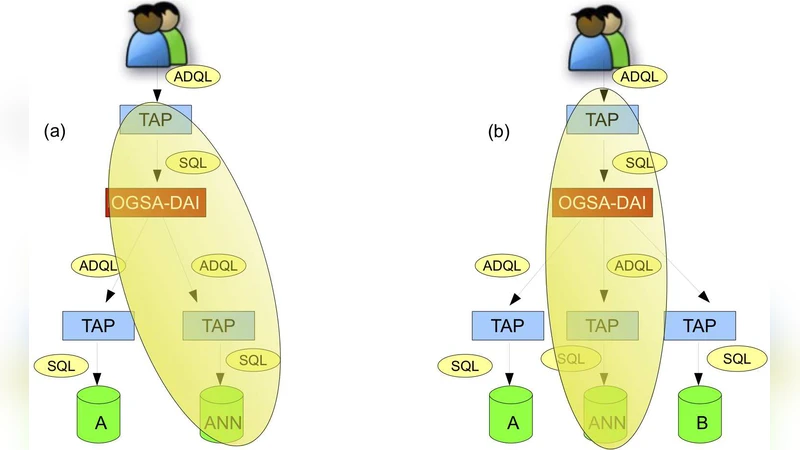
Technically, AstroDAbis is built on top of a TAP Factory backed by OGSA‑DAI. The TAP Factory allows a single query to reference multiple TAP services; OGSA‑DAI then decomposes the request into sub‑queries, executes them against the respective services, and recombines the results into a unified result set. Users can create annotations via a web UI that expands templated queries into ADQL, or they can upload bulk annotations in VOTable format. The service also exposes a Linked Data (RDF) endpoint, publishing both the catalog objects and the associated annotations as triples, thereby enabling external Semantic Web tools to discover and link the data.
The authors trace the conceptual lineage of AstroDAbis to the Distributed Annotation System (DAS) used in bioinformatics and to an earlier “AstroDAS” prototype that lacked VO‑standard compliance. With the emergence of TAP, AstroDAbis can now be implemented using open IVOA standards, making it a first‑class citizen of the VO ecosystem. At the time of writing the service is a prototype hosted by the Wide Field Astronomy Unit in Edinburgh, with plans to mature it into a production service.
Key benefits highlighted include: (1) enhanced re‑use of expert knowledge embedded in the literature, (2) reduced computational cost of cross‑matching by providing pre‑computed equivalence URIs, and (3) a pathway toward richer, machine‑readable astronomical metadata that can be leveraged by Semantic Web applications. The paper also acknowledges open challenges such as ensuring annotation quality and provenance, handling URI collisions, scaling to very large catalogs, and defining access control and versioning for community‑generated tags.
In summary, AstroDAbis represents a significant step toward integrating observational data with the interpretive knowledge that astronomers generate, thereby extending the functionality of the Virtual Observatory from a data‑only platform to a knowledge‑enabled environment.
Comments & Academic Discussion
Loading comments...
Leave a Comment