Lie symmetry analysis and exact solutions of the quasi-geostrophic two-layer problem
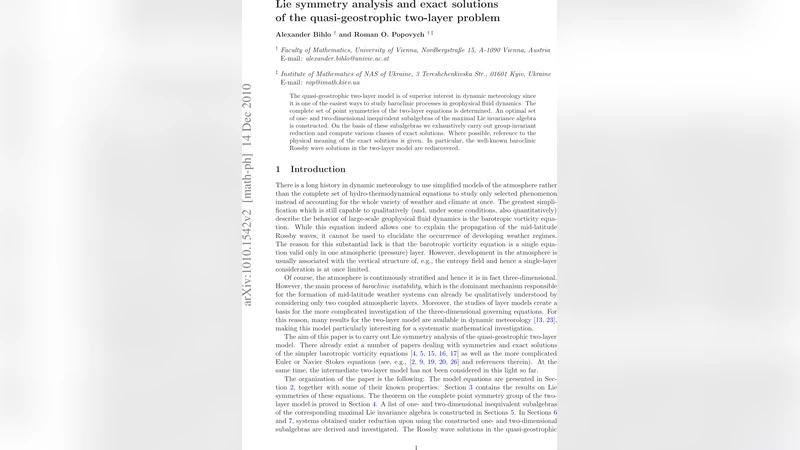
The quasi-geostrophic two-layer model is of superior interest in dynamic meteorology since it is one of the easiest ways to study baroclinic processes in geophysical fluid dynamics. The complete set of point symmetries of the two-layer equations is determined. An optimal set of one- and two-dimensional inequivalent subalgebras of the maximal Lie invariance algebra is constructed. On the basis of these subalgebras we exhaustively carry out group-invariant reduction and compute various classes of exact solutions. Where possible, reference to the physical meaning of the exact solutions is given. In particular, the well-known baroclinic Rossby wave solutions in the two-layer model are rediscovered.
💡 Research Summary
The paper applies Lie‑group symmetry methods to the quasi‑geostrophic (QG) two‑layer model, a cornerstone of dynamical meteorology for studying baroclinic processes. After presenting the governing equations—two streamfunctions ψ₁, ψ₂ and the inter‑layer temperature (or potential temperature) θ—the authors rewrite the system in a variational form and introduce the most general point transformation acting on (t, x, y, ψ₁, ψ₂, θ). By solving the determining equations they obtain a finite‑dimensional Lie algebra of eight independent generators: time translation, horizontal translations in x and y, planar rotation, scaling of space and streamfunctions, and a discrete exchange symmetry swapping the two layers while reversing θ. This algebra is shown to be a semidirect product of a three‑dimensional Euclidean subalgebra with a scaling and exchange subalgebra.
Using the adjoint representation, the authors construct an optimal list of inequivalent one‑ and two‑dimensional subalgebras. For each subalgebra they compute the associated invariants, thereby reducing the original system of nonlinear partial differential equations to ordinary differential equations (for one‑dimensional subalgebras) or to lower‑dimensional PDEs (for two‑dimensional subalgebras). The reductions are carried out exhaustively, and the resulting reduced equations are solved analytically.
The solutions recovered include the classic baroclinic Rossby‑wave modes, which appear when the reduction is based on a combination of translation in x and time together with a phase speed c. Linear travelling‑wave solutions, logarithmic shear flows, and trigonometric nonlinear wave‑shear interaction solutions are also obtained. In the two‑dimensional reductions, the authors find more intricate structures such as coupled wave‑shear packets and non‑separable similarity solutions that describe the deformation of Rossby waves by a background shear and the transfer of energy between layers.
Physical interpretation is given for each class of exact solution. The Rossby‑wave family reproduces the westward propagation and meridional dispersion observed in mid‑latitude atmospheric patterns, with the dispersion relation explicitly expressed in terms of the β‑parameter, layer depth, and mean flow. The nonlinear interaction solutions illustrate how baroclinic instability can grow, saturate, and redistribute momentum and potential vorticity between the two layers, providing analytical insight into the mechanisms that underlie the formation of cyclones and anticyclones. Parameter studies show that increasing the inter‑layer separation or the basic shear enhances the growth rate, in agreement with classical linear stability theory.
Overall, the work demonstrates that Lie symmetry analysis not only recovers known solutions of the QG two‑layer model but also systematically generates new families of exact solutions with clear meteorological relevance. By mapping the full symmetry group, constructing an optimal subalgebra basis, and performing exhaustive reductions, the authors furnish a powerful analytical toolbox for researchers studying baroclinic dynamics, offering benchmark solutions for testing numerical schemes and deepening theoretical understanding of atmospheric wave‑mean‑flow interaction.
Comments & Academic Discussion
Loading comments...
Leave a Comment