Properties of the Exceptional ($X_{ell}$) Laguerre and Jacobi Polynomials
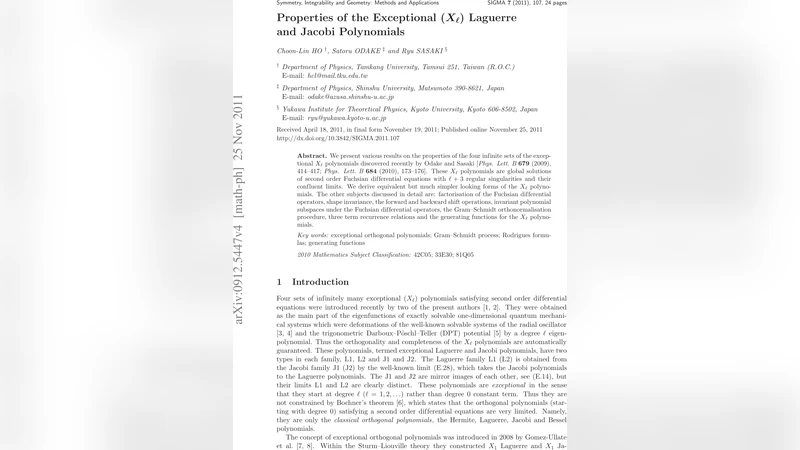
We present various results on the properties of the four infinite sets of the exceptional $X_{\ell}$ polynomials discovered recently by Odake and Sasaki [{\it Phys. Lett. B} {\bf 679} (2009), 414-417; {\it Phys. Lett. B} {\bf 684} (2010), 173-176]. These $X_{\ell}$ polynomials are global solutions of second order Fuchsian differential equations with $\ell+3$ regular singularities and their confluent limits. We derive equivalent but much simpler looking forms of the $X_{\ell}$ polynomials. The other subjects discussed in detail are: factorisation of the Fuchsian differential operators, shape invariance, the forward and backward shift operations, invariant polynomial subspaces under the Fuchsian differential operators, the Gram-Schmidt orthonormalisation procedure, three term recurrence relations and the generating functions for the $X_{\ell}$ polynomials.
💡 Research Summary
The paper provides a comprehensive study of the four infinite families of exceptional (X_{\ell}) Laguerre and Jacobi polynomials that were introduced by Odake and Sasaki in 2009‑2010. These polynomials are global solutions of second‑order Fuchsian differential equations possessing (\ell+3) regular singularities (or their confluent limits). The authors first derive much simpler closed‑form expressions for the (X_{\ell}) polynomials. By factorising the associated Fuchsian operators into a product of two first‑order operators, they reveal a supersymmetric‑like structure and establish shape invariance: a parameter shift leaves the spectrum unchanged while the eigenfunctions acquire a simple multiplicative factor.
The paper then introduces forward and backward shift operators that raise or lower the polynomial degree by one. These operators are identified with the two first‑order factors obtained in the factorisation and act on the (\ell)-dependent deformation polynomials. Using them the authors construct invariant polynomial subspaces that remain closed under the action of the Fuchsian operator, thereby generalising the classical invariant subspace property of ordinary orthogonal polynomials.
A detailed Gram–Schmidt orthonormalisation procedure is presented. Because the weight function is modified by the (\ell)-th deformation polynomial, the inner product and normalisation constants acquire explicit (\ell)-dependent factors expressed in terms of beta and gamma functions. The orthogonality relation (\langle X^{(\ell)}{n},X^{(\ell)}{m}\rangle=\delta_{nm}N^{(\ell)}_{n}) is proved, and the normalisation constants are given in closed form.
The authors derive three‑term recurrence relations for the exceptional families. While the structure mirrors that of ordinary Laguerre and Jacobi polynomials, additional (\ell)-dependent coefficients appear. These coefficients are obtained directly from the shift operators and the factorised form of the differential operator, and they reduce to the classical recurrence coefficients when (\ell\to0).
Finally, generating functions for the (X_{\ell}) families are constructed. Starting from the known generating functions of the classical polynomials, the authors insert the deformation polynomial and a corrective factor (F_{\ell}(t,x)) that encodes the (\ell)-dependence. The resulting generating function simultaneously encodes the entire hierarchy of exceptional polynomials, reproduces the classical generating function in the limit (\ell=0), and provides a compact tool for deriving further identities (e.g., differential‑difference equations, integral representations).
Overall, the paper systematically unifies several algebraic and analytic aspects of the exceptional (X_{\ell}) Laguerre and Jacobi polynomials: operator factorisation, shape invariance, shift operations, invariant subspaces, orthogonalisation, recurrence, and generating functions. By presenting these results in a unified and simplified framework, the authors not only deepen the theoretical understanding of exceptional orthogonal polynomials but also open avenues for applications in supersymmetric quantum mechanics, spectral theory, and computational methods that rely on orthogonal polynomial expansions.
Comments & Academic Discussion
Loading comments...
Leave a Comment