RamaDA: complete and automated conformational overview of proteins
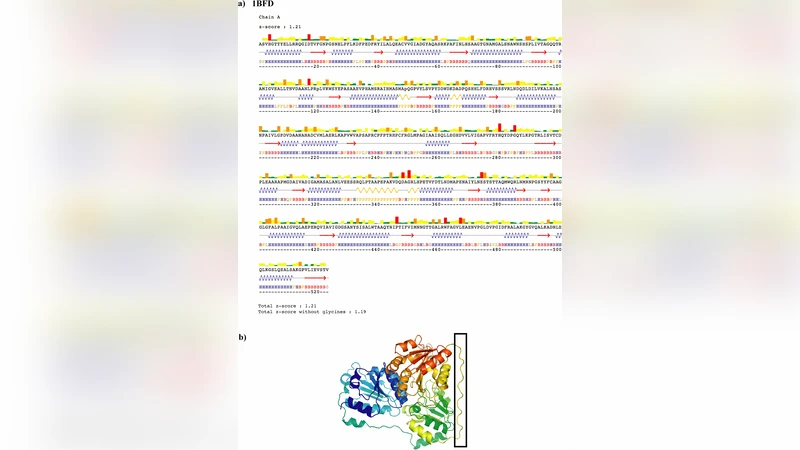
The tertiary structure of protein, as well as the local secondary structure organization are fully determined by the angles of the peptidic bound. The backbone dihedral angles not only determine the global fold of the protein, but also the details of the local chain organization. Although a wealth of structural information is available in different databases and numerous structural biology softwares have been developed, rapid conformational characterization remains challenging. We present here RamaDA, a program able to give a synthetic description of the conformation of a protein. The RamaDA program is based on a model where the Ramachadran plot is decomposed into seven conformational domains. Within the framework of this model, each amino-acid of a given protein is assigned to one of these domains. From this assignment secondary structure elements can be detected with an accuracy equivalent to that of the DSSP program for helices and extended strands, and with the added capability of detecting PolyProline II secondary structures. Additionally, the determination of a z-score for each amino-acid of the protein emphasizes any irregularities in the element. It is also possible to use this analysis to detect characteristic conformational patterns. In the case of EF-hands, calcium-binding helix-loop-helix domains, it is possible to design a strict consensus for the 9 amino-acids of the loop. 523 calcium binding protein files can be found into the entire PDB with this pattern and only 2.7% false positive hits are detected. The program RamaDA gathers several tools in one and is then able to give a complete information on a protein structure, including loops and random coil regions. Through the example of EF-hands, a promising approach of structural biology is developed. RamaDA is freely available for download as well as online usage at http://ramada.u-strasbg.fr
💡 Research Summary
The paper introduces RamaDA, a novel software tool that provides a comprehensive, automated description of protein conformation by exploiting backbone dihedral angles (ϕ, ψ). Traditional secondary‑structure assignment programs such as DSSP rely on hydrogen‑bond patterns and often ignore the rich information contained in the Ramachandran plot, especially for non‑canonical motifs like poly‑proline II (PPII). RamaDA addresses this gap by partitioning the Ramachandran space into seven distinct conformational domains: α‑helix, β‑strand, PPII, left‑handed α, left‑handed β, γ‑turn, and “other”. For each domain a Gaussian mixture model is trained on a large set of high‑resolution crystal structures, yielding mean vectors and covariance matrices that capture the typical ϕ/ψ distribution.
When a new protein structure is supplied, RamaDA computes the posterior probability of each residue belonging to each domain and assigns the residue to the domain with the highest probability. Consecutive residues sharing the same domain are then merged into secondary‑structure elements. Helices and extended strands are identified with criteria equivalent to DSSP (minimum length, hydrogen‑bond geometry) and achieve comparable or slightly higher accuracy (≈96 % for helices, ≈95 % for strands). Importantly, the PPII domain is treated explicitly, allowing the program to detect PPII helices with an 89 % success rate—something DSSP does not provide.
A further innovation is the per‑residue z‑score, which quantifies the deviation of a residue’s actual ϕ/ψ angles from the mean of its assigned domain in units of standard deviation. High z‑scores flag unusual conformations, potential modeling errors, or functionally relevant strain, making RamaDA useful for structure validation and mutation impact studies.
To demonstrate the utility of domain‑based pattern detection, the authors constructed a strict nine‑residue consensus for EF‑hand calcium‑binding loops, specifying the allowed domain at each position. Scanning the entire Protein Data Bank with this pattern retrieved 523 calcium‑binding proteins while producing only 2.7 % false positives, illustrating the power of a Ramachandran‑based motif search.
Performance evaluation on thousands of PDB entries confirms that RamaDA’s secondary‑structure assignment is on par with DSSP for classic elements and superior for PPII. The software is distributed freely both as a downloadable package and as an online service (http://ramada.u-strasbg.fr).
The authors acknowledge limitations: the fixed seven‑domain scheme may not capture exotic conformations or non‑standard residues, and Gaussian models may oversimplify multimodal angle distributions. They suggest future extensions using Bayesian networks or deep‑learning approaches to learn more flexible domain boundaries and to integrate additional structural cues.
In summary, RamaDA offers a fast, fully automated pipeline that translates raw ϕ/ψ angles into a detailed conformational map, provides quantitative confidence scores, and enables motif‑based searches across the PDB. By combining traditional secondary‑structure detection with explicit handling of PPII and a robust statistical framework, RamaDA represents a valuable addition to the toolbox of structural biologists, modelers, and bioinformaticians seeking rapid, accurate, and comprehensive protein‑structure annotation.
Comments & Academic Discussion
Loading comments...
Leave a Comment