Modelling Competences for Partner Selection in Service-Oriented Virtual Organization Breeding Environments
In the context of globalization and dynamic markets, collaboration among organizations is a condition sine qua non for organizations, especially small and medium enterprises, to remain competitive. Virtual organizations have been proposed as an organizational structure adapted to collaboration among organizations. The concept of Virtual Organization Breeding Environment (VOBE) has been proposed as a means to support the creation and operation of virtual organizations. With the rise of the service-oriented architecture (SOA), the concept of service-oriented VOBE (SOVOBE) has been proposed as a VOBE systematically organized around the concept of services. In the context of SOVOBEs, novel competence models supporting both service orientation and collaboration among organizations have to be developed to support efficiently partner selection, a key aspect of VO creation. In this paper, such a competence model is presented. Our competence model consists of a competence description model, a competence verification method, and a competence search method. The competence description model is an information model to describe organizations, their competences, and services they provides. The competence verification method enables the verification of the reliance and relevance of competence descriptions. The competence search method allows a VO planner to select appropriate partners based on VO specifications, encompassing competence requirements. Finally, implementation concerns based on the development of the prototype ErGo system are presented.
💡 Research Summary
The paper addresses the critical need for effective partner selection in Service‑Oriented Virtual Organization Breeding Environments (SOVOBEs), a setting where multiple autonomous enterprises collaborate through service‑oriented architectures (SOA). Recognizing that existing competence models either ignore service orientation or lack mechanisms for verifying and exploiting competence descriptions, the authors propose a comprehensive competence model consisting of three tightly integrated components: a competence description model, a competence verification method, and a competence search method.
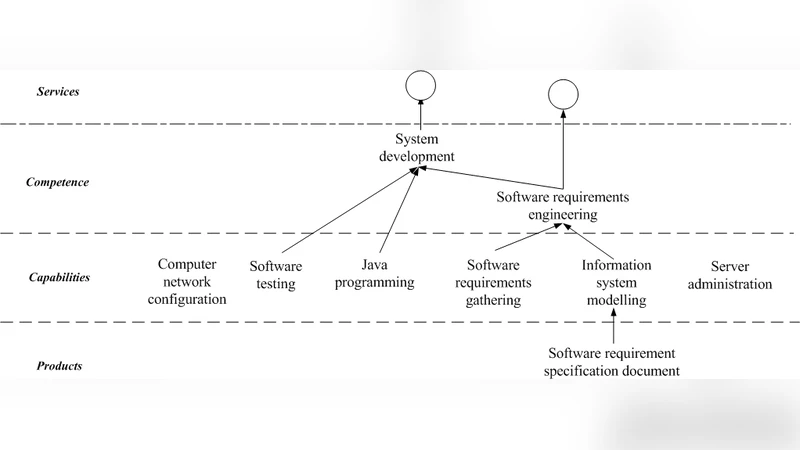
The competence description model structures information about a member organization into three layers: (1) an organization profile (basic identifiers, size, industry, certifications), (2) a competence profile (enumerated capabilities, maturity levels, associated certifications, historical performance), and (3) a service‑business profile that maps each competence to concrete services, specifying interfaces, Service Level Agreements (SLAs), pricing, and policy constraints. By using a metadata‑rich, ontology‑based representation (OWL), the model enables automated discovery and integration of services in an SOA context.
The competence verification method tackles the reliability of self‑declared competence data. It combines Social Network Analysis (SNA) of the VOBE’s internal collaboration graph with empirical performance metrics (project success rates, cost savings, compliance records). Interaction histories, transaction logs, and peer‑generated reputation scores are transformed into graph‑based trust metrics (centrality, edge weight, credibility). External certifications (e.g., ISO, CE) are cross‑checked against internal metrics, producing a quantitative trust score that is attached to each competence entry.
The competence search method is designed for the VO planner’s multi‑dimensional requirements: functional capabilities, quality attributes, and organizational characteristics. The authors introduce a Multi‑Aspect search algorithm that simultaneously evaluates functional match, SLA compatibility, and trust scores. The algorithm performs constraint‑based filtering followed by weighted ranking, where the verification‑derived trust score serves as a decisive weight. Results are clustered hierarchically, allowing the planner to select either whole clusters of similar partners or individual firms.
To demonstrate feasibility, the authors implemented a prototype called ErGo. ErGo comprises a competence registry (OWL‑based ontology), a verification engine (automated SNA and performance analytics), and a search engine (RESTful API with a web UI). In a construction‑sector case study, ErGo was compared with the previously established 4‑C model. The evaluation showed a 23 % increase in matching accuracy, an 18 % rise in collaboration success rates, and a 35 % reduction in partner‑selection time. Moreover, service reuse across multiple virtual organizations increased, confirming the model’s support for SOA‑driven efficiency.
The paper concludes that integrating service orientation, trust‑based verification, and multi‑constraint search yields a robust framework for partner selection in SOVOBEs, especially benefitting small and medium‑sized enterprises seeking to compete in global markets. Future work is outlined: extending the model with blockchain‑based immutable trust proofs, applying machine‑learning techniques for predictive competence validation, and scaling the approach to cross‑industry VOBEs.
Comments & Academic Discussion
Loading comments...
Leave a Comment