A graph theoretical Gauss-Bonnet-Chern Theorem
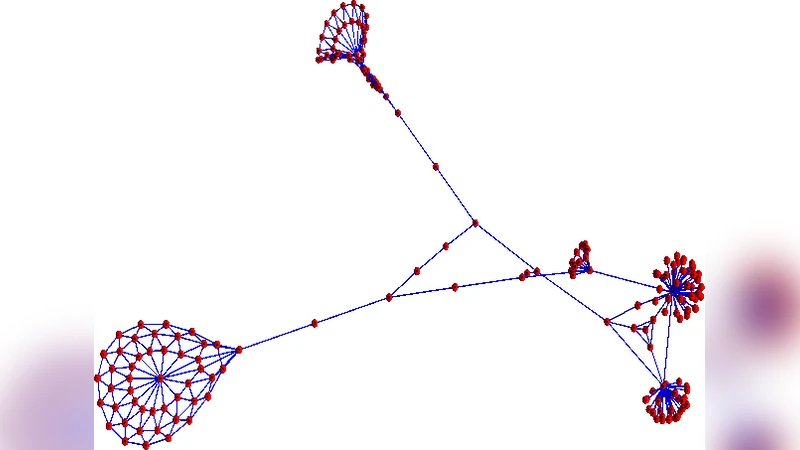
We prove a discrete Gauss-Bonnet-Chern theorem which states where summing the curvature over all vertices of a finite graph G=(V,E) gives the Euler characteristic of G.
💡 Research Summary
The paper establishes a fully discrete analogue of the Gauss‑Bonnet‑Chern theorem for finite simple graphs. The authors begin by recalling the classical continuous theorem, which relates the integral of the scalar curvature of a Riemannian manifold to its Euler characteristic, and they note that existing discrete versions such as the Gauss‑Bonnet‑Boltzmann theorem rely on a planar embedding and an angle‑defect definition. To overcome these limitations, they introduce a curvature function defined purely combinatorially at each vertex v:
K(v) = 1 – deg(v)/2 + Σ_{f∋v} 1/|f|,
where deg(v) is the vertex degree and the sum runs over all minimal cycles (treated as 2‑cells) that contain v; |f| denotes the length of the cycle. The first term represents a unit contribution of the vertex itself, the second term penalises each incident edge, and the third term distributes a fractional curvature contribution from each cycle equally among its vertices.
Next, the authors embed the graph G into a 2‑dimensional cell complex X(G) by regarding every minimal cycle as a 2‑cell. In this setting the Euler characteristic is given by the usual cellular formula χ(G)=|V|−|E|+|F|, where |F| counts the 2‑cells. Summing the vertex curvature over all vertices yields
Σ_{v∈V} K(v) = |V| – (1/2) Σ_{v}deg(v) + Σ_{f} (|f|·1/|f|) = |V| – |E| + |F| = χ(G).
The proof hinges on two elementary combinatorial identities: the handshaking lemma Σ_{v}deg(v)=2|E| and the observation that each minimal cycle of length |f| contributes exactly |f| terms of 1/|f|, one from each of its vertices. Both identities hold for arbitrary finite graphs, regardless of planarity or connectivity.
The paper then examines several illustrative cases. For trees (no cycles) the curvature reduces to K(v)=1−deg(v)/2, and the sum equals 1, matching the Euler characteristic of a tree. For complete graphs K_n the minimal cycles are all triangles; the curvature formula reproduces the known Euler characteristic χ(K_n)=1−n+ C(n,2)−C(n,3). The authors also discuss planar versus non‑planar graphs, emphasizing that because cycles, not faces of an embedding, define curvature, the theorem applies without any embedding assumptions.
A comparative discussion with the Gauss‑Bonnet‑Boltzmann theorem shows that the new curvature replaces angular deficits with purely combinatorial weights, thereby extending the theorem to graphs lacking a geometric embedding. The authors argue that this provides a more intrinsic topological invariant for graphs.
Finally, the paper outlines future directions: extending the curvature to higher‑dimensional cell complexes (hypergraphs), investigating connections with graph Laplacians and spectral invariants, and applying the discrete Gauss‑Bonnet‑Chern framework to network analysis, where curvature could quantify local “bottleneck” or “flatness” properties. In summary, the work delivers a clean, embedding‑independent discrete Gauss‑Bonnet‑Chern theorem, bridging combinatorial graph theory with classical differential topology.
Comments & Academic Discussion
Loading comments...
Leave a Comment