Representations and Ensemble Methods for Dynamic Relational Classification
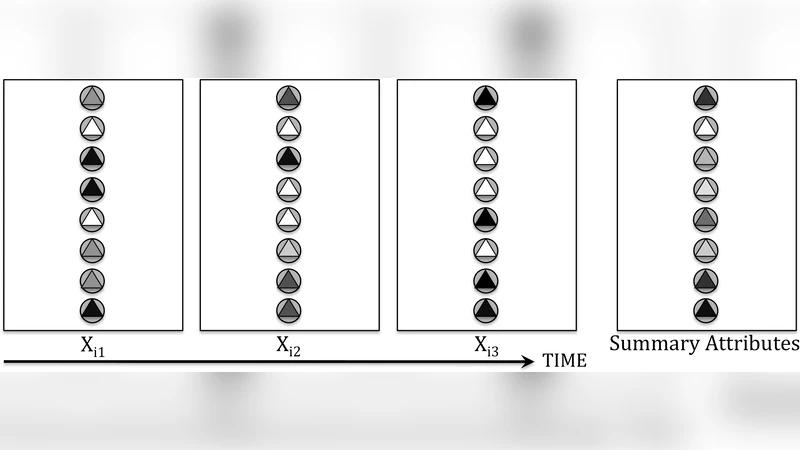
Temporal networks are ubiquitous and evolve over time by the addition, deletion, and changing of links, nodes, and attributes. Although many relational datasets contain temporal information, the majority of existing techniques in relational learning focus on static snapshots and ignore the temporal dynamics. We propose a framework for discovering temporal representations of relational data to increase the accuracy of statistical relational learning algorithms. The temporal relational representations serve as a basis for classification, ensembles, and pattern mining in evolving domains. The framework includes (1) selecting the time-varying relational components (links, attributes, nodes), (2) selecting the temporal granularity, (3) predicting the temporal influence of each time-varying relational component, and (4) choosing the weighted relational classifier. Additionally, we propose temporal ensemble methods that exploit the temporal-dimension of relational data. These ensembles outperform traditional and more sophisticated relational ensembles while avoiding the issue of learning the most optimal representation. Finally, the space of temporal-relational models are evaluated using a sample of classifiers. In all cases, the proposed temporal-relational classifiers outperform competing models that ignore the temporal information. The results demonstrate the capability and necessity of the temporal-relational representations for classification, ensembles, and for mining temporal datasets.
💡 Research Summary
The paper addresses a critical gap in statistical relational learning: the overwhelming focus on static snapshots despite the prevalence of temporal dynamics in real‑world networks. Rossi and Neville propose a comprehensive framework for constructing and exploiting temporal‑relational representations (TRRs) that capture how links, attributes, and nodes evolve over time. The framework consists of four sequential steps. First, the analyst selects which relational components are time‑varying (edges, node attributes, or node existence). Second, a temporal granularity is chosen for each component: a single timestep, a sliding window of consecutive timesteps, or the union of all past timesteps. Third, a temporal influence model is assigned, which determines how much weight past observations receive when predicting the current state. Four weighting schemes are explored: exponential decay (emphasizing recent observations), linear decay (more gradual forgetting), inverse‑linear decay (intermediate behavior), and uniform weighting (treating all timesteps equally). Finally, a weighted relational classifier is trained on the transformed data. The authors extend two classic relational classifiers—Relational Bayes Classifier (RBC) and Relational Probability Trees (RPT)—to incorporate the temporal weights, allowing each conditional probability or split statistic to be a weighted sum over time‑adjusted observations.
Beyond single‑model learning, the authors introduce five families of temporal ensemble methods that leverage the TRR space: (1) temporal sampling of nodes and edges, where each base learner is trained on a stochastic sample of the graph at each timestep; (2) transformation of the temporal feature space via randomization, varying decay parameters, or clustering of temporally weighted features; (3) injection of noise along the time axis (e.g., permuting node attributes across timesteps) to improve generalization; (4) random permutation of class labels across time to diversify decision boundaries; and (5) heterogeneous ensembles that combine different relational algorithms (RBC, RPT, weighted-vote Relational Neighbor, Relational Dependency Networks) with varied temporal weightings. These ensembles are designed to increase classifier diversity while preserving the temporal information that static ensembles discard.
The experimental evaluation uses real communication data from the Python open‑source community, comprising both email and bug‑tracking interactions. The dataset spans 01/2007–09/2008, with three‑month timesteps, and includes automatically extracted textual topics and centrality measures. The prediction task is binary: whether a developer successfully closed a bug in a given timestep. The authors compare TRR‑enhanced RBC and RPT against their static counterparts and against a prior temporal relational method (Sharan et al.). Results show consistent improvements: TRR models achieve 7–12 % higher accuracy than static models, and temporal ensembles further boost performance by an additional ~4 %. Ablation studies reveal that exponential decay works best when recent activity is most predictive, while linear or inverse‑linear decay benefits domains where older interactions retain relevance.
Key insights include: (i) the choice of temporal granularity and weighting dramatically influences predictive power, underscoring the need for a systematic search over the TRR space; (ii) weighting relational components differently (e.g., decaying edges but keeping node attributes uniform) can capture heterogeneous dynamics within the same network; (iii) temporal ensembles provide a principled way to avoid the costly selection of a single optimal TRR by aggregating diverse, time‑aware models.
In conclusion, the paper demonstrates that integrating temporal dynamics into relational representations is both feasible and highly beneficial for classification tasks. The proposed framework offers a flexible, extensible pipeline—from component selection through weighted classifier training to temporal ensemble construction—that can be adapted to a wide range of dynamic network domains. Future work suggested includes automated meta‑learning for TRR selection, scaling to streaming graphs, and applying the methodology to other temporal relational problems such as anomaly detection or link prediction.
Comments & Academic Discussion
Loading comments...
Leave a Comment