Reoccurring patterns in hierarchical protein materials and music: The power of analogies
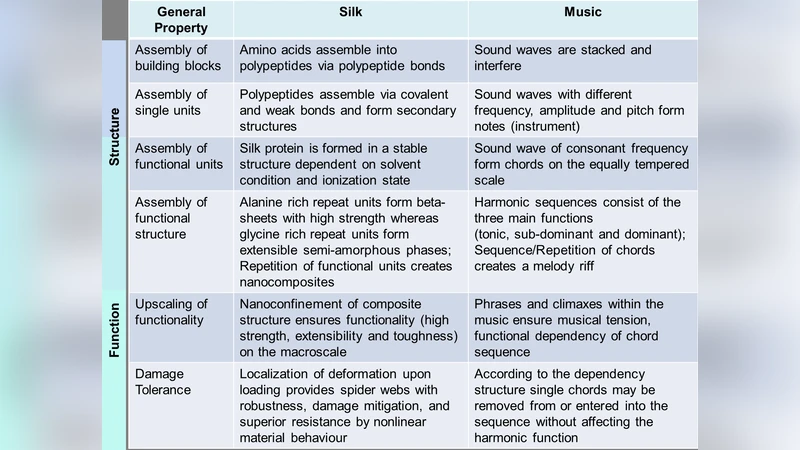
Complex hierarchical structures composed of simple nanoscale building blocks form the basis of most biological materials. Here we demonstrate how analogies between seemingly different fields enable the understanding of general principles by which functional properties in hierarchical systems emerge, similar to an analogy learning process. Specifically, natural hierarchical materials like spider silk exhibit properties comparable to classical music in terms of their hierarchical structure and function. As a comparative tool here we apply hierarchical ontology logs (olog) that follow a rigorous mathematical formulation based on category theory to provide an insightful system representation by expressing knowledge in a conceptual map. We explain the process of analogy creation, draw connections at several levels of hierarchy and identify similar patterns that govern the structure of the hierarchical systems silk and music and discuss the impact of the derived analogy for nanotechnology.
💡 Research Summary
**
The paper presents a novel interdisciplinary framework that draws a deep analogy between hierarchical biological materials—specifically spider silk—and classical music. The authors argue that both systems exhibit strikingly similar multi‑level architectures, and that these parallels can be captured rigorously using category‑theoretic ontology logs (ologs). An olog is a categorical representation consisting of objects (sets) and arrows (functions) that encode the relationships among components of a system. To make the representation more intuitive for highly hierarchical domains, the authors introduce “hierarchical ologs,” which retain the same objects but organize sub‑categories into tree‑like structures, thereby clarifying the nesting of lower‑level building blocks within higher‑level assemblies.
The methodological core of the work is the construction of a functor—a structure‑preserving mapping—between the protein‑silk category and the music category. At the lowest level, amino acids correspond to elementary sound waves (sine, triangular, sawtooth). Polypeptide chains map to musical tones, secondary structures (α‑helices, β‑sheets, amorphous regions) map to individual notes characterized by pitch, duration, and timbre, and larger protein aggregates (nanocomposites, fibers) map to chords and rhythmic riffs. The top‑level functional properties—shear strength, toughness, elasticity—are linked to musical attributes such as consonance, emotional valence, and harmonic stability. This functor is an isomorphism: the positions of objects and arrows are preserved, ensuring that the compositional rules (e.g., function composition) hold identically in both domains.
Concrete examples illustrate the power of this mapping. In spider silk, clusters of 3–4 hydrogen bonds within β‑sheet nanocrystals confer a specific shear strength that depends on geometric confinement. The authors encode this as a relation “cluster → shear strength” in the silk olog. In music, consonant intervals obey a logarithmic frequency ratio (12‑tone equal temperament), which the authors formalize as “frequency pair → consonance → emotional response.” By aligning these two relations through the functor, quantitative data from materials science can be transferred to the musical side and vice versa, opening the possibility of using well‑studied musical datasets to inspire new nanomaterial designs, or of applying material‑science principles to algorithmic composition.
The paper also addresses limitations. Protein folding is often non‑deterministic; the same sequence may adopt multiple secondary structures, introducing ambiguity into the silk olog. Similarly, musical perception (pitch, timbre) can be subjective and context‑dependent. The authors propose augmenting the ologs with environmental metadata (pH, temperature, solvent conditions) and listener characteristics (cultural background, auditory acuity) to create a “grammar” that disambiguates mappings.
Beyond research, the authors highlight educational benefits. Hierarchical ologs provide a visual, step‑by‑step abstraction that can help students grasp complex nanoscale architectures by relating them to familiar musical concepts. The categorical framework also facilitates knowledge sharing across disciplines, allowing researchers in materials science, music theory, and computer science to collaboratively extend the model.
In conclusion, the study demonstrates that analogical reasoning, when grounded in rigorous mathematical tools such as category theory and ontology logs, can reveal deep structural commonalities between seemingly unrelated fields. By formalizing the analogy between spider silk and classical music, the authors open a pathway for cross‑fertilization: musical theory can inform the design of hierarchical nanomaterials, while insights from biomaterials can enrich the analysis of musical structure and perception. This interdisciplinary bridge promises novel design strategies for nanotechnology, new perspectives on music cognition, and a powerful pedagogical framework for teaching complex hierarchical systems.
Comments & Academic Discussion
Loading comments...
Leave a Comment