Apollonian packings as physical fractals
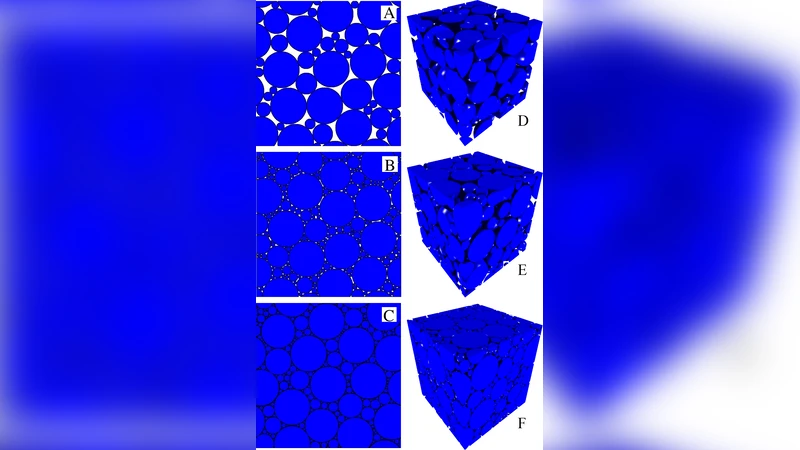
The Apollonian packings (APs) are fractals that result from a space-filling procedure with spheres. We discuss the finite size effects for finite intervals $s\in[s_\mathrm{min},s_\mathrm{max}]$ between the largest and the smallest sizes of the filling spheres. We derive a simple analytical generalization of the scale-free laws, which allows a quantitative study of such \textit{physical fractals}. To test our result, a new efficient space-filling algorithm has been developed which generates random APs of spheres with a finite range of diameters: the correct asymptotic limit $s_\mathrm{min}/s_\mathrm{max}\rightarrow 0$ and the known APs’ fractal dimensions are recovered and an excellent agreement with the generalized analytic laws is proved within the overall ranges of sizes.
💡 Research Summary
The paper investigates how the classic Apollonian packing (AP), a space‑filling fractal generated by recursively inserting the largest possible non‑overlapping spheres into the interstices of an initial configuration, behaves when the range of sphere sizes is finite. In the traditional theory the size distribution follows a power law n(s)∝s^{-(d_f+1)} and the fractal dimension d_f is defined only in the asymptotic limit where the smallest diameter s_min → 0. Real physical systems, however, always have a non‑zero lower cutoff, so the authors refer to such objects as “physical fractals” and set out to quantify the finite‑size corrections.
Starting from the definition of the number of spheres N and the occupied volume fraction φ in terms of the 0‑th and d‑th moments of the size distribution, they introduce a proportionality constant f(s_min,s_max) into the power‑law distribution. Imposing the condition that the packing becomes space‑filling (φ→1) as s_min → 0 yields an explicit expression for f that depends only on the maximal sphere size, the initial porosity ε_{s_max}, and the difference d−d_f. Substituting this result back gives generalized formulas for the normalized number of spheres and the porosity:
N/N_{s_max}=1+
Comments & Academic Discussion
Loading comments...
Leave a Comment