Transition from static to dynamic macroscopic friction in the framework of the Frenkel-Kontorova model
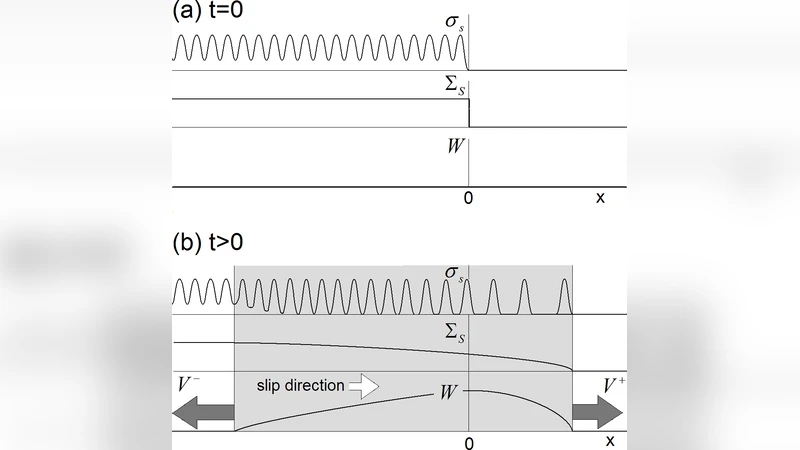
A new generation of experiments on dry macroscopic friction has revealed that the transition from static to dynamic friction is essentially a spatially and temporally non-uniform process, initiated by a rupture-like detachment front. We show the suitability of the Frenkel-Kontorova model for describing this transition. The model predicts the existence of two types of detachment fronts, explaining both the variability and abrupt change of velocity observed in experiments. The quantitative relation obtained between the velocity of the detachment front and the ratio of shear to normal stress is consistent with experiments. The model provides a functional dependence between slip velocity and shear stress, and predicts that slip velocity is independent of normal stress. Paradoxically, the transition from static to dynamic friction does not depend explicitly on ether the static or the dynamic friction coefficient, although the beginning and end of transition process are controlled by these coefficients.
💡 Research Summary
The paper addresses the recently observed non‑uniform nature of the transition from static to dynamic friction, where a rupture‑like detachment front propagates across the interface. The authors propose that the one‑dimensional Frenkel‑Kontorova (FK) model, originally devised for atoms moving in a periodic substrate, can be adapted to macroscopic dry friction by treating asperities as a chain of masses coupled by springs and interacting with a rigid opposing surface through a periodic potential. By relating the FK parameters (mass M, spring constant Kb, and substrate force amplitude Fd) to macroscopic material properties (shear modulus μ, Poisson’s ratio ν, density ρ, asperity spacing b) and to the normal stress ΣN, they introduce a dimensionless factor A that scales with ΣN/pN (pN being the penetration hardness). When ΣN = 0 the periodic potential vanishes, and when ΣN reaches pN the potential reaches its maximum, reproducing the physical intuition that contact forces grow with normal load.
In the continuum limit the FK lattice yields the sine‑Gordon (SG) equation ∂²u/∂t² − c²∂²u/∂x² + A sin u = ΣS/μ − f/μ, where c is the longitudinal wave speed, ΣS the applied shear stress, and f the frictional resistance per unit area. In the absence of driving forces the SG equation admits soliton (kink) solutions that represent “macroscopic dislocations”. Each kink carries a localized stress/strain pulse, has a characteristic width D ≈ b/(2πA), and moves with a velocity U that can range from zero up to the shear‑wave speed c. The average slip velocity W is proportional to the product of kink density N and kink velocity U (W ≈ U N b/A). Importantly, the amplitude of the stress pulse and the kink width depend only on material constants and the normal stress ΣN, not on the density of kinks or on the slip rate. Consequently, the slip velocity is independent of ΣN and is controlled solely by the applied shear stress.
To capture the transition from static to dynamic friction, the authors employ a non‑stationary, self‑similar simple‑wave solution of the SG equation (the “Witham” approach). This solution describes a region bounded by two detachment fronts that propagate leftward and rightward with velocities V₋ and V₊. Inside the region the fields (stress, strain, slip velocity) vary smoothly; at the leading edge the front speed can approach the shear‑wave speed c, while at the trailing edge it may be sub‑Rayleigh. The model predicts two distinct families of fronts: a slower “sub‑Rayleigh” front (velocity < cs) and a faster “super‑shear” front (velocity > cs, up to c). The front speed is a monotonic function of the ratio ΣS/ΣN; for low ratios the fronts are slow, but once a critical ratio is exceeded the speed jumps abruptly, reproducing the experimentally observed sudden changes in front velocity.
The authors validate the theory against a series of PMMA block experiments in which shear force is increased at constant normal load. The first slip pulse (precursor) appears at a shear stress roughly one‑third of the value predicted by classical Coulomb friction, consistent with the model’s prediction that kink nucleation requires only a fraction of the static‑friction threshold. Measured front velocities ranging from a few percent of the Rayleigh speed to super‑shear values align quantitatively with the theoretical V(ΣS/ΣN) curve obtained by fitting the parameter A to the known normal load. The model also reproduces the spatial distribution of stress and slip velocity during pulse propagation, showing that slip is confined between the two fronts and that the maximum slip occurs at the initial rupture point.
Beyond laboratory friction, the paper argues that the same framework can be applied to fault mechanics and earthquake dynamics. In a fault, the “macroscopic dislocations” correspond to slip‑defects along the fault plane; their collective motion generates rupture fronts analogous to the detachment fronts described here. The independence of slip velocity from normal stress, and its direct proportionality to shear stress, offers a possible explanation for the observed scaling of earthquake slip rates with shear stress while being relatively insensitive to overburden pressure.
In summary, the work demonstrates that the Frenkel‑Kontorova model, when extended to macroscopic asperity ensembles and coupled with a self‑similar SG solution, provides a unified, quantitative description of the static‑to‑dynamic friction transition. It accounts for the existence of two types of detachment fronts, predicts their velocity dependence on the shear‑to‑normal stress ratio, explains the observed precursor slip pulses, and suggests broader applicability to geophysical slip phenomena.
Comments & Academic Discussion
Loading comments...
Leave a Comment