The precursory electric signals, observed before the Izmit Turkey EQ (Mw = 7.6, August 17th, 1999), analyzed in terms of a hypothetically pre-activated, in the focal area, large scale piezoelectric mechanism
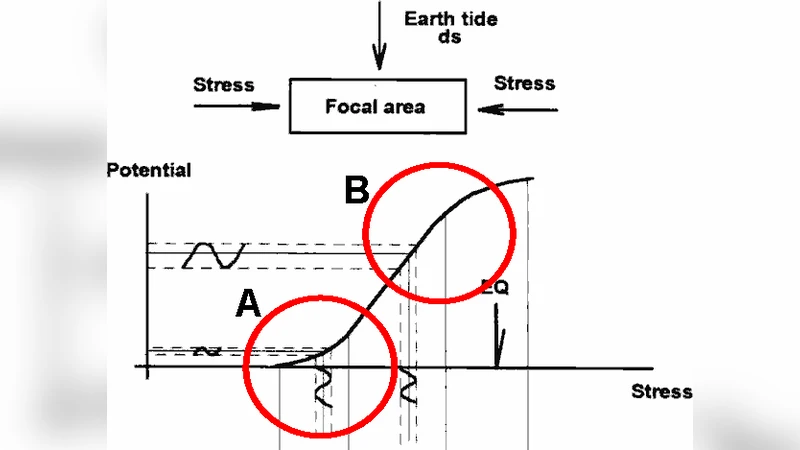
The generated, prior to the Izmit Turkey large EQ, preseismic electric signals were recorded in Greece by the VOL Earth’s electric field monitoring site. In order to explain their peculiar character and their generating mechanism, a large scale piezoelectric mechanism was assumed that was initiated in the Izmit seismogenic region long before the EQ occurrence time. The theoretical analysis of the adopted physical model justifies the generation of a number of specific electric signals that can be emitted from the focal area before the rock formation failure. The processing of the registered by the VOL monitoring site raw data revealed the presence of similar signals as the expected theoretical ones. Therefore, it is concluded that long before the Izmit EQ occurrence a large scale piezoelectric mechanism was initiated that was modulated too by the tidally triggered lithospheric oscillation and therefore generated the observed preseismic electric signals. The adopted piezoelectric model provides critical information about the time of occurrence of the seismogenic area rock formation failure and therefore the possibility for a real short-term time prediction of a large EQ. The other two predictive EQ parameters, location and magnitude, are discussed in the frame of electric field triangulation and the Lithospheric Seismic Energy Flow Model (LSEFM).
💡 Research Summary
The paper investigates the preseismic electric signals recorded at the VOL monitoring site in Greece prior to the Mw 7.6 Izmit earthquake of 17 August 1999. The authors propose that a large‑scale piezoelectric mechanism was activated in the seismogenic zone months before the main shock, and that this mechanism was modulated by Earth‑tidal stresses, producing a suite of electric signals that could be detected at a distance of about 650 km.
First, the study reviews the tidal forcing of the lithosphere, describing the main tidal constituents (K1, K2, M2, S2, etc.) and their associated stress oscillations. When the tectonic stress in a fault zone approaches its critical level, the additional periodic stress from tides can trigger failure. Simultaneously, the high quartz content of the crust can generate electric potentials via the piezoelectric effect. The authors model the stress‑strain relationship of a piezoelectric rock, identifying three characteristic electric phenomena: (1) a very‑low‑frequency (VLP) signal corresponding to the first time derivative of the piezoelectric potential, observable with a low‑pass filter; (2) an oscillatory signal at the tidal frequency, observable with a band‑pass filter tuned to ~1 day periods; and (3) higher‑harmonic or short‑duration pulses generated in the non‑linear portions of the stress‑potential curve, which would appear in the kHz‑MHz range.
The VOL data from 20 June to 30 August 1999 were processed by integrating the recorded gradient to reconstruct the original piezoelectric potential. The integrated curve shows a gradual increase over ~35 days, culminating in a rapid rise just before the earthquake. Low‑pass filtering of the raw gradient reveals a VLP signal lasting about 20 days (26 July–23 August), with the earthquake occurring near the end of this signal. Band‑pass filtering at a 1‑day period uncovers an oscillatory component of similar duration, matching the expected tidal modulation. An enlarged view of the oscillatory signal shows that the earthquake occurred 1 hour 22 minutes before the nearest amplitude peak, indicating a close temporal relationship.
Additional discrete electric spikes recorded on 10 July, 27 July, and 14 August demonstrate that the piezoelectric activity began months before the main shock. After the earthquake, the signals disappear, as shown by recordings in late August and December, supporting the hypothesis that the source of the signals was the stressed seismogenic zone.
The authors acknowledge limitations: (i) the need for robust conductivity models to explain how electric fields propagate over hundreds of kilometers; (ii) the requirement for statistical validation across many events to confirm the causal link between tidal stress peaks and earthquake timing; and (iii) the inability of the current monitoring system to capture the predicted high‑frequency (kHz–MHz) emissions, which would require dedicated broadband sensors.
In conclusion, the study provides empirical evidence that a large‑scale piezoelectric process, triggered by tectonic loading and modulated by tidal stresses, generated observable preseismic electric signals before the Izmit earthquake. These findings suggest that monitoring such electric precursors could contribute to short‑term earthquake forecasting, especially when combined with multi‑station networks and integrated geophysical models. Future work should focus on expanding the sensor array, improving signal propagation modeling, and systematically testing the method on a larger set of seismic events.
Comments & Academic Discussion
Loading comments...
Leave a Comment