Density classification on infinite lattices and trees
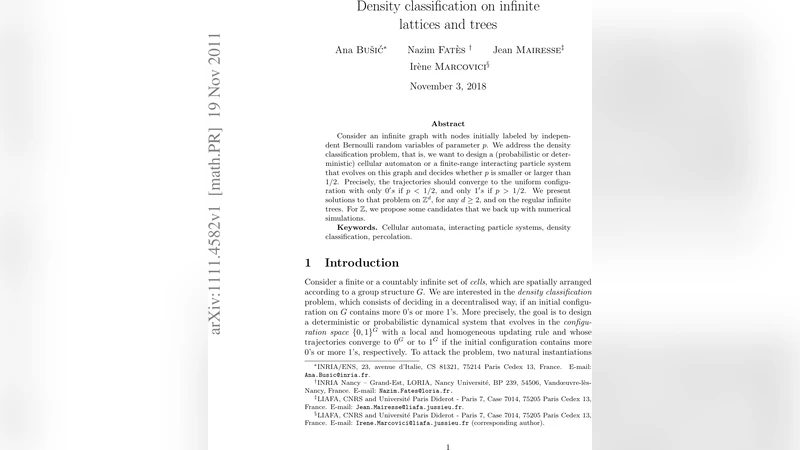
Consider an infinite graph with nodes initially labeled by independent Bernoulli random variables of parameter p. We address the density classification problem, that is, we want to design a (probabilistic or deterministic) cellular automaton or a finite-range interacting particle system that evolves on this graph and decides whether p is smaller or larger than 1/2. Precisely, the trajectories should converge to the uniform configuration with only 0’s if p<1/2, and only 1’s if p>1/2. We present solutions to that problem on the d-dimensional lattice, for any d>1, and on the regular infinite trees. For Z, we propose some candidates that we back up with numerical simulations.
💡 Research Summary
The paper tackles the classic density‑classification problem in an infinite‑size setting. Given a countable graph G (e.g. a lattice ℤ^d or a regular infinite tree) each vertex is initially labelled independently by a Bernoulli(p) random variable. The task is to design a homogeneous, finite‑range dynamical system – either a deterministic cellular automaton (CA), a probabilistic cellular automaton (PCA), or a continuous‑time interacting particle system (IPS) – whose evolution “decides” whether p is smaller or larger than ½. Formally, for p<½ the distribution of the configuration at time t should converge weakly to the all‑zero configuration δ₀, and for p>½ to the all‑one configuration δ₁.
Background and negative results.
The density‑classification problem was first studied on finite rings ℤ/nℤ, where it is known that no deterministic CA can solve it perfectly for all n (Land & Belew, 1995). Later work showed that probabilistic CA can achieve arbitrary precision but still cannot be perfect. The authors extend this impossibility to any PCA (or IPS) on ℤ/nℤ (Proposition 1). Their proof shows that a perfect classifier would have to preserve the number of 1’s almost surely after each update, which contradicts the required convergence to a uniform state when the initial majority is opposite. The same argument applies to Cartesian products of cyclic groups, ruling out perfect classifiers on all finite d‑dimensional tori.
From subgroups to higher dimensions.
Proposition 2 states that if a local rule classifies density on a subgroup H ⊂ G, then the same rule (with the same neighbourhood) classifies density on the whole group G. This observation allows the authors to lift a construction on ℤ² to any ℤ^d with d≥2 by treating ℤ^d as a stack of ℤ²‑layers that evolve independently.
Positive constructions on ℤ².
The core contribution is a deterministic CA, known as “Toom’s rule”, defined by
T(x){i,j}=maj(x{i,j}, x_{i,j+1}, x_{i+1,j})
where maj is the majority of three bits. The rule is asymmetric: it looks only east and north of each cell. Theorem 1 proves that T classifies density on ℤ². The proof relies on site percolation on the triangular lattice (the graph formed by the three neighbours used by the rule). The percolation threshold for the triangular lattice is exactly ½, so for p>½ there is almost surely no infinite 0‑cluster. Moreover, each finite 0‑cluster is an “eroder”: after a finite number of iterations it disappears completely, and clusters never merge or split. Because the size of clusters decays exponentially, only finitely many clusters can affect any given site, and after a random but almost surely finite time that site will be 1. By translation invariance the whole configuration converges to all‑1; the case p<½ follows by symmetry.
Asynchronous version.
The authors also define an IPS that uses the same local majority rule but updates cells at independent Poisson times (one cell at a time). The same percolation‑based arguments apply, showing that the asynchronous dynamics also converges to the correct uniform configuration.
Extension to regular trees.
On a k‑regular infinite tree the authors consider the neighbourhood consisting of a parent and two children and apply the same three‑input majority rule. The percolation threshold on a regular tree is also ½, so the same reasoning shows that for p>½ all finite 0‑subtrees are eroded in finite time, leading to convergence to all‑1 (and analogously for p<½). This yields, to the authors’ knowledge, the first examples of perfect density classifiers on infinite non‑amenable graphs.
One‑dimensional case.
For ℤ the asymmetric three‑site majority does not work; elementary blocks of four identical cells become frozen. The authors discuss several candidate rules inspired by the “positive rates” conjecture and present Monte‑Carlo simulations. Simulations indicate that the candidates tend to converge to the correct uniform state, but convergence slows dramatically as p approaches ½, and no rigorous proof is available. The one‑dimensional case therefore remains an open problem.
Significance.
The paper demonstrates that, contrary to the finite‑size setting, perfect density classification is achievable on infinite lattices of dimension two or higher and on regular trees, using very simple local majority‑type rules. The analysis showcases a fruitful blend of cellular‑automaton theory, interacting particle systems, and percolation theory. Moreover, the fact that both synchronous (PCA/CA) and asynchronous (IPS) updates work underscores the robustness of the construction for distributed computing applications, such as fault‑tolerant sensor networks or consensus protocols in statistical‑physics models. The unresolved one‑dimensional case points to subtle differences between amenable and non‑amenable geometries and suggests further research directions.
Comments & Academic Discussion
Loading comments...
Leave a Comment